Despegue ← Neuquén OPPORTUNITY
22 more opportunitiesOther opportunities ▾
ESEN Where my company can get in
Neuquén · Vaca Muerta · satellite service
The new pipelines create operating work; the truck window has already closedthesis

Midstream, storage and GyP channel services

No defensible market figure
The bridge truck stopped being a market: the trunk system more than doubled its capacity and keeps growing, and no 2026 source publishes how much crude still moves by truck.
up to date · reviewed Sep 16, 2026
unconf 2026window openour reading
At a glance
Who buys
The producer in a remote area with no pipeline connection
the 4 doors →
In which projects
San Matías Gas Pipeline, Perito Moreno Gas Pipeline expansion, Vaca Muerta Oleoducto Sur
what each one invests →
When
It was closed by a pipe, not by a competitor: the trunk line more than doubled its capacity. What is left is contracted when each project moves from construction to operation — the northern stretch in the first quarter of 2027; Punta Colorada projects its first vessel from December. prob Sep 8, 2026 ↗
what to watch and where it stands →
The main barrier
Capital and contract, not paperwork: the provincial hydrocarbons register does not reach whoever sells transport, storage or maintenance — there only the supplier certification applies, and it is free. The expensive one is the other door: USD 500,000 of access bonus. prob May 4, 2026 ↗
the whole entry map →
Where you get in
Do not compete in transport —these are regulated monopolies with capacity committed— and ⛔ do not count on bridge trucking: that window has closed. Enter through the edges the pipeline growth opens, knowing when:
the 4 routes →

The core of the midstream —pipeline transport— is a vertically integrated regulated oligopoly: you do not attack it. ⛔ And this page had a thesis that fell: it sold a short bridge-trucking window at ~USD 15 a barrel while the pipeline was saturated. That window is closed, and it was not closed by the new pipeline we were watching but by the old one: the trunk concessionaire took its capacity from 36,000 to 86,000 cubic metres a day and has a bridge project under way to exceed 110,000. On top of that the truck could never compete —the official tariff for the same stretch is USD 1.53 a barrel—. What remains are the edges: pipeline maintenance, third-party storage and the provincial company's channel, and none of them publishes a price.

verif primary sourceestim our own calculationthesis our readingHow to read all five →

Who really pays?

The pipeline charges a regulated tariff, but the pipeline is not the customer for satellite services. ⛔ And one door has closed: the truck's. The ones that remain, with their real buyer:

If you sellCrude logistics by truck in areas with no gathering
→
The producer in a remote area with no pipeline connection verif ↗

⛔ this is no longer an evacuation window. Trunk capacity went from 36,000 to 86,000 cubic metres a day and the pipeline costs USD 1.53 a barrel against the truck's USD 15. What remains is what the source itself said and the page did not publish: the truck «also responds to the lack of infrastructure in remote areas». It is structural logistics, not a peak — and nobody publishes its volume.

If you sellThird-party storage (upstream tank farm: storage + throughput + handling + blending)
→
The operator-shipper that needs buffer capacity or nomination balancing estim

Producers without storage of their own that need a buffer or nomination balancing. The incumbent at the export terminal holds 780,000 cubic metres; the intermediate buffer at the head of the basin is less covered. ⚠️ But the price of that service is an international benchmark, with no published local value: no figure can be put on it.

If you sellO&M, dispatch and pipeline/facilities engineering/construction
→
The pipeline operator or the project SPV (which subcontracts the EPC) prob ↗

The pipeline owner and the project company contract the service; the expansion works are awarded to an EPC (a large contractor won Duplicar Norte, ~USD 400M). The EPC is sold construction services, not the concession. Integrity/inspection and fiscal metering are their own niche (see the pipeline integrity niche): here it's O&M + engineering, without double-counting.

If you sellStructured services and farm-in to the GyP carry (15 new areas)
→
GyP as state partner + the awarded consortium for each area prob Sep 3, 2026 ↗

The provincial company enters with a carried interest. ⚠️ of the fifteen areas tendered, only eight received a bid —twenty bids from ten bidders—, seven drew no interest and none has been awarded: the financial envelopes were opened on 16 September 2026, with more than USD 180 million in bonuses and more than USD 230 million of committed exploration, and the pre-award is still pending. The minimum access bonus of USD 500,000 is in the tender documents, as is the obligation to fund 100% of the State's share.

▸
Maintenance is paid for by the pipeline's owner; construction, by the project company; entry into the channel, by the provincial company alongside the consortium. ⛔ And almost nobody pays for a truck to evacuate any more: it is paid for, and will go on being paid for, by whoever produces where no pipe reaches.

Which projects move this demand

USD 2,486 M 2025 ↗

437 km, 30-inch export pipeline between Allen and Punta Colorada, with a marine terminal of six tanks and two monobuoys six kilometers offshore, in the San Matias Gulf…

see the project →

Why this project exists: the expansion of the Perito Moreno Gas Pipeline (ex-GPNK) by +14 MMm3/d of capacity…

see the project →
USD 1,300 M Jun 26, 2026 ↗

A ~472 km pipeline linking Tratayén (Neuquén) with San Antonio Oeste, on the San Matías Gulf (Río Negro), with capacity to carry ~27 MMm3/d of Vaca Muerta gas…

see the project →

When the window opens

Two numbers have to be watched separately, not subtracted: how much capacity the pipe has and how much is produced. And there is a third clock that is not physical: in the provincial company's channel, of the fifteen blocks tendered eight received bids and their financial envelopes, opened on 16 September 2026, commit more than USD 230 million of exploration; none has been awarded yet.

What to watchWhat changes when it happensStatus
Authorized capacity of the crude trunk system
It is the denominator of this whole page: while the pipe has headroom, no alternative evacuation service gets paid. Every new authorization is also the signal that there is operation and maintenance to contract.
86,000 cubic metres a day with the expansion completed, and a USD 25 million bridge project with a stated 85% progress to reach 110,000-112,000 verif Sep 14, 2026 ↗
The maximum pipeline transport tariff
It is the ceiling any alternative has to beat, and today it stands at USD 1.53 a barrel on the trunk line. A resolution outside the five-year schedule would be the public signal that a carrier is repricing, which is the only thing that would give an alternative service room again.
USD 9.6011 per cubic metre on the Allen-Puerto Rosales stretch, before taxes, on a five-year tariff schedule verif Jun 11, 2025 ↗
Crude production in the basin
It is the numerator. ⚠️ It goes separately from capacity and is not subtracted from it: the monthly published figure is by province and the pipeline capacity is basin-wide, so subtracting them mixes two universes.
634,406 barrels a day in the province of Neuquén in May 2026, a provincial record verif May 2026 ↗
Physical milestones at the Punta Colorada export terminal
Each milestone is visible months before the first vessel and sets when operation and maintenance get contracted: moorings, subsea pipe, filling, first loading.
the two single-point moorings arrive in late October 2026 and the seven-kilometre subsea pipe is under construction; the first phase is stated at 190,000 barrels a day prob Sep 8, 2026 ↗
The award of the provincial company's areas
The award defines which areas have a new operator, and a new operator without infrastructure of its own is the only new buyer of satellite services appearing in the basin.
twenty bids from ten bidders on eight of the fifteen areas tendered, and seven drew no interest.
See the evidence
the financial envelopes, opened on 16 September 2026, add up to more than USD 180 million in bonuses to the provincial Treasury and more than USD 230 million of exploration investment. None has been awarded: the pre-award report to the provincial company's board comes next
verif Sep 16, 2026 ↗
What signals the game has changed
The truck window has already closed, and a pipe closed it

This is not a future risk: it happened. Trunk capacity went from 36,000 to 86,000 cubic metres a day with the Duplicar project and there is a USD 25 million bridge project to exceed 110,000.

See the evidence
And the truck could never compete: the official tariff for the same stretch is USD 1.53 a barrel against the truck's USD 15. The very source behind the figure said, back in 2024, that the service would «run out and disappear» during 2025. verif the capacity; estimacion the tariff comparison
The operators integrate their own midstream

The trunk line belongs to the operators: the more integration, the less service to third parties. thesis

The provincial channel draws less interest than expected

Of the fifteen areas tendered in Round 1/2026, only eight received a bid and seven drew no interest.

See the evidence
none has been awarded, although the financial envelopes of 16 September 2026 already commit more than USD 230 million of exploration. If the awards slip or fall through, the only new buyer of satellite services appearing in the basin does not appear. prob

The opportunity in depth

How to get inthe gap and the routes that open it
1

Maintenance, operation and engineering of the new pipelines, contracted when each project moves from construction to operation. And those dates exist: the trunk line's northern stretch enters service in the first quarter of 2027; the Punta Colorada line receives its moorings in late October 2026 and projects its first vessel from December. You compete by contract, not by concession. (Integrity inspection and metering are their own market: they are on the pipeline integrity page.)

2

Third-party storage at the head of the basin, monetizing throughput, handling and blending, not the tank rental. ⚠️ The price of that service is not published in the country.

3

Technical and financial partner in the provincial company's channel. ⚠️ With the size stated properly: fifteen areas were tendered, only eight received a bid, seven drew no interest and none has been awarded. And it is not cheap: an access bonus of at least USD 500,000 and funding 100% of the State's share, recoverable interest-free and only if there is production.

4

Logistics for areas with no gathering, which is what remains of the truck: the source itself says those vehicles also respond to «the lack of infrastructure in remote areas». It is not a window market, it is structural logistics — and nobody publishes its volume.

What you needcapital, certification, tax regime and who pays
The service gets paid (real logistics bottleneck). What you need to enter — the full map, laid out:
Capital
Investment with long contracts for maintenance and fixed storage. For the provincial channel the number is written into the tender documents: an access bonus of at least USD 500,000, a work plan in units of USD 5,000 to be executed within up to four years, and funding 100% of the State's share, recoverable interest-free and only if there is production.
Register
⚠️ the provincial register of hydrocarbon companies is not the entry procedure for transport, storage or maintenance — the decree binds whoever bids for permits or concessions, and the provincial channel's tender documents require it of the awarded operator. For the other three doors what applies is Neuquén supplier certification, which is free and online.
Regime
By siting storage and maintenance bases in the basin you capitalize Ley 3502 —turnover tax and stamp duty exemption and ten years of fiscal stability, with no investment floor in the text of the law— and Ley 378, which sells public land at a promotional price within a band between the assessed value and market value.
Who pays
It is not the pipeline: it is the pipeline's owner for maintenance, the project company for construction, and the provincial company alongside the consortium for the channel.
▸ You tell us where to see what your company does and we tell you whether we see a sign that it fits this opportunity, with the evidence behind it. See if my company fits this opportunity →
When you get paid, and what blocks it
It pays by contract, not by window. Pipeline maintenance and storage are investments with long contracts, and they are contracted when each project moves from construction to operation — those dates exist and are above. ⛔ The truck no longer does: the pipeline costs a tenth as much for the same stretch. Bottleneck: capital and contract. ⚠️ And one correction: the provincial register of hydrocarbon companies is not the entry procedure for transport, storage or maintenance — it binds whoever bids for permits or concessions, and the provincial channel's tender documents require it of the awarded operator. For the other three doors what applies is Neuquén supplier certification, which is free and online. estim
Who you compete againstwho is already there and what share they take
Who is
already in
Market
split
Oldelval~65%+ of crude transport

Monopoly on the Allen-Puerto Rosales trunk line, with a regulated tariff and the operators as owners. ⭐ And it is the actor that closed the truck window: its capacity went from 36,000 m³ a day in 2024 to 86,000 with the Duplicar project completed verif the concessionaire's own site, and it has a USD 25 million bridge project under way to take it to 110,000-112,000 prob.

See the evidence
Duplicar Norte —207 km of 24-inch pipe, +220,000 barrels a day verif the operator's press release— finished mainline welding on 8 September 2026 and enters service in the first quarter of 2027, not at the end of 2026.
VMOS S.A.Future dominant player in export crude

The 437 km Allen-Punta Colorada pipeline, with two single-point moorings. ⚠️ It is not in service: the pipe was laid in August 2026, but the two moorings only arrive at Punta Colorada in late October and the seven-kilometre subsea line is still under construction. The company itself projects exports from December 2026, with a first phase of 190,000 barrels a day. prob

TGSMonopoly of gas transport/treatment

Perito Moreno USD 700-800M (21→35 MMm3/d) + NGL USD 3,000M (573 km, 2.7 Mt/year, export USD 1,200M/year) prob figures declared by TGS in its project announcements.

Operator of the export storage terminalLeader in storage (Puerto Rosales)

780,000 m3 after expansion (~USD 500-600M); inaugurated first 3 tanks + jetty (2025).

See the remaining player
GyPState partner (carry 10-20%)

State partner with a carried interest. ⚠️ Round 1/2026 tendered fifteen areas but only eight received a bid —twenty bids from ten bidders— and the other seven drew no interest. None has been awarded: the financial envelopes were opened on 16 September 2026 and added up to more than USD 180 million in bonuses to the provincial Treasury and more than USD 230 million in committed exploration investment verif Government of Neuquén; the pre-award report and the provincial company's board resolution are still pending. The minimum access bonus of USD 500,000 does hold, and it is in the tender documents. prob

The jobs it createsTransport and terminal/tank operation jobs; the GyP channel opens the door to SMEs as partners of the provincial State. thesis

Non-addressable

Pipeline transport: a vertically integrated regulated oligopoly, with capacity committed in advance and growing besides. Not addressable, and less so than before. estim

Addressable share

The edges: maintenance and engineering for the new pipelines, third-party storage at the head of the basin, the provincial company's channel and logistics for areas with no gathering. ⛔ None of the four publishes a local price, so no figure is put on them. unconf

Entry range for a supplier

⛔ No entry range is published: the four remaining edges are contracted one by one and none has a published local price. The truck window, which was the only one with a verified unit and price, has closed. unconf

Why we do not put a number on it The only stretch with a verified unit and price was bridge trucking, and this pass withdrew it: its volume is from 2024 and its price is 9.8 times the tariff of a pipeline that now does have capacity. The four remaining edges —pipeline maintenance, third-party storage, the provincial company's channel and logistics for areas with no gathering— are contracted one by one and none publishes a local price.

▸ Leverage, not a guarantee — plus a warning this page owes itself: the bridge-trucking thesis fell, and we did not replace it with another figure because none of the remaining edges publishes a local price.
How we
calculate it

The number comes from multiplying the year’s activity by the unit price, and it is cross-checked against independent methods that give the same result.

The full calculation, step by step
Annualization window: NONE — Neuquén has no window, and that is the statement. This TAM does not spread a capex over years: it measures current annual activity, the kind already running. The province produces 634,406 bbl/d of oil and 118 MMm³/d of gas —July 2026, against 81 in November 2025— with 37 drilling rigs and 13 frac spreads at work, so the unit is the well, the stage or the tonne, not a peak spread over time. All the Neuquén niches are measured with this same unit, so their TAM/year figures are comparable with one another. ⚠️ What is NOT comparable: a Neuquén TAM/year against one from Catamarca, San Juan or Salta. Both are written «USD X M/year» and measure different objects — here it is a recurring flow; there, a construction capex spread over a window that closes. ⛔ This niche has no market figure, and the arithmetic of why is in plain sight. The only piece that had a unit and a price was bridge trucking: `31,450 barrels a day × USD 15 a barrel × 365 days = USD 172 M/year`. The multiplication is correct; the two factors no longer are. The volume is from June 2024, when the trunk system moved 36,000 m³ a day. The concessionaire publishes today a capacity of 86,000 m³ a day and has a USD 25 million bridge project under way to exceed 110,000. The surplus that justified the truck does not exist, and no 2026 source publishes a volume of crude evacuated by truck. The price is not a margin: it is a penalty. The official trunk-line tariff is USD 9.6011 per cubic metre; a cubic metre holds 6.2898 barrels, so the pipeline costs USD 1.53 a barrel — the truck, at USD 15, costs 9.8 times more for the same stretch. That is not a sustainable premium: it is what is paid while there is no pipe. What remains, and why it has no figure either: maintenance and engineering for the three pipelines, third-party storage and the provincial company's channel. All three are contracted and none publishes a local price. ⛔ Between inventing a number and saying there is none, here there is no number.

Concentration High at the core and higher than when this page was written: pipeline transport is a vertically integrated regulated oligopoly with capacity committed in advance, and its capacity has just grown 140% —from 36,000 to 86,000 m³ a day on the trunk line—, with more work under way. That leaves no room for an alternative evacuation service. At the edges —third-party storage, pipeline maintenance, the provincial company's channel— concentration is low, but none of the three publishes a local price.

The rule that moves it

What moves this market is not a reform but the pipeline boom: the Punta Colorada line and the gas pipeline expansion are large-investment-regime projects, and by multiplying the outlets they generate demand for operation, maintenance and engineering. ⛔ And one correction: the provincial register of hydrocarbon companies is not the service supplier's entry door — the decree binds whoever bids for permits or concessions, and the provincial channel's tender documents require it of the awarded operator. For everyone else what applies is Neuquén supplier certification, which is free.

See the underlying reading

The underlying policy that opens up this demand. It is the same inference declared by the rules and the program pillars pushing in this direction.

stability → long-term investment
enables
Invest in Neuquén: the 'Neuquén RIGI' asks for no investment floor
See the rule →
Ley 3502 gives Turnover Tax/Stamp exemption and ten-year fiscal stability, with no investment floor in its text: it capitalizes the tank farms and O&M bases that get established in the basin.
enables
Industrial promotion: land at fiscal price and exemptions by agreement
See the rule →
Ley 378 gives land at fiscal price in industrial parks for the physical bases of the service (tankage, O&M).
enables
Ley Bases: the RIGI is born
See the rule →
RIGI approved VMOS and the Perito Moreno expansion (TGS): it's the engine that generates the demand for O&M, engineering and midstream satellite services.
touches
Neuquén sets entry rules to operate in Vaca Muerta: registry and minimum equity
See the rule →
⚠️ this register is not the service supplier's vetting door. The decree binds whoever bids for permits or concessions, and the provincial channel's tender documents require it of the awarded operator.
See the full legal grounds
To sell transport, storage or maintenance what applies is Neuquén supplier certification, which is free.
enables
The State reorders the trunk gas pipelines and forces firm transportation contracts to be redrawn
See the rule →
Firm capacity on the Perito Moreno pipeline and its loops left the state contracts and moves to open tenders: gas evacuation becomes contractable on a firm basis — tender results anticipate how much incremental gas gets out, and when.

Where the number comes from

USD 1.53 a barrel by pipeline, against ~USD 15 by truck: the truck costs 9.8 times more for the same stretch

See the calculation, the variables and how it was validated

What follows is not a market calculation: it is the arithmetic showing why this page withdrew its headline figure. The formula we published held; its two factors no longer do.

USD 9.6011 per m³ ÷ 6.2898 barrels per m³=USD 1.53 a barrel by pipeline, against ~USD 15 by truck
Official trunk-line tariffUSD 9,6011 per cubic metreannual review
Maximum tariff for the Allen-Puerto Rosales stretch, set by resolution on a five-year schedule. It is the ceiling any alternative has to beat.
Authorized trunk-line capacity86,000 cubic metres per daylive data
Published by the concessionaire itself. It was 36,000 in 2024, which is the snapshot the truck figure rested on. A USD 25 million bridge project is under way to exceed 110,000.
Cost of trucking~USD 15 per barrelannual review
A producer stated it to a newspaper in 2024 —some USD 2,835 per 30-cubic-metre truck—; it is not a published tariff. The same article said the service would «run out and disappear» during 2025.

⛔ None of the remaining stretches has a figure. Pipeline maintenance and engineering, third-party storage and the provincial company's channel are contracted one by one and publish no local price. The exploratory ceiling this page once cited rested on international benchmarks, so it is not published either: it is not a market size.

The number rests on a few variables. The formula shows how it moves when each one changes; and each variable carries its freshness seal — how often it is worth revisiting. estim

How solid the number is unconf

The figure this market seemed to have —~USD 172 M a year of bridge trucking— does not hold, and the arithmetic is in plain sight. The multiplication closes; its two factors do not. The volume, 31,450 barrels a day, is a snapshot from June 2024, when the trunk line moved 36,000 cubic metres a day, and no 2026 source publishes a volume of crude by truck to replace it. And the USD 15 a barrel price is not a margin but a penalty: the official tariff for the same stretch is USD 9.6011 per cubic metre, which divided by the 6.2898 barrels in a cubic metre gives USD 1.53 a barrel, almost ten times less. The capacity licensed today we read on the concessionaire's own site. ⛔ Between inventing a number and saying there is none, here there is no number.

Coverage: the Ley 3338 public register of Certified Neuquén Suppliers, counted in full on 14 September 2026: 1,029 companies, with 161 in logistics and transport and 116 in operation and maintenance · Sep 14, 2026 · not reviewed: the trade in the register is declared by the company itself and nobody audits it —the only registrant under «midstream» is a winery—, certifying is voluntary and the operators do not publish who they award to: the gap is stated among the certified firms, never «in the province»

How to cite this figure: Despegue (2026). Midstream, storage and GyP channel services · Neuquén. despegueargentina.com/en/neuquen/midstream-evacuacion-crudo · terms of use

Neighbouring marketsOne market in the same group, from USD 280 to USD 520 M a year

First step · free
The first read of your company

We look at what your company does and tell you whether we see a sign that it fits this market, with the evidence behind it. If we do not see one, we say so too and name the condition that would change it. One page as a dated PDF, within 48 working hours.
Not here for a company? Invest · Work (in Spanish) · Start a business (in Spanish) · Institutions
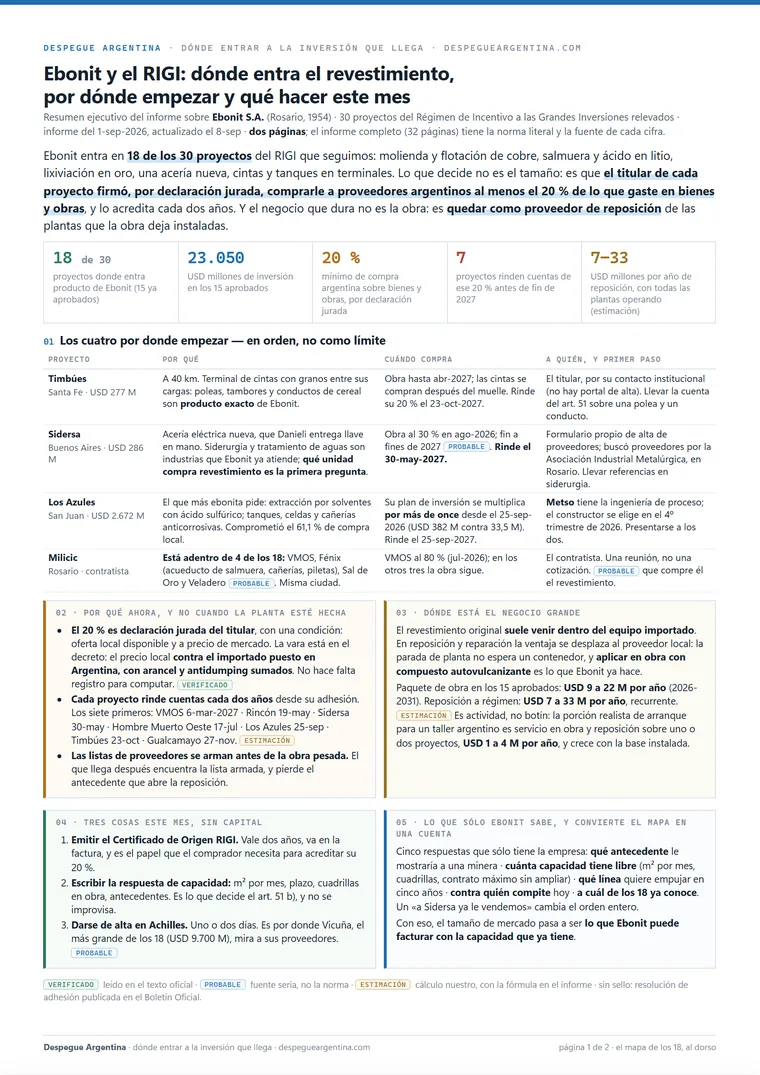
Page 1 of the example executive summaryOpen the report ↗A real analysis · a real company, open in full →

Ignacio Aredez
Analysis and curation: Ignacio Aredez
Head of Despegue
Method and track record →
  • 20+ years in technology, 15 of them in data and AI, for clients across Europe and the Americas
  • Certified in AI governance (ISO/IEC 42001)
  • Machine Learning (Google Cloud)
  • Registered expert with the European Commission
How to read the seals →
  verif primary source · prob primary source pending · unconf a source said it · estim our own calculation · thesis our reading · the date belongs to the datum, at the precision its source allows
This is not financial advice. The TAM is an estimate with a transparent method, not an official figure; the framing is labeled as thesis. Every figure carries its source. ← All opportunities in Neuquén