Metalworking, boilermaking and industrial maintenance
More than 50 metalworking shops in the basin operate with idle capacity while the imported module enters turnkey through the RIGI route and trade opening. But the same agenda sets a floor of 20% local suppliers and leaves a crack that imports do not cover from close by: certified local fabrication (ASME, API) and maintenance of the installed base. The one who certifies today —not the one who competes on price— enters right as Vaca Muerta's 18-26 treatment plants get underway.
On this page
Who really pays?
The obvious name is not the client. Manufacturing is not sold to «the operator» as such: there are three different buying routes, and for critical equipment the owner keeps the decision.
The purchase of critical equipment stays with the owner, not the contractor, and is settled by its own tender: that is where local content is decided, tender by tender.
The large EPCs —one of them an operator's own, which integrates engineering and manufacturing— capture the large works; the SME comes in through the subcontract, or the module arrives imported and turnkey through the RIGI modular route.
This is the recurring flow - on the order of ~USD 120-200M/yr - where proximity and lead time beat the imported option, and it already attracts foreign capital: a Colombian company is setting up a maintenance and metallurgy centre in the basin.
Which projects move this demand
The RIGI's first oil upstream project. Adhesion on 25-Jun-2026 (Minute 23 of the Evaluating Committee) and approval by Resolution 1025/2026…
see the project →YPF mega-development: plateau of 240,000 bbl/d in 2032, 1,152 wells. A signal of the scale jump in Neuquén upstream leveraged on already-secured…
see the project →Development of ~70,000 bbl/d, ~380 wells, 35-year concession. 10% carry for GyP. The works include a Central Processing Facility (CPF)…
see the project →Development of the asset Pluspetrol bought from ExxonMobil. Peak of 100,000 bbl/d + 12 MMm3/d, +600 wells. Includes GyP's mandatory 10% carry.
see the project →437 km, 30-inch export pipeline between Allen and Punta Colorada, with a marine terminal of six tanks and two monobuoys six kilometers offshore, in the San Matias Gulf…
see the project →When the window opens
Metalworking demand is not triggered by the well - that is tube steel - but by surface installations: every treatment plant, terminal or pumping station that advances is manufacturing first and maintenance for years afterwards.
Beyond the RIGI modular route, import liberalization and the end of the PAIS Tax are ALREADY in force: importing the turnkey skid/vessel is structurally cheaper, it is not a hypothesis.
See the evidence
The RIGI 20% and Forjando Vaca Muerta are the demand floor; without enforcement, the capturable TAM shrinks. thesis
The opportunity in depth
The opportunity in depth
Locally certified manufacturing - ASME Section VIII pressure vessels, API 650 tanks, API 6A wellheads - replacing the imported vessel and module. The bottleneck is not welding: there are more than 50 shops with spare capacity.
Mechanical maintenance as a framework contract (plant turnarounds, integrity of static and rotating equipment): recurring, on the order of ~USD 120-200M/yr, where proximity and lead time beat the imported option. It is the move that is already attracting foreign capital.
Made-to-order modules for the wellpad (~475 wells/year) and reconditioning of API valves and components: the bespoke and service work the imported module does not cover.
When you get paid, and what blocks it
already in
split
An operator's EPC integrates engineering + equipment fabrication + modularization (with a module factory in Argentina). Another contractor is building the 6-tank storage yard (120,000 m3) of the VMOS terminal prob trade press on the award. They capture the heavy fabrication and the electromechanical assembly.
The SME's structural competitor is NOT another SME, it is the imported turnkey module/equipment that enters through the RIGI modular route. YPF valve tender (USD 10M): 80% importers, 20% local; Asian suppliers ~25% cheaper.
>50 metalworking shops in the regional directory (17 in Neuquén capital, 12 in Rincón de los Sauces, 6 in Centenario); >150 in the extended ecosystem. ~77% operate with >=25% idle capacity and the sector's revenue fell ~30-40% in the 2025 trough (GAPP, the sector's chamber; it is cyclical --drilling rig count -21% y/y, price + Toyota Well efficiency + imported competition--, not structural).
Setting up a maintenance and metallurgy centre - reconditioning of valves and API components - in the Distrito Industrial Río Neuquén. A signal that certified maintenance attracts foreign capital.
The jobs it createsIt reactivates the more than 50 regional metalworking shops now running with idle capacity; skilled industrial employment - welders, boilermakers - and import substitution. Among the highest local-employment impacts. thesis
The heavy works (plants, terminals, pumping) are taken by the large EPCs and the imported module via RIGI (in valves ~80% of the tendered value). Not addressable head-on. estim
Addressable: certified local fabrication (ASME Sec. VIII, API 650/6A) substituting the imported module or vessel + made-to-order wellpad skids + mechanical maintenance under a framework contract.
See the full breakdown
An SME that qualifies as a supplier of an ASME vessel/process skid takes a share of the demand floor from RIGI 20% local content + Forjando Vaca Muerta. thesis
Why we do not put a number on it What IS calculated - the USD 55-100M/year opened up by closing the local-content gap - is what gets shared across ALL new local supply, not what one company takes: there are more than 50 metalworking shops in the basin and nobody publishes the split. Publishing it as an entry range would inflate it by the number of shops.
calculate it
The number comes from multiplying the year’s activity by the unit price, and it is cross-checked against independent methods that give the same result.
The full calculation, step by step
Concentration LOW-MEDIUM and highly fragmented in process-steel fabrication (a mosaic of >50 metalworking shops, no dominant incumbent, unlike OCTG=Tenaris or fracturing=SLB/Halliburton). The real concentration is in the large EPCs for the heavy works. The SME's 'competitor' is the module imported via RIGI.
The rule that moves it
The federal agenda pressures it: with no non-automatic licenses and no Impuesto PAÍS, the imported module and vessel enter without prior permit and cheaper (the RIGI modular route brings them turnkey). But the same RIGI sets a floor of 20% local suppliers (Art. 176), and on top of that sits the provincial regime that the trade opening does not touch: Compre Neuquino (Ley 3338: 60% by law, and the real capture is a series that has to be dated: 27% in 2022 and 46.22% in the second half of 2025, both from Centro PyME-ADENEU — the gap closed to less than half while certified firms went from 95 to more than a thousand — 1,002 as of 28 Aug 2026 and 1,029 as of 14 Sep, counted one by one in the public registry. The provincial adhesion to the RIGI does not displace that 60%: Ley 3491 was read in full and does not mention it, so the two floors stack) + the Forjando Vaca Muerta program + the tax credit of Decreto 982/2021 to the operator that buys local, on top of the establishment that Ley 3502 and Ley 378 make cheaper. That provincial floor —not protection, which is not coming— is the capturable market.
See the underlying reading
The underlying policy that opens up this demand. It is the same inference declared by the rules and the program pillars pushing in this direction.
better export netbackNeighbouring markets5 markets in the same group, from USD 7 to USD 850 M a year
See the remaining 2 neighbouring markets
Electric power and infrastructure for the basin~USD 230 M - 430 MMonitoring, reporting and verification (MRV/LDAR) of methane and GHG~USD 7M - 18MHow we validate this figure
There is no public figure for the basin's metalworking market, so the number is derived from the Compre Neuquino basket (USD 3,029M with local supply, official data); the percentage that is metalworking (12-20%) is the assumption that weighs most and we flag it as an estimate. What is verified in the official regulation is the 20% local-content floor of the RIGI. And we are symmetric with the data that is inconvenient: the sector's revenue drop and idle capacity are chamber self-reporting, and they correspond to the cyclical 2025 trough —fewer rigs but more output—, not structural damage.
Coverage: the public registry of Proveedores Neuquinos Certificados under Ley 3338, counted company by company across its twelve categories: 1,002 certified, with 283 in engineering and construction against 35 in well drilling, 39 in HSE, 9 in exploration, 5 in downstream and 2 in production and reservoirs · Aug 28, 2026 · not reviewed: getting certified grants preference and not authorisation, so a company can supply without appearing on it: the gap is in certified supply —the universe that decides the 60 % reservation— and not in the whole market
How to cite this figure: Despegue (2026). Metalworking, boilermaking and industrial maintenance · Neuquén. despegueargentina.com/en/neuquen/metalmecanica-caldereria-mantenimiento · terms of use
We look at what your company does and tell you whether we see a sign that it fits this market, with the evidence behind it. If we do not see one, we say so too and name the condition that would change it. One page as a dated PDF, within 48 working hours.
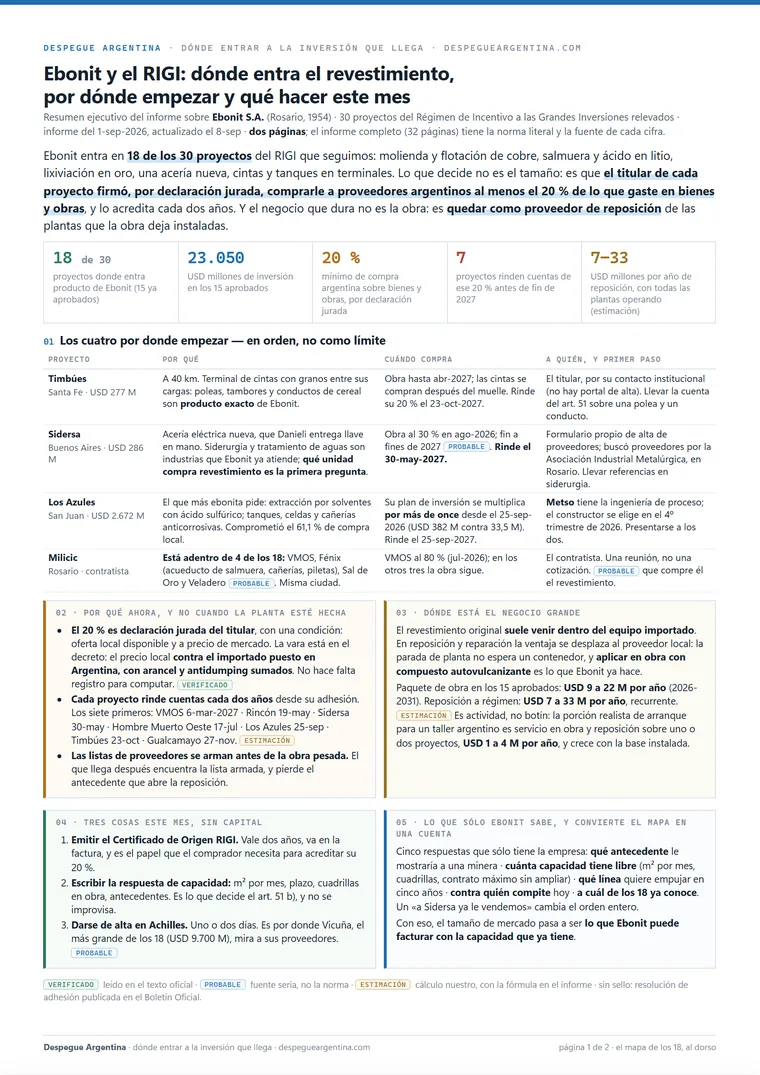 Open the report ↗A real analysis · a real company, open in full →

- 20+ years in technology, 15 of them in data and AI, for clients across Europe and the Americas
- Certified in AI governance (ISO/IEC 42001)
- Machine Learning (Google Cloud)
- Registered expert with the European Commission