What is being invested in San Juan
Every project in this portfolio, with its sponsor, where it stands under the RIGI and which tax regime applies to it. Below: the province’s indicators, the rules that affect it, what is still in the pipeline and our reading of where it is heading.
San Juan

See the full San Juan profile — how the economy is made up, alignment with the national government and tax regime
Pro-mining cooperation with the national investment agenda, with an agenda of its own in parallel thesis. San Juan joined the RIGI through Ley 2671-I, passed on 15-Aug-2024 verif. It has four mining projects approved under the regime: Los Azules, Gualcamayo, Veladero phases 8 and 9 and Vicuña, the last one as a long-term strategic export project, with Resolución 1154/2026 published in the Official Gazette on 30-Jul-2026 verif. In parallel, the province passed Ley 2827-M on Local Mining Development on 02-Jul-2026, with 80% local employment and 60% local purchases as targets for each project prob. After the second quarter of 2026 it closed a provincial agreement with Vicuña: long-term royalty stability, an infrastructure trust of 1.5% of gross revenue over the life of the mine and a USD 250 M advance scheduled for the fourth quarter of 2026 prob.
San Juan levies no new taxes on the mine: it charges 3% royalties on mine-mouth value (Ley provincial 716-M, within the framework of Ley nacional 24.196) and negotiates per-project agreements —the provincial agreement it signed with Vicuña adds royalty stability, an infrastructure trust and a USD 250 M advance—. What the province does impose is local content: 80% of jobs and 60% of purchases from San Juan as targets for each project (Local Mining Development Law, passed Jul-2026; regulations and RE.PRO.MIN promised before the end of 2026).
Fiscal regime & incentives in detail
Key indicators
San Juan
Key indicators
San JuanSan Juan is already Argentina's first copper district in development, yet it does not export a single dollar of copper: its entire mining floor today —13.46% of GRP, 87.6% of provincial exports in January-August 2026— is gold and silver (Veladero, Gualcamayo). The bet is the transition. Vicuña (USD 18,100 M), Los Azules, El Pachón and the ~700 MW power expansion turn the province into a decade-long copper construction site, with an overlapping build peak in 2026-2030. Service demand is not generated yet by copper operations —which start around 2030— but by the construction already underway and the high-voltage grid that must be laid first.
the full data
the full data
the full data
the full data
Investment climate
analyst reading
Investment climate
analyst readingSan Juan is not yet the province of copper: it is the province turning into one.
Its floor —what pays the bills today— is gold: Veladero and Gualcamayo account for 87.6% of what the province exports (January-August 2026) and anchor 13.46% of its GRP. On that floor it builds the largest development in Argentine mining: three overlapping copper mega-projects —Vicuña (USD 18,100 M, approved under the RIGI), Los Azules (McEwen, already approved) and El Pachón (Glencore, USD 9,500 M, filed)— plus the ~700 MW grid the mountains need to sustain them. San Juan has four mining projects approved under the RIGI today.
See the full analysis
Confidence rests on verifiable facts: a Vicuña technical study with capex and 25-year production, a comprehensive governor–Vicuña agreement that puts infrastructure and public works on the miner's account, and an ENRE resolution that already models electricity demand to 2030. The opportunity for those who plug in is not generated yet by copper operations —which only start around 2030—: it is generated by construction, which already hires and already buys. And the timing? Frankly: in Q1 2026 the country's aggregate investment (INDEC's gross fixed capital formation) fell 11.6% year on year.
But for San Juan that number reads the right way up: copper capex is a 25-year decision made on the metal price and RIGI stability, not on the quarter. The real risk is not that capital won't come —the studies, the amounts and the four RIGI approvals are already there—: it is timing. The company places Vicuña's FID, at the earliest, at the end of 2026, and El Pachón is still not approved; every month of delay pushes the construction peak forward. Entering now, with the works starting and the local supplier market still to be built, is entering early.
Confidence holds by facing head-on what tests it. The factors to follow closely:
- The price of copper (LME) and gold, and Vicuña's FID: the three copper studies assume incentive prices and Vicuña is the most sensitive (IRR ~14.8%); copper below the FID threshold —or gold falling sharply, which would break the 87.6% export floor— would slow satellite construction demand.
- Social license and the implementation of the Glaciers Law: the reform is NOW law (Ley 27.804, passed 08-Apr-2026, enacted by Decreto 271/2026, Official Gazette 24-Apr-2026), and it lifted the indefinite environmental veto that hung over high-altitude copper —a clearance in favor of Vicuña and El Pachón, which operate in a periglacial environment—. The vector to watch is no longer passage but its provincial implementation and judicial risk: there is a real precedent of stoppage (in April 2026 a La Rioja court order banned Vicuña's transit through La Rioja for 30 days, and the company rerouted its logistics through San Juan).
RIGI portfolio · San Juan
5 projects · USD 22,828 M
RIGI portfolio · San Juan
5 projects · USD 22,828 MThis portfolio is the province’s engine: each megaproject drives years of demand for services, energy, water, sand and logistics. For most investors, the entry point is in that wake — the map below.
see the project
The largest mining project in Argentine history by announced investment, and, according to the operator, the first copper Long-Term Strategic Export Project (PEELP) —the RIGI tier for staged investments of USD 1,000 million, with benefits brought forward—: it integrates Josemaría and Filo del Sol in the San Juan cordillera, Iglesia Department, on the Chilean border. See the full project →
see the project
Phase 1 of one of Argentina's two largest undeveloped copper deposits, alongside Vicuña: a resource declared by Glencore of ~6,000 Mt @ 0.43% Cu, 2.2 g/t Ag and 130 g/t Mo. See the full project →
see the project
Leach-based copper cathode project in Calingasta (San Juan). See the full project →
see the project
Reactivation and deepening of the Gualcamayo gold and silver mine (San Juan): the 'Deep Carbonates (DCP)' project extends the mine life toward the sulfide orebody at depth. See the full project →
see the project
Engineering, construction, operation and maintenance of new leach pads (phases 8 and 9) at Veladero Mine, to sustain gold production and exports. See the full project →
If you supply these projects rather than invest in them, we cross what your company does against them and tell you which ones it fits into: Where my company can get in →
Reforms that touch the province
29 in force · 2 in execution · 1 pendingRIGI and investment6
▸RIGI: what paperwork you have to file afterwardsDecreto 749/2024in forceNATIONALAug 23, 2024
▸Federal Registry of Mining Suppliers: it is public, and does not certify complianceRes. S.M. 84/2022in forceNATIONALNov 29, 2022
▸Salta: 70/60 local mining procurementSalta Ley 8164 (Official Gazette Oct 22, 2019)in forcePROVINCIAL2019
▸San Juan: 80/60 local mining procurementLey Provincial 2827-M (San Juan, Official Gazette 16-Jul-2026)in forcePROVINCIALJul 16, 2026
▸San Juan approved the agreement with Vicuña by lawLey Provincial 2836-M (San Juan, published Aug 27, 2026)in forcePROVINCIALAug 27, 2026
▸RIGI: railway infrastructure is addedDecreto 748/2026in forceNATIONALAug 18, 2026
Fiscal and monetary anchor3
▸Fiscal anchor: surplus two years in a rowExecutive execution policy on the extended budget (Decreto 1131/2024)in forceNATIONALFeb 1, 2026
▸No excise duty on insurance, satellite or vehiclesLaw 27.802, arts. 189 and 195 (Titles XXIV and XXV)in forceNATIONALMar 6, 2026
▸Losses indexed to CPI, citizenship without tax residenceLaw 27.802, arts. 190, 191 and 194 (Title XXIV)in forceNATIONALMar 6, 2026
FX and exit from currency controls1
▸Dollar credit is no longer for exporters onlyDNU 736/2026 (Official Gazette, Aug 14, 2026) · BCRA Communication «A» 8467in forceNATIONALAug 14, 2026
Trade opening3
▸Argentina and the US sign their first trade and investment agreementBilateral agreement signed Feb 5, 2026 (no number; pending congressional approval)pendingNATIONALFeb 5, 2026
▸Certifications: approval from a reference country is accepted, with no repeat processDecreto 892/2025 (Official Gazette, Dec 17, 2025)in forceNATIONALDec 17, 2025
▸Importing mining equipment duty-free: the list and the procedureResolution 73/2026 of the Mining Secretariat (Official Gazette, 1 Sep 2026), implementing s. 21 of Law 24,196in forceNATIONALSep 1, 2026
Market deregulation5
▸Public works: the registries that filtered who could compete fallDecreto 105/2025in forceNATIONALFeb 17, 2025
▸Trucks: digital RUTA and the end of extra provincial requirementsDecreto 832/2024in forceNATIONALSep 13, 2024
▸Longer trucks: Annex R updated after 30 yearsDecreto 689/2026in forceNATIONALJul 31, 2026
▸Winemaking: the National Wine Institute repeals the bulk of its rulesINV Resolución 37/2025 (RESOL-2025-37-APN-INV#MEC)in forceNATIONALNov 7, 2025
▸Being a Registration Authority: what the rules requireSICYT Resolution 11/2025, Annex II, Sections 1 and 4in forceNATIONALFeb 20, 2025
Energy and natural resources6
▸The State puts 16 high-voltage works out to tender, and six of them run through four of the five provincesRes. SE 202/2026 (Official Gazette, Aug 12, 2026), the Plan's first workin executionNATIONALAug 11, 2026
▸Mining: export duties to 0% for most productsDecreto 563/2025in forceNATIONALAug 6, 2025
▸Renewables: from state subsidy to private contractRes. SE 400/2025 + DNU 70/2023 (art. 176)in forceNATIONALOct 20, 2025
▸Mining: new procedure for VAT refundsJoint Gen. Res. ARCA-Mining Secretariat 5878/2026 (Official Gazette, Jul 23, 2026)in forceNATIONALJul 23, 2026
▸What you can sell to a mining exploration with VAT that comes backResolution 66/2026 of the Mining Secretariat (Official Gazette, 19 Aug 2026), on s. 14 bis of Law 24,196in forceNATIONALAug 19, 2026
▸The registry that turns a supplier into a mining beneficiaryResolution 68/2026 of the Mining Secretariat (Official Gazette, 19 Aug 2026), creating the Mining Investment Registryin forceNATIONALAug 19, 2026
State, institutions and security3
▸First energy privatization closed: Transener goes private for USD 356 MRes. 673/2026 MECON (Official Gazette, May 12, 2026) + Res. 130/2026 ENReGEin executionNATIONALMay 12, 2026
▸Anti-roadblock protocol: federal forces can clear road blockadesResolución 943/2023 (Ministry of Security)in forceNATIONALDec 14, 2023
▸San Juan takes over sections of national routesLey Provincial 2837-A (San Juan, published Aug 27, 2026)in forcePROVINCIALAug 27, 2026
Labor5
▸Hire formally for 4 years with employer contributions of 2%+3%Decreto 315/2026 (Official Gazette, May 4, 2026), Ley 27.802 Title XXin forceNATIONALMay 4, 2026
▸Ley Bases: labor modernization and registered employmentLey 27.742, Titles IV-V (Decreto 847/2024); Title II Ch. IV (Decreto 695/2024)in forceNATIONALSep 26, 2024
▸Labor: the company agreement beats the industry union dealLaw 27,802, sections 130 to 137 and 149in forceNATIONALMar 6, 2026
▸What a camp wage and roster can be built withLaw 27.802, arts. 31, 33, 34, 35, 41, 42 and 43 (Title I)in forceNATIONALMar 6, 2026
▸How much must keep running during a strikeLey 27.802, ss. 101 and 102 (Title VII), rewriting s. 24 of Ley 25.877in forceNATIONALMar 6, 2026
What is coming · and what already landed · 5 pending signals · 2 landed
Provincial government acts not yet enacted that would move the satellite ecosystem. Each with its official source and unconfirmed seal: it is the political pipeline to follow, not a promise — we do not build an opportunity on what is not law yet.
See the full reading and the announcement verbatim
See the full reading and the announcement verbatim
San Juan's legislature passed Ley Provincial 2836-M on 19 August; it was published on 27 August and is in force according to the provincial Digest. It approves the Acta Compromiso of 5 August between the province and Vicuña Argentina S.A. and its annexes A, B, C and D, which set out the DIA Contribution, the Fixed DIA Contribution and the early execution of infrastructure works, and which Decreto 1066-MM-2026 had already ratified. The law has two articles and does not transcribe the Acta: the USD 250 million, the 1.5% and the 3% still cannot be read in a published official text.
See the full reading and the announcement verbatim
See the full reading and the announcement verbatim
See the other signal
See the full reading and the announcement verbatim
Provincial acts and data points that already happened, each checked against its official source and dated. Where the act left a norm, the line takes you to its card instead of repeating it; where it left none —a bond placement, a current-activity data point— the full card goes here.
See the full reading and the announcement verbatim
See the full reading and the announcement verbatim
Our reading · San Juan
2 theses · how the pieces convergeOpen the thesis and its evidence — the reasoning, the pieces, the laws and what we watch
- 1The provinces' historical channel of political financing —the discretionary federal transfer— closed structurally as the flip side of the surplus (non-automatic transfers to provinces fell 87.7% in real terms in June, the lowest June since 2005). The governor loses the instrument with which he sustained his economy without depending on private investment in his territory.consistentMechanism: R1 (the surplus IS the cut in discretionary spending; the withdrawal of transfers is its arithmetic flip side, not an accident) — same link as the federal-funding substitution thesis, read here from the side of the governor's INCENTIVES, not of works financing.
- 2With the second channel also barred —RIGI's art. 165 shields the SPV against new provincial taxes; Río Negro's Feb-2025 'export royalty' attempt was struck down that way—, the governor's only margin is to compete for investment by lowering the cost of entry. The July-15 batch shows it operating simultaneously and across jurisdictions: Río Negro adhered to RIMI by UNANIMITY with a single-window procedure and its own stacked exemptions (Ley 5857), and 6 mining RIGI projects landed across 5 provinces (San Juan, Mendoza, Salta, Jujuy, Catamarca) that competed to host them instead of taxing them.provenMechanism: R7 inverted (the tension over rent mutates into inter-provincial competition for investment: same actor, incentive flipped) + R2 (each provincial adhesion completes the federal regime's legal-certainty promise in its territory).
- 3Operational corollary: as long as the federal fiscal regime holds, the watch condition «governors' tension over rent» has a structural bias in its favor (not isolated cases but an equilibrium of incentives), and provincial adhesion legislation becomes a LEADING INDICATOR of where the next capital lands — a new observable to order the federal map and choose our next province.pendingMechanism: Synthesis R1 → R7 inverted → R2: no single rule describes the incentive-regime change or its methodological consequence (reading provincial adhesions as a predictor).
- That the governor decides at the margin: with no federal cash to ask for and no new rent to tax, he would rather compete for investment than raise the pressure on what he already has inside. This is an assumption about political behaviour, not a datum.
- That the shutdown of discretionary federal cash holds. It is the arithmetic counterpart of the surplus: if the surplus gives way, the transfer comes back and the incentive to compete undoes itself.
- That art. 165 of the RIGI holds against whatever a province tries. Today it has one precedent —Río Negro's attempt to tax exports, struck down in 2025— not a body of case law.
- A province with RIGI or RIMI projects under way raising royalties, gross-receipts tax or mandatory carry on the sector in its annual tax law. Vector: 2027 provincial tax laws in the Official Gazettes, observable — the exact signal of the governors-rent watch condition.
- Governors, via Congress, forcing over the veto the reopening of discretionary transfers or an automatic ATN revenue-sharing law: it would reopen the old channel and dismantle the incentive to compete. Vector: parliamentary proceedings, observable.
- Provincial legislature turnover in 2027 repealing or conditioning current RIGI/RIMI adhesions. Vector: provincial Official Gazettes, observable.
- pending At least one more province adheres to RIMI (or enacts an equivalent single-window RIGI/RIMI adhesion process) before Mar-2027. how we check: Provincial Official Gazettes + the legislation monitoring register; re-checked periodically.
- pending No province with RIGI projects under way raises royalties, gross-receipts tax or mandatory carry on the sector in its 2027 tax law. how we check: Provincial 2027 tax laws (passed Nov-Dec 2026) in the provincial Official Gazettes; this is the exact vector of the watch condition «governors' tension over rent».
Open the thesis and its evidence — the reasoning, the pieces, the laws and what we watch
- That the registered jobs of department residents in November 2023 describe today's local labour supply well. The official series was not updated after that, so it is the starting-point snapshot.
- That the construction employment figure each company publishes is close to the real peak. In Vicuña it is an average over the 40 months of construction its technical study foresees, so the peak is higher.
- That the supplier roll of Vicuña, Rincón or Sal de Oro shows that most camp, food or transport contracts are held by firms registered in the department of the works. Vector: each project's local-purchasing reports and provincial registers of mining suppliers.
- That, if the State publishes the jobs-by-department series again, the construction jobs of people living in Iglesia or Los Andes grow by a magnitude comparable to the works (thousands, not tens). Vector: CEP-XXI jobs-by-department series.
- pending From now to 31-Dec-2027, among the camp, food and staff-transport contracts of Vicuña, Rincón and Sal de Oro that become public, most are won by firms registered in the provincial capital or outside the province, not in Iglesia or Los Andes. how we check: The awards and contractors published for Vicuña (San Juan), Rincón and Sal de Oro (Salta), with each firm's registered address. Only those with a declared address are counted.
We look at what your company does and tell you whether we see a sign that it fits this market, with the evidence behind it. If we do not see one, we say so too and name the condition that would change it. One page as a dated PDF, within 48 working hours.
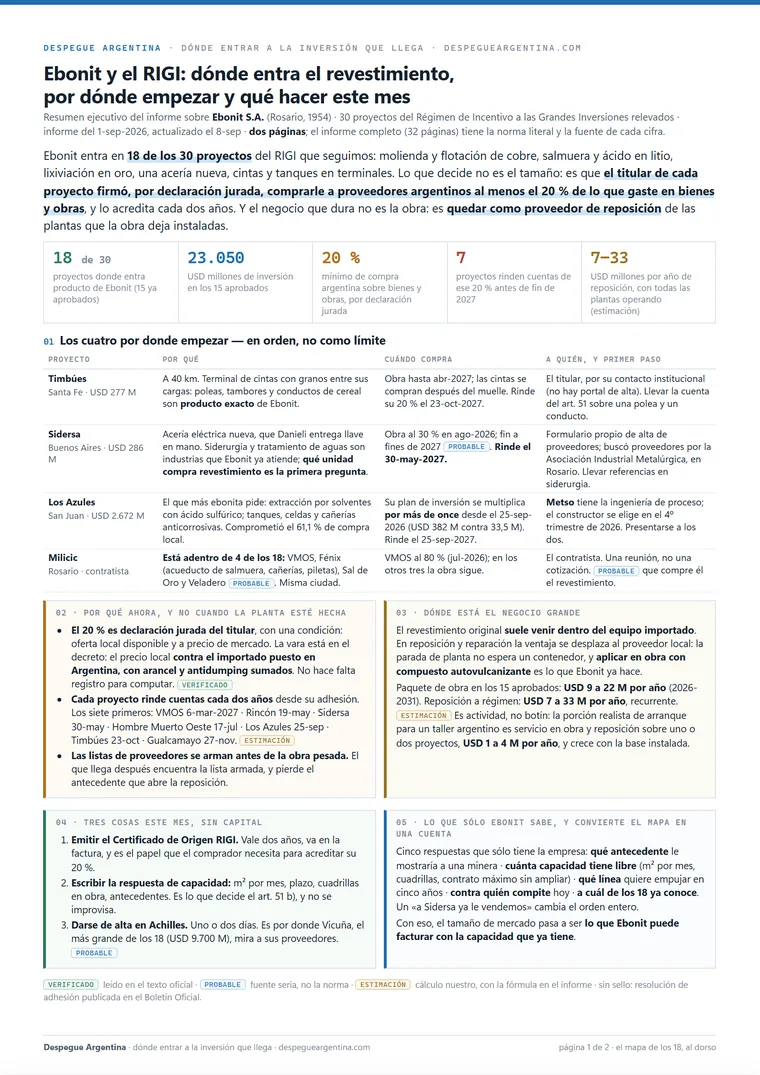 Open the report ↗A real analysis · a real company, open in full →

- 20+ years in technology, 15 of them in data and AI, for clients across Europe and the Americas
- Certified in AI governance (ISO/IEC 42001)
- Machine Learning (Google Cloud)
- Registered expert with the European Commission