Despegue TO SUPPLY · RÍO NEGRO ESEN
up to date · reviewed Oct 15, 2026
PATAGONIA · THE SUPPLIER TRACK

What the projects in Río Negro are going to buy

USD245million per year · sum of the TAMs of 8 opportunities · they overlap — the method of each one is in its own page ↓

You do not have to be here to sell to these projects. If you sell from another province or from abroad, this page works the same for you — what demand each project opens, who is already covering it and where the gap is.

Opportunities · where you come in · 8 satellite markets

The entry point to the boom: satellite-service opportunities quantified in USD, with their competitive map, the gap to enter and how demand evolves.

What this menu covers and what it leaves out
What this menu covers, stated plainly: the quantified niches are the service band of the Río Negro energy corridor —the Punta Colorada terminal and VMOS, the San Matías gas pipeline, the port of San Antonio Este and the conventional fields of Catriel—, measured as service rendered on Río Negro soil and not as the size of the works passing through it. The big LNG figure is not here, and that is deliberate: the USD 685 M/year usually quoted as the offshore gap is the charter of the FLNGs, income for the owner of the vessels and not a contractable market; and the maritime piece that was one —towage, AHTS and crew transfer on the LNG side— has had an owner since May 2026, awarded to the Adani-Meridian consortium for ten years. The scale of the project lives in the Southern Energy card of the portfolio; here we publish what is addressable. Nor is the certified training of 6G welders and NDT technicians a niche of this menu, though we did analyze and audit it: the bottleneck is real —some 225 formal training places against more than a thousand jobs on the San Matías lay alone— but the market is around one million dollars a year and its value is strategic, not size. That is why it was published as an occupations track, with seven pages of its own, and lives alongside the induced-economy niches on the page for residents. The seventh was added in August 2026, and it is not driven by a construction project: it is driven by an asset that starts spinning. The maintenance of turbocompressors and rotating equipment is the demand that remains once the corridor's construction ends — a new 60,000 HP compressor plant at Allen plus the uprating of the existing one at San Antonio Oeste, the two LNG compressor stations and the crude-system pumps— and today nobody serves it from the province: it is bought in Neuquén, in Bahía Blanca or from the factory. It is also the niche where the search for the price came up empty, and we say so rather than hide it: there is no published maintenance rate per HP per year, and four documents were opened to prove it —the 2024 financial statements of tgs and of TGN and the ENARGAS installed-power report— before calculating the number over the asset's investment. It comes out deliberately small, and the reason is the finding that bounds it: TGN, the country's largest seller of this service, bills around USD 22 M a year across all of Argentina for it, pipelines included. A single corridor cannot be worth a multiple of that. And the eighth was added in August 2026: it is the only one in this province with an expiry date — so it is published with the warning up front. The aggregates and earthmoving along the pipeline route are a project running from May 2026 to April 2028: when it ends, this market does not shrink, it switches off. That is why its annual figure is neither added to nor compared with the other seven, which measure activity that continues. It is also the niche where the bill of quantities does not exist in public: the proponent's environmental study was opened in full —804 pages— and it gives not a single cubic metre, so the volume is calculated from the design parameters that same study does publish: 443.5 km of Río Negro route —the other 29 are in Neuquén—, a 36-inch pipe, 0.8 meters of cover and a 16-metre working right-of-way that widens to 30 where there is no access. And it brings the precedent that explains why the window matters: when the VMOS crude pipeline opened its front, the earthmoving went to a Rosario contractor that was already installed. Local content pushes, but it does not compel buying from someone who cannot deliver.
the matrix continues — swipe →
Which of these 8 do you fit into?

There are 8 markets and not all of them are yours. Tell us what your company does and we tell you which ones it fits into, through which door and when they buy.

Where my company can get in
category
arc
Oil & gas core
Well core
well services, downhole and frac inputs
1 niche
Workover, pulling and reactivation of Catriel's conventional fieldsWell services (mature conventional) · Pulling/workover SME with a Río Negro seal
~USD 20-40 M/yrwindow open
what a new supplier could bill ~USD 2-6 M/yr thesis
Pays TODAY, and it is running expenditure on producing wells. And since February 2026 there is a provincial scheme that pays for doing exactly this, with no closing date: you pay 6 % in royalties instead of 12 % on whatever extra you produce.
competition Fragmented and low-barrier — the opposite of Añelo shale
Gas and midstream
treatment, compression and evacuation
2 niches · 1 with urgent demand
Port logistics and project cargo transport (Puerto San Antonio Este)Port logistics / project cargo transport · Port-logistics / heavy-haul operator
~USD 13-22 M/yearurgent demand
what a new supplier could bill ~USD 3-8 M/yr thesis
Pays TODAY: the gas pipeline's line pipe has been coming in through the port since August 2026, and it is twelve vessels. Construction runs to 2028 and underneath it sits the perpetual floor of port operation…
competition Port operation is a de facto monopoly: a single concession, a single operator…
Maritime and offshore services of the Golfo San MatíasMaritime / offshore services · Maritime, offshore and onshore-base services
~USD 41-80 M/yearwindow open
what a new supplier could bill ~USD 5-12 M/yr thesis
The LNG marine core has already been awarded —Adani-Meridian, ten years— and it was awarded through a global tender, not a direct purchase. The gap is satellite and onshore, and it bills from start-up…
competition High and consolidating
Surface and environment
physical infrastructure, water, pipelines and energy
1 niche · 1 with urgent demand
Catering, lodging and worksite services (Sierra Grande – San Antonio)Lodging / catering / facility · Lodging, industrial catering and facility management
~USD 40-70 M/yearurgent demand
what a new supplier could bill ~USD 4-10 M/year thesis
Pays TODAY, and it is spending on works already under way. Peak 2026-2028 and an operating floor far smaller than it looks: the gas pipeline's permanent work does not stay on the coast, it stays in Allen…
competition Bimodal. In the large contracts (camp modules, at-scale construction mess hall): concentrated…
Support
Support and professional services
engineering, compliance, digitalization, real estate and talent
4 niches · 1 with urgent demand
Aggregates, fill and earthmoving along the San Matías pipeline routeSupply and haulage of aggregates and imported fill from quarry, gravel and grading of the service track, earthmoving for the right-of-way and the trench, concrete for special crossings, and heavy-equipment hire with operator · aggregate quarries and gravel plants / bulk hauliers with tipper and semi-trailer / earthmoving contractors with their own heavy fleet / ready-mix concrete plants / heavy-equipment hire firms with operator
USD 8.3-32.8 M/yr during the construction window from May 2026 to April 2028urgent demand
what a new supplier could bill ~USD 1.8 M/yr, only during the window thesis
This is the only market in Río Negro with an expiry date, so the warning goes first…
competition Medium, with a clean division that sets the whole strategy: the earthmoving is concentrated in…
Certified metalworking shop for the corridor (Alto Valle)Metalworking / boilermaking / industrial O&M · Certified metalworking shop (API/ASME)
~USD 30-50 M/yearwindow open
what a new supplier could bill ~USD 3-8 M/yr thesis
Construction fabrication window 2026-2028, and beneath it the perpetual floor of metalworking maintenance from 2027-2028, which is the core. It calls for certifying and setting up before start-up.
competition In construction it is concentrated in main contractors from outside Río Negro
Maintenance of turbocompressors and rotating equipment along the corridorMaintenance of machines that spin: gas turbocompressors, turbogenerators and crude pumps, with their overhauls, borescope inspections, vibration analysis, gearboxes, auxiliaries and control systems · rotating-equipment service bases (gas turbine, turbocompressor and centrifugal pump) / repair shops for gearboxes and process compressors / vibration analysis, laser alignment and borescope services / turbomachinery control-system integrators
USD 1.6-8.4 M/yr at steady state from 2028-2029window open
what a new supplier could bill ~USD 0.4 M/yr within 2-3 years thesis
This market does not bill yet, and that is worth saying first: the Allen compressor plant starts spinning when the San Matías pipeline is commissioned, expected in 2028, and the LNG stations on the same stretch follow…
competition High, and for a reason that is technical rather than commercial: whoever built the machine…
Industrial O&M of the Punta Colorada terminal, tanks and monobuoysIndustrial O&M / coastal asset integrity · Certified industrial O&M coastal base
~USD 12-30 M/yearwindow open
what a new supplier could bill ~USD 3-8 M/yr thesis
Does NOT pay until commissioning: it is about positioning before start-up for the perpetual recurring contract, not invoicing yet. ⚠️ And start-up moved forward: connection at Allen on 15 December 2026 and full capacity in July-September 2027, against the 2028 the roadmap stated until March.
competition Bifurcated. High/captive in the monobuoy/subsea slice…
Every opportunity carries two figures: the market per year, and what a new supplier could bill — the share of that market a company entering today can take, not the whole market. Both are estimates with a transparent method, not official data. The arc is our reading of how demand evolves (estimate/thesis). Tap an opportunity to see the competitive map, the gap and how it is calculated.
Ecosystem companies · Río Negro
thesiswho is already inside better export netback

These companies are the two sides of the market a supplier plugs into. The operators are the demand —the clients you invoice: Phoenix and TanGo lead Río Negro production, level in August 2026, and PAE, YPF and Pampa anchor the corridor and the LNG, putting up the capital that drags along construction, services, logistics and operation. Golar is the midstream incumbent: owner and operator of the Golfo San Matías FLNGs. The opportunity map above comes from crossing the two sides: where corridor demand grows and the local service doesn't reach yet.

The crackThe way in here isn't a lost tender: it's a law. The Río Negro oilfield-services ecosystem barely exists yet —what in Neuquén is already an established supplier ecosystem is still to be built here— and Ley 5805 reserves 60% of the corridor's purchases for certified Río Negro suppliers. Whoever registers first in the Registro de Proveedores Rionegrinos enters the 60% the law reserves —and which is won by matching: there are 8 points of price window, not a premium—, not a fight for share against an incumbent.
Operatorsthe corridor's demand · the province's crude leader opens the list10
01
Phoenix Global Resources
Rio Negro's leading oil producer
private
34.1% of crude
›
Provincial shareverif
34.1%
What it does here
Pioneering shale operator on the Río Negro side of Vaca Muerta. In the exploratory stage of Confluencia Norte and Sur it drilled and completed seven horizontal wells (three in Norte and four in Sur) and invested about USD 123 M, above the original commitment of almost USD 90 M. In June 2026 it filed its declaration of commerciality; in that stage it used 75% Río Negro sand. Decreto 917/26 (October 2026) approved commerciality, merged the two blocks and granted it a 35-year unconventional exploitation concession, with a first plan of 40 wells between 2027 and 2031 and USD 494.4 M of estimated investment.
Production
Río Negro's leading oil producer: 34.1% of the province's crude in March 2026, out of a small provincial total of about 22,800 barrels a day (official production register of the Energy Secretariat). In November 2025 it already exceeded 25%, according to the specialized press (EconoJournal, 25-Nov-2025), which also reported that the new Confluencia Sur pad exceeded 5,000 barrels a day in testing and that, together with Confluencia Norte, Phoenix exceeded 7,000.
Market share
34.1% of Río Negro's oil production (Mar-2026) — the province's top producer. In Nov-2025 its share was 27.4% under its previous corporate name in the dataset (Petrolera El Trébol).
Profile
Mercuria-controlled operator that brought Vaca Muerta shale development to the Rio Negro side of the basin (Confluencia): the proof that the formation produces commercially in Rio Negro.
thesiswhat this company buys, and when better export netback

It took shale to the Río Negro side of the basin at Confluencia: proving that the formation produces commercially there is a netback decision, because every well on the edge sits closer to the profitability line than one in the Neuquén core.

thesiswhat this company buys, and when the bottleneck moves to transport

Río Negro development depends on where the crude comes out, and that outlet is the corridor ending at Punta Colorada. Its activity is read by looking at the corridor's capacity as much as at the price of the barrel.

02
Golar LNG
Owner of the Golfo San Matías FLNGs, which it charters to SESA
Operator›
What it does here
Owner and converter of the two liquefaction vessels of the Southern Energy project, which it charters to SESA for 20 years: Hilli Episeyo (2.45 MTPA, net hire of USD 285 M per year plus 25% of the FOB price above USD 8/MMBtu, start-up scheduled for 2027) and MK II (3.5 MTPA, final investment decision on 06-Aug-2025, USD 400 M per year, under conversion at the CIMC Raffles shipyard in China, with USD 1,000 M spent as of 30-Sep-2025 out of a USD 2,200 M budget, start-up scheduled for 2028). SESA operates the vessels with Golar's support. It also holds 10% of SESA's equity.
Profile
The world specialist in floating liquefaction that provided the vessels for Argentine LNG: it collects a 20-year charter fee (tolling model), with price exposure via the commodity component. Its schedule (Hilli 2027, MK II 2028) IS the schedule of San Matias Gulf LNG.
thesiswhat this company buys, and when stability → long-term investment

It charges a twenty-year charter rate under a tolling model: that long contract is what makes the vessels financeable, and it is also what gives the coastal supply chain a horizon —demand for services does not switch off when construction ends, it lasts as long as the charter.

thesiswhat this company buys, and when each phase buys something different

Its calendar is the project's calendar: Hilli in 2027 and MK II in 2028. Everything the onshore works, the pipeline and the moorings have to deliver is ordered against those two dates, and a supplier can read its window there without waiting for any announcement.

03
SACDE
Builder of the VMOS oil pipeline (JV with Techint)
private
Operator›
What it does here
Techint's partner in the joint venture that built the VMOS oil pipeline (437 km, 30 inches, Allen→Punta Colorada): construction since February 2025, last automatic weld on 01-Nov-2025 and about 2,000 workers at the peak of construction. Precedents of the same joint venture: the Perito Moreno Gas Pipeline and Section II of Duplicar for Oldelval. For the pipeline works, the joint venture chose Villa Regina as its operations base prob.
Profile
Argentine construction company of the Mindlin group (linked to Pampa Energía). In the Río Negro corridor it is Techint's partner in the JV that built the VMOS oil pipeline; together with Techint it lost the San Matías pipeline construction tender to the Víctor Contreras–SICIM JV (~15% cheaper according to press reports).
thesiswhat this company buys, and when opening and deregulation

It is Techint's partner in the joint venture that built VMOS and it lost the San Matías pipeline job to the Víctor Contreras-SICIM joint venture, whose bid was ~15 % cheaper: the local incumbent stopped winning by default in the corridor. For a supplier that means the buyer of each job can change from one tender to the next.

thesiswhat this company buys, and when each phase buys something different

Its market is the laying and assembly phases, not the operating ones: it comes in when heavy construction starts and leaves before commissioning. Whoever sells to it has that same window and not the one of the whole project.

04
SICIM
Leader of the San Matías pipeline construction JV (51%)
private
Operator›
What it does here
Leader (51%) of the JV with Víctor Contreras (49%) that won the civil works for the three sections of the San Matías pipeline: about USD 530 M, a bid close to 15% cheaper than Techint–SACDE's (about USD 80 M difference), awarded in late April 2026; 471 km of 36 inches, construction start in mid-2026 and a 24-month term prob. The RIGI accession (Resolución ME 873/2026, USD 1,300 M of total investment) sets 30-Jun-2026 as the start of construction and 1-May-2028 as the estimated start of operations verif.
Profile
Italian pipeline EPC (Busseto, 1962; +20,000 km laid across ~26 countries). It leads the JV that won the San Matías pipeline construction from Techint–SACDE with a bid ~15% cheaper — the incumbent's second defeat in the corridor (the first: Welspun in pipes). In July 2026 another consortium with a foreign component (Pumpco–Bonatti–Contreras Hermanos) repeated the pattern on the Argentina LNG trunk pipeline.
thesiswhat this company buys, and when opening and deregulation

It won the San Matías pipeline job from Techint-SACDE with a bid ~15% cheaper: it is the incumbent's second defeat in the corridor, after the pipe. Open competition brought the price of the work down and changed who signs the purchase orders downstream.

thesiswhat this company buys, and when each phase buys something different

As a pipeline EPC it comes in at the laying and welding phase, between May 2026 and April 2028 on San Matías. What it buys in the area —logistics, camp, testing, earthworks— is bought inside that window.

05
TanGo Energy
New Río Negro conventional and shale concession holder
private · parent listed
Operator›
What it does here
Concession holder under Decreto 509/26: it receives five oil and gas areas and three transport concessions. Three of those areas are reconverted to unconventional for thirty-five years from 09-03-2026, expiring on 09-03-2061 — Charco del Palenque, Jarilla Quemada and part of Entre Lomas; Jagüel de los Machos and 25 de Mayo-Medanito SE are not reconverted and keep their earlier term. The pilot adds up to USD 66 M: at Charco del Palenque, two horizontal wells of roughly 2,800 meters of lateral in 2027-2028 for USD 32 M, plus up to 66 more wells between 2029 and 2045 if results hold; at Jarilla Quemada, one vertical well with a lateral for USD 17 M and up to 29 more between 2031 and 2047; at partial Entre Lomas, 255.6 km² with one well for USD 17 M and up to 29 more. It also holds a 35% non-operated stake in Loma Guadalosa, where Pan American Energy operates under Decreto 447/26.
Profile
Operator built on the former Aconcagua Energía (recapitalized after its default via Tango Energy S.A.U., the vehicle co-controlled by Vista and Trafigura's affiliate that today holds ~100% of the capital) and led by Pablo Iuliano (former CEO of YPF); it took over Río Negro's conventional assets with a mandate to reconvert toward shale. The target declared by the CEO (60,000 barrels/day in 5 years, with investments of USD 200-250 M/yr if the pilot works) is a press-conference statement: probable.
thesiswhat this company buys, and when better export netback

It took over Río Negro's conventional production: a mature field is the first to fall below the profitability line when the margin narrows and the first to come back when it improves. Its activity is the most sensitive reading of the netback in the whole basin.

thesiswhat this company buys, and when the asset leaves demand that does not expire

A mature conventional asset does not buy new construction: it buys maintenance, workovers, facility repairs and surface services. It is a different market from shale, with smaller, nearby suppliers, and it is open today.

06
Techint Ingeniería y Construcción
Builder of the VMOS oil pipeline (JV with SACDE)
private
Operator›
What it does here
Builder of the VMOS oil pipeline in a JV with SACDE: 437 km, 30 inches, 2 sections (~110 km Allen→Chelforó + 327 km Chelforó→Punta Colorada), 22 special crossings (2 with horizontal directional drilling), more than 2,000 estimated direct jobs; construction started in February 2025, last automatic weld completed on 01-Nov-2025 at the entrance to the Punta Colorada terminal (October record: 175 welds and more than 4 km in a single day).We found no published amount for the JV's contract: the figure in circulation is the total investment of the VMOS project, declared at USD 2,900-3,200 M. Direct precedent of the same JV: the Perito Moreno Gas Pipeline. Techint is also building the Duplicar Norte oil pipeline for Oldelval: 24 inches and 207 km from Auca Mahuida to Allen; regular line welding finished in September 2026 and start-up is scheduled for the first quarter of 2027 verif. According to the press, the works are worth around USD 380-400 M prob.
Profile
Engineering and construction arm of the Techint Group (Italian-Argentine, Rocca family), the country's largest pipeline builder. In the Río Negro corridor it is half of the JV that built the VMOS oil pipeline (437 km to Punta Colorada) and it is building the Duplicar Norte oil pipeline for Oldelval; it lost, however, the San Matías pipeline tenders (construction: Víctor Contreras–SICIM JV ~15% cheaper; pipes: Welspun 28 % below the Tenaris bid, 203 against ~280 M) — the opening broke the group's construction quasi-monopoly.
thesiswhat this company buys, and when opening and deregulation

It is the country's largest pipeline builder and in the Río Negro corridor it lost two tenders in a row: the San Matías pipeline and, on the pipe side, the one to Welspun. The protection that capped the market stopped working, and the incumbent now wins or loses on price.

thesiswhat this company buys, and when each phase buys something different

It built VMOS's 437 km and is building Duplicar Norte: its window is laying and assembly. The supplier that sells to it comes in at that phase, not at the operating phase of the pipeline it built.

07
Víctor Contreras
Argentine partner in the San Matías pipeline JV (49%)
private
Operator›
What it does here
Argentine partner (49%) in the SICIM-led JV (51%) prob that won the civil works for the three sections of the San Matías pipeline (~USD 530 M, awarded late April 2026; 471 km of 36 inches, start mid-2026, 24-month term). It contributes the basin's operating base (Añelo) and the local track record in large-diameter pipelines.
Profile
Argentine builder of large-diameter pipelines (CUIT 33-50624902-9), headquartered in Buenos Aires with a branch in Neuquén. Local partner (49%) in the San Matías pipeline JV: the case of the large-SME basin builder that, allied with an international EPC, wins the job from the incumbent.
thesiswhat this company buys, and when opening and deregulation

It is the other face of openness: an Argentine basin contractor, based in Añelo, which in alliance with an international EPC beat the incumbent to the job. The gap competition opens was not captured only by imports — it was also captured by the local firm that partnered well.

thesiswhat this company buys, and when each phase buys something different

A 49% partner in the San Matías pipeline joint venture: its window is the laying work, May 2026 to April 2028, and it is the tier the basin's small supply chain sells to.

YPF S.A.
Anchor of the Rio Negro export corridor
Operator›
What it does here
Anchor of the Río Negro export corridor: partner in VMOS (terminal at Punta Colorada, RIGI accession under Resolución 302/2025), 25% of Southern Energy (LNG, Golar release of 02-May-2025) and party to the joint development agreement for Argentina LNG with Eni and XRG (12 MTPA, final investment decision targeted for the second half of 2026). In Río Negro's conventional assets, as part of Proyecto Andes, it signed in May 2025 the transfer of Señal Picada–Punta Barda, the province's largest producing block, to Petróleos Sudamericanos; but as of June 2026 the Energy Secretariat's official production register still assigns that block to YPF, which in March 2026 contributed 17% of the province's crude.
Profile
Majority state-controlled energy company, the leading operator in Vaca Muerta and a shareholder in VMOS.
thesiswhat this company buys, and when the bottleneck moves to transport

It is a shareholder in both VMOS and Southern Energy: it put capital into both ways out —crude through the Atlantic and liquefied gas through the Gulf— because its output grows at the speed of evacuation and not of the well. Its plan is read by looking at the pipelines and the coast.

thesiswhat this company buys, and when the RIGI promise is kept

Putting together an LNG business with international partners requires the return to be collectable abroad: free access to foreign exchange is what turns the project into something a major is willing to sign. Without it, Vaca Muerta gas stays in the domestic market and the export plan does not exist.

Pan American Energy (PAE)
Majority partner in Loma Guadalosa (52%) + Southern LNG lead
private · parent listed
Operator›
What it does here
Operator of Loma Guadalosa, which the provincial government presents as Río Negro's first unconventional concession. Article 4 of Decreto 447/26 splits the concession between Pan American Energy with 52%, Tango Energy with 35% and Continental Resources with 13%, and the term runs thirty-five years from 04-Aug-2025 through 04-Aug-2060. The operator role, the first-unconventional-concession status and the USD 36 M pilot, up to 44 additional wells and over USD 1,000 M if it is confirmed come from the government's announcement of 05-May-2026, not from the decree prob. It also leads Southern Energy with 30% of SESA, the floating LNG project in the Golfo San Matías, according to Golar's release of 02-May-2025 prob.
Profile
One of the country's largest private energy companies; strong in Vaca Muerta and in the export business (crude via VMOS and LNG via Southern Energy).
thesiswhat this company buys, and when the bottleneck moves to transport

Its bet is on the export business through both routes, crude via VMOS and gas via Southern Energy: both are evacuation. As long as the capacity to take the product out is the constraint, that is where its spending concentrates, and not on adding wells.

thesiswhat this company buys, and when better export netback

As the country's second-largest oil producer, its drilling pace moves with the netback: every improvement in relative prices at the wellhead widens the margin and pulls activity forward, with demand for sand, water, equipment and logistics behind it.

Pampa Energía
Partner in Southern LNG and VMOS on the Rio Negro coast
Operator›
What it does here
Partner in the Southern Energy floating LNG project with 20% of SESA (alongside PAE 30%, YPF 25%, Harbour 15% and Golar 10%); it is also part of VMOS, whose export terminal sits at Punta Colorada (Río Negro) verif.
Profile
Integrated energy company (upstream + power generation). A test case of the RIGI effect: it tenfold-increased its capex in Rincón de Aranda once crude offtake was secured.
thesiswhat this company buys, and when the bottleneck moves to transport

It is the dataset's textbook case for the rule: it multiplied its capex tenfold at Rincón de Aranda once it secured the crude's way out. It was not the price that moved the investment, it was evacuation — first you settle where it comes out, then you drill.

thesiswhat this company buys, and when each phase buys something different

Rincón de Aranda has three stages dated in the resolution: CPF, pipelines and 50 wells through 2028; 70 wells through 2031; 139 wells through 2041. The first buys civil works and plant; the following ones, drilling and repeat logistics.

Services and suppliersthe incumbents · who you compete with8
Line of businessCompanies
Logistics, transport and marine services4
Construction and civil works2
Manufacturers and industrial suppliers2

The report shows who they are, which projects they appear in and where your company can fit. Request the report

the bar shows each operator's declared share of provincial crude output (official SESCO dataset, Mar-2026) · Phoenix Global Resources leads with ~34.1% · each one's gas and projects live in its card
First step · free
The first read of your company

We look at what your company does and tell you whether we see a sign that it fits this market, with the evidence behind it. If we do not see one, we say so too and name the condition that would change it. One page as a dated PDF, within 48 working hours.
Not here for a company? Invest · Work (in Spanish) · Start a business (in Spanish) · Institutions
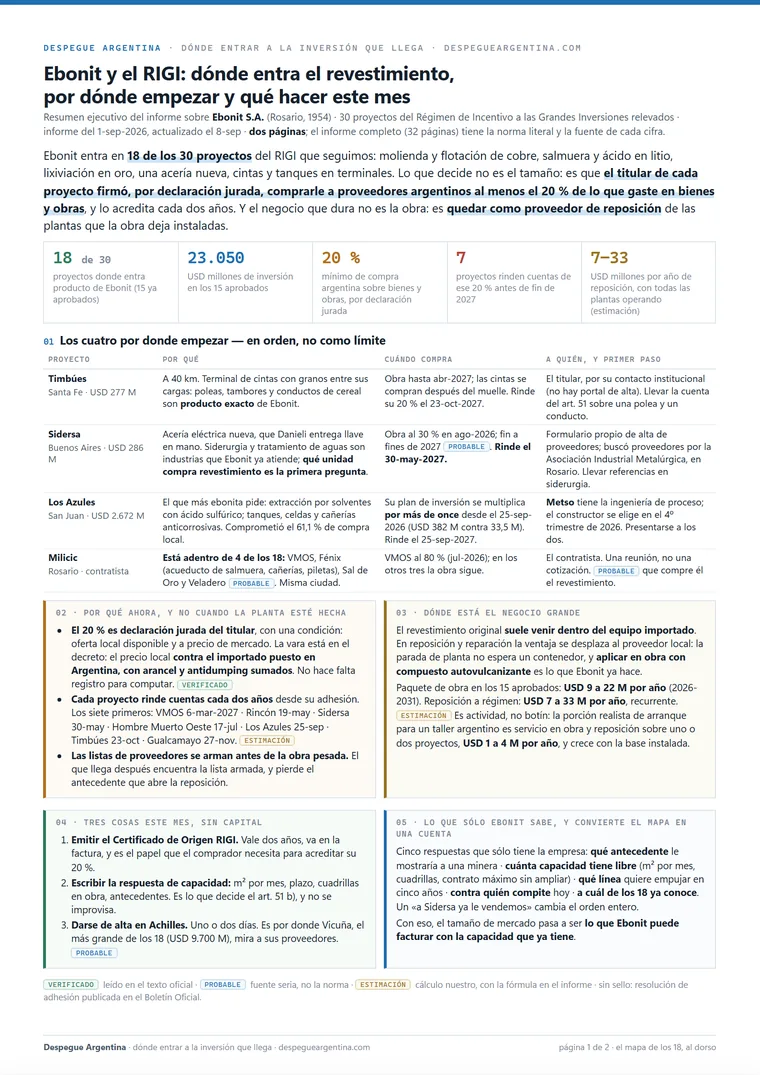
Page 1 of the example executive summaryOpen the report ↗A real analysis · a real company, open in full →

Ignacio Aredez
Analysis and curation: Ignacio Aredez
Head of Despegue
Method and track record →
  • 20+ years in technology, 15 of them in data and AI, for clients across Europe and the Americas
  • Certified in AI governance (ISO/IEC 42001)
  • Machine Learning (Google Cloud)
  • Registered expert with the European Commission
How to read the seals →
  verif primary source · prob primary source pending · unconf a source said it · estim our own calculation · thesis our reading · the date belongs to the datum, at the precision its source allows
Market figures are estimates with a transparent method, not official data: every niche publishes how it is calculated. Looking for the investment numbers? See the version to invest. Jobs and trades? The version to work.