Despegue ← Neuquén OPPORTUNITY
22 more opportunitiesOther opportunities ▾
ESEN Where my company can get in
Neuquén · Vaca Muerta · satellite service
The fracturing curve reinforces it; of transport deregulation, half arrivedthesis

Logistics and transport (trucks, multimodal)

Estimated entry range for a supplier
~USD 85-130 M/yr
Estimated market: ~USD 850 M/yr
up to date · reviewed Sep 14, 2026
estim Aug 2026urgent demandour reading
At a glance
Who buys
The sand provider, not the operator on its own
the 3 doors →
In which projects
YPF 'LLL Oil'
what each one invests →
When
The truck is the only mode until 2029: the branch line reaching Zapala is not tendered until after the three state lines, whose bids open on 11 November 2026. Meanwhile the sand to be moved grows every year. thesis Sep 11, 2026
what to watch and where it stands →
The main barrier
It is not getting hold of the truck: it is the length of the contract. The equipment pays back over years and freight is contracted by season, and whoever invests carries the difference. On top of that, registration is paid once for each operator, not once and for all. thesis
the whole entry map →
Where you get in
Not competing as one more truck: six hauliers concentrate the largest operator's sand tenders and one alone runs more than 1,200 units. The gap is in the hours the existing fleet loses waiting and running back empty:
the 3 routes →

Moving Vaca Muerta's sand is an ~USD 850 million a year business: seven million tonnes that leave almost entirely from Entre Ríos and travel by truck. The fleet assigned to it is between 4,000 and 4,300 trucks, six trips a month each, and the industry reckons 700 to 800 more have to be added per year. But the number that matters is another: the trip takes 70 to 75 hours against the 48 that are optimal and the return runs empty. The capacity lost waiting is of the same order as the entire fleet the sector plans to buy through 2028, and that —not the train, which moves 2.6% and keeps falling— is the gap a new entrant can take.

verif primary sourceestim our own calculationthesis our readingHow to read all five →

Who really pays?

Freight is not always paid by the operator, and the customer changes with the cargo and the leg. Three different doors — knowing which one is yours is the first step of the sale:

If you sellTrunk sand freight (long haul)
→
The sand provider, not the operator on its own prob Aug 15, 2026 ↗

Sand is sold delivered at the well —about USD 145 a tonne by the Entre Ríos route, freight included—: whoever arranges or subcontracts the long-haul truck is usually the Entre Ríos sand producer, and the operator buys the sand delivered.

If you sellIntegrated logistics / last mile
→
The operator that internalizes, directly prob ↗

The largest operators, with their own sand logistics, internalize part of the freight and contract carriers and cooperatives directly.

If you sellRoad and decongestion infrastructure (yards, bypass, accesses)
→
The oil companies' trust — not the State verif Apr 9, 2026 ↗

Ten operators finance the Añelo bypass and run the tender; they recover via royalty advance + toll.

▸
The real customer depends on what is sold and on which leg: in sand freight, whoever sells it delivered to the well; in the last mile, the operator that internalizes. And the major decongestion infrastructure is paid by the oil companies' trust, not the highway authority. Mixing up the doors means knocking on the wrong one.

Which projects move this demand

USD 25,000 M May 15, 2026 ↗

YPF mega-development: plateau of 240,000 bbl/d in 2032, 1,152 wells. A signal of the scale jump in Neuquén upstream leveraged on already-secured…

see the project →

When the window opens

Freight demand moves with fracturing, not with oil production, and the way the load travels can be counted. These five numbers publish themselves, with a date.

What to watchWhat changes when it happensStatus
Tonnes of frac sand moved by rail
It is the only official number that says whether haulage is shifting to rail or is still trucks. Today it answers no: rail moves some 15,000 tonnes a month —2.6% of the volume— and fell from 203,000 tonnes in 2024 to 147,000 in 2025 while total demand grew. Its peak was 565,118 tonnes in 2019. The day that row doubles twice in a row, the long-haul trucking business has changed.
monthly · January to July 2026: 106,624 tonnes, against 146,992 in all of 2025 verif Jul 2026 ↗
Fracturing stages per month in the Neuquina basin
The bulk of the load is sand, and sand moves when fracturing happens: each stage demands hundreds of tonnes. The month's stages are the direct thermometer of next quarter's freight demand, which is the horizon on which fleet is contracted.
official series by well, province and fracturing date verif 2026 ↗
FADEEAC's freight transport cost index
It is the margin of the business: the tariff is agreed by season and the cost moves every month. When the index runs faster than the agreed tariff, the haulier loses on a contract already signed — which is exactly this page's barrier.
monthly · August 2026: up 1.66% in the month prob Aug 2026 ↗
The tender for Trenes Argentinos Cargas' three lines
Until those contracts are signed, Ferrosur Roca is not tendered — the only branch line that currently reaches Zapala and could carry sand. Meanwhile it runs on a precarious extension to 10 September 2027, and no operator commits investment without a long concession.
bids open on 11 November 2026 prob Sep 11, 2026 ↗
The Añelo bypass coming into service
These are the kilometres that take heavy traffic out of the centre of Añelo, which is where hours of the trip are lost today. When it opens, the case for truck yards to decongest the town changes size. Ten operators finance it through a trust, not the state: whoever builds invoices the trust.
awarded in April 2026, with completion expected in October 2027 verif Apr 9, 2026 ↗
What signals the game has changed
The train arrives, but not within this window

TBSA's corridor needs 700 days from an approval that has not yet arrived, and the branch line that currently reaches Zapala goes to tender only after the three state lines, whose bids open on 11 November 2026.

See the evidence
It does not reorder the business before 2029, but when it does, whoever built only long-haul trucking is exposed. thesis
More in-house logistics by operators

Vertical integration (YPF/Marín, Tecpetrol) reduces outsourced freight. thesis

The provinces along the route start charging the trucks

The provinces the trucks cross have started charging those not based there: Entre Ríos sharply raised the levy it charges on sand leaving its territory and La Pampa is designing tolls for heavy transport. These are costs landing on a tariff already agreed for the season. thesis

Mining asks for the same trucks at the same time

Copper development will coincide with Vaca Muerta's and demands very similar services: the same equipment and the same drivers. It is risk and leverage at once — it lifts freight prices and at the same time makes people harder to find. thesis

The opportunity in depth

How to get inthe gap and the routes that open it
1

The loaded return. Sand trucks run back empty from Neuquén towards the Litoral, and the alternative the industry itself is studying is returning with grain. Whoever assembles that fit splits the fuel across two loads instead of one: it is the largest saving available today, and it needs neither train nor barge.

2

Cut the waiting, do not add trucks. The trip takes 70 to 75 hours against 48 optimal, and the hours are lost at quarries, at loading and unloading points and on the access roads. Regulated parking, synchronised slots and transfer nodes are what give those hours back. ⚠️ The Añelo bypass is already awarded and finishes in October 2027: any yard being planned has to serve the situation after that date, not today's bottleneck.

3

The handling at both ends. Drying, wellhead silos and pumping are USD 25 of the USD 122 it costs to move each tonne —about USD 175 M a year— and are done with far less fleet capital than the long haul. ⚠️ It is not vacant: a single haulier controls the field's main storage hub and the last mile.

What you needcapital, certification, tax regime and who pays
The basin pays to move its inputs.
Capital
The yard, the silo or the transfer plant are bought once and amortised over years, and that is the trap: freight is contracted by season.
See the detail
The head of one of the basin's large hauliers put it that way in August 2026: short contracts hold back adding fleet and technology. No source publishes the entry ticket, but the scale is measured: moving 100,000 tonnes from the Paraná basin takes about 500 trucks prob, and each does six trips a month. It is measured in dozens of units, not in one. (⚠️ Ley 3502 sets no investment floor for fiscal stability verif text of the law: the USD 500,000 often quoted verif implementing decree is the bottom of the band that decides who gets the abbreviated adhesion procedure, not the door to the regime.)
Certification
Registering as a freight supplier is quick because it is subcontracted — what really costs is not certification but the contract that backs the investment in the yard, the silo or the transfer plant.
See the detail
The truck operates under the national RUTA haulage registration, now digital and free, and no province or municipality can ask a registered haulier for extra paperwork. ⚠️ What is paid once per client is the registration: every operator demands its own platform and its own file before letting a truck into the field, and taking sand to the wellhead requires special-cargo licenses and specific equipment.
Regime
Locating the yard, the silo or the transfer plant in the basin capitalises on the provincial regime: Ley 378 (land at fiscal price in industrial parks) and Ley 3502 (turnover tax and stamp duty exemption plus tax 10-year stability, no investment floor in the text of the law). The truck adds the national digital waybill, which is free and self-declared.
Who pays
Freight is paid for differently depending on the load: the operator that brings it in-house, the sand supplier who sells it delivered at the well, or the oil companies' trust when what is being built is road infrastructure.
▸ You tell us where to see what your company does and we tell you whether we see a sign that it fits this opportunity, with the evidence behind it. See if my company fits this opportunity →
When you get paid, and what blocks it
Pays today: there are between 4,000 and 4,300 trucks on the move. Registering as a freight supplier is quick because it is subcontracted, but the margin is thin and the tariff is agreed by season while the equipment pays back over years. Yards, silos and transfer plants demand investment and a contract that backs it. estim
Who you compete againstwho is already there and what share they take
Who is
already in
Market
split
The six that concentrate the largest operator's sand tendersConcentrated on the long haul

The long haul is not fragmented: six hauliers concentrate the largest operator's sand tenders, and the biggest of them runs more than 1,200 trucks and controls the field's main storage hub and the last mile. The fleet assigned to sand haulage is 4,000 to 4,300 units, at six trips a month (2026).

Rail consortium for the Añelo corridorFuture dominant player in the rail mode

⚠️ Rail does not start from zero: it has been moving frac sand since 2013, although today that is some 15,000 tonnes a month —2.6% of the volume— and a third of what it moved in 2019. The corridor needs 700 days from an approval that has not yet arrived.

Operators with in-house logisticsGrowing share

Vertical integration; YPF (Marín) co-drives the rail line to Añelo to move sand.

Last-mile and silos supplier in bankruptcyWas a last-mile / silos reference player

In insolvency proceedings since mid-2025: a collapsed incumbent, not a reference. ⚠️ That its fall left the last mile and wellhead silos vacant is NOT verified: later evidence pushes the other way, because a single haulier controls the main storage hub and that business.

The jobs it createsMass transport employment (drivers, yard operators); cutting the lost hours decongests the roads and Añelo, lowers road accidents and the logistics cost of the whole basin. thesis

Non-addressable

The long-haul freight of the sand is already counted in the sand niche (delivered at the well), and the operators' vertical integration takes a growing share. What is captive and what is already counted have to be netted out. estim

Addressable share

Addressable: coordinating the return load, the yards and transfer nodes that cut the waiting, and the handling at both ends —drying, wellhead silos and pumping—, which is ~USD 175 M of the ~USD 850 M. estim

Entry range for a supplier

Between 10 and 15% of the ~USD 850 M haulage submarket, which is the same method and the same number the sand niche uses on the same money. estim

▸ The train does not arrive in time for this window: today it moves 2.6% of the sand, its share keeps falling, and its concession is settled only after the three state lines go to tender. Until 2029 the truck is the only mode, and that is why the game is truck productivity, not truck replacement.
How we
calculate it

The number comes from multiplying the year’s activity by the unit price, and it is cross-checked against independent methods that give the same result.

The full calculation, step by step
Annualization window: NONE — Neuquén has no window, and that is the statement. This TAM does not spread a capex over years: it measures current annual activity, the kind already running. The province produces 634,406 bbl/d of oil and 118 MMm³/d of gas —July 2026, against 81 in November 2025— with 37 drilling rigs and 13 frac spreads at work, so the unit is the well, the stage or the tonne — not a peak spread over time. All Neuquén niches are measured with this same unit, so their TAM/year figures do compare with one another.⚠️ What is NOT comparable: a Neuquén TAM/year against one from Catamarca, San Juan or Salta. Both are written «USD X M/year» and measure different objects — here it is a recurring flow; there, a construction capex spread over a window that closes.Bottom-up: volume ~7 M t/yr (2026, with 5.5 M t in 2025 and 8 M t expected for 2027) times the USD 122/t that run from the quarry to the well, which is what haulage charges. That margin comes broken into four published legs: USD 70 of long-haul freight, USD 15 of drying, USD 27 of last mile and USD 10 of wellhead pumping, on a tonne that leaves Ibicuy at USD 22 and reaches the well at USD 145. ⚠️ That is the price of the Entre Ríos route, where the bulk of the volume comes from —between 70% and 87% depending on the source—; the rest comes from closer quarries and costs less, so the total is published as an order of magnitude (~USD 850 M) and not to the million. Grouped by what it is, moving the tonne is USD 97 (~USD 680 M/yr) and processing it at both ends, USD 25 (~USD 175 M/yr). The satellites of freight —water, equipment, chemicals, people— are not added: they have no public tariff.

Concentration High on the long haul and in storage: six hauliers concentrate the largest operator's sand tenders and one alone runs more than 1,200 trucks and controls the field's main storage hub and the last mile. Rail was never empty —it already moves some 15,000 tonnes of frac sand a month— but that is 2.6% of the volume and its share keeps falling. The gap is not one of competitors: it is one of capacity and lost hours.

The rule that moves it

Logistics is moved by two things at once: the national deregulation of freight transport and, in the basin, the road infrastructure the oil companies themselves finance.

See the underlying reading

The underlying policy that opens up this demand. It is the same inference declared by the rules and the program pillars pushing in this direction.

better export netback
enables
Trucks: digital RUTA and the end of extra provincial requirements
See the rule →
The ruta becomes digital, free and declarative, and no province or municipality can ask the registered carrier for extra paperwork: a single national window lowers the freight compliance cost.
touches
Hidrovía: the deregulation Congress stopped
See the rule →
Opening coastal shipping to foreign vessels came by decree and Congress blocked it, so the river route remains unavailable. And even if it were opened it would not change the picture tomorrow: the sand producers themselves say sending sand by ship costs more today than by truck.
enables
Longer trucks: Annex R updated after 30 years
See the rule →
After thirty years untouched, the catalogue of weights and dimensions for freight transport was redone: the tractor-semitrailer stays at 19.60 metres and B-trains get three scales, up to 31.25.
See the full legal grounds
On a corridor with no railway, more load per trip is directly fewer trips per tonne — and it is the only capacity lever already in force.

Where the number comes from

~USD 850 M/yr — the same money the sand niche quantifies, seen from transport. Of that total, some USD 680 M are moving the tonne and some USD 175 M processing it at both ends.

See the calculation, the variables and how it was validated

The market is built from two numbers that move —how many tonnes have to be moved and how much haulage charges for each— and from the internal split of that charge, which barely moves.

~7 M t of sand × USD 122/t of haulage=~USD 850 M/yr
Sand to move~7 M t/yrlive data
It rises with every well: 5.5 M t (2025) → 7 M t (2026) → 8 M t (2027). It is the engine of the market's growth.
What haulage charges~USD 122/tlive data
It is what separates the USD 22 of the tonne at the Ibicuy quarry from the USD 145 it reaches the well at: 84% of the price. ⚠️ It is the price of the Entre Ríos route, where the bulk of the volume comes from —between 70% and 87% depending on the source—; the rest comes from closer quarries and costs less. It moves with diesel and the exchange rate.
Moving versus processingUSD 97 moving, USD 25 processingannual review
Of the USD 122, moving the tonne is USD 97 —USD 70 of long-haul freight and USD 27 of last mile— and processing it at both ends is USD 25 —USD 15 of drying and USD 10 of wellhead pumping—. The split comes from the published breakdown, not from a percentage of ours. ⭐ And it changes a decision: whoever buys trucks and whoever builds a silo are not in the same market.

Freight for tubulars, cement, chemicals, water, equipment and people belongs to this market and is not in the figure: none of those loads has a published tariff, and an invented number is worth no more than none. And what is counted does not add to the sand niche: it is the same USD 850 M seen from the truck rather than from the tonne.

The number rests on a few variables. The formula shows how it moves when each one changes; and each variable carries its freshness seal — how often it is worth revisiting. estim

How solid the number is estim

The price stopped being our own calculation: one source publishes the five legs of the tonne —USD 22 at the Ibicuy quarry, 70 of long haul, 15 of drying, 27 of last mile and 10 of pumping— and another puts the haulage business at some USD 850 M a year; both reach the same number without knowing each other.⚠️ With two caveats we prefer to write down. The first: those USD 145 are the price of the Entre Ríos route, where the bulk of the volume comes from —between 70% and 87% depending on the source—; the rest travels from closer quarries and costs less, so the total is an order of magnitude and not a figure to the million. The second is about the truck counts circulating in the press: the ones published «per day» mix the whole basin's logistics with the sand's, and one of them presents an entire fleet as if it were a daily count. The fleet that is measured is 4,000 to 4,300 trucks assigned to sand haulage, at six trips a month.What remains our own estimate is how much of those USD 850 M a new entrant can capture.

Coverage: the CNRT's official series of tonnes carried by rail, which has its own category for frac sand, and the public registry of Certified Neuquén Suppliers under Ley 3338, counted in full: 1,029 companies, 161 of them in «Logistics and transport» · Sep 14, 2026 · not reviewed: that registry is not the universe of supply: of the six hauliers that concentrate YPF's sand tenders only one appears in the logistics category, the largest is classified in another category and four do not appear because they are from other provinces

How to cite this figure: Despegue (2026). Logistics and transport (trucks, multimodal) · Neuquén. despegueargentina.com/en/neuquen/logistica-transporte-multimodal · terms of use

Neighbouring markets5 markets in the same group, from USD 7 to USD 800 M a year

First step · free
The first read of your company

We look at what your company does and tell you whether we see a sign that it fits this market, with the evidence behind it. If we do not see one, we say so too and name the condition that would change it. One page as a dated PDF, within 48 working hours.
Not here for a company? Invest · Work (in Spanish) · Start a business (in Spanish) · Institutions
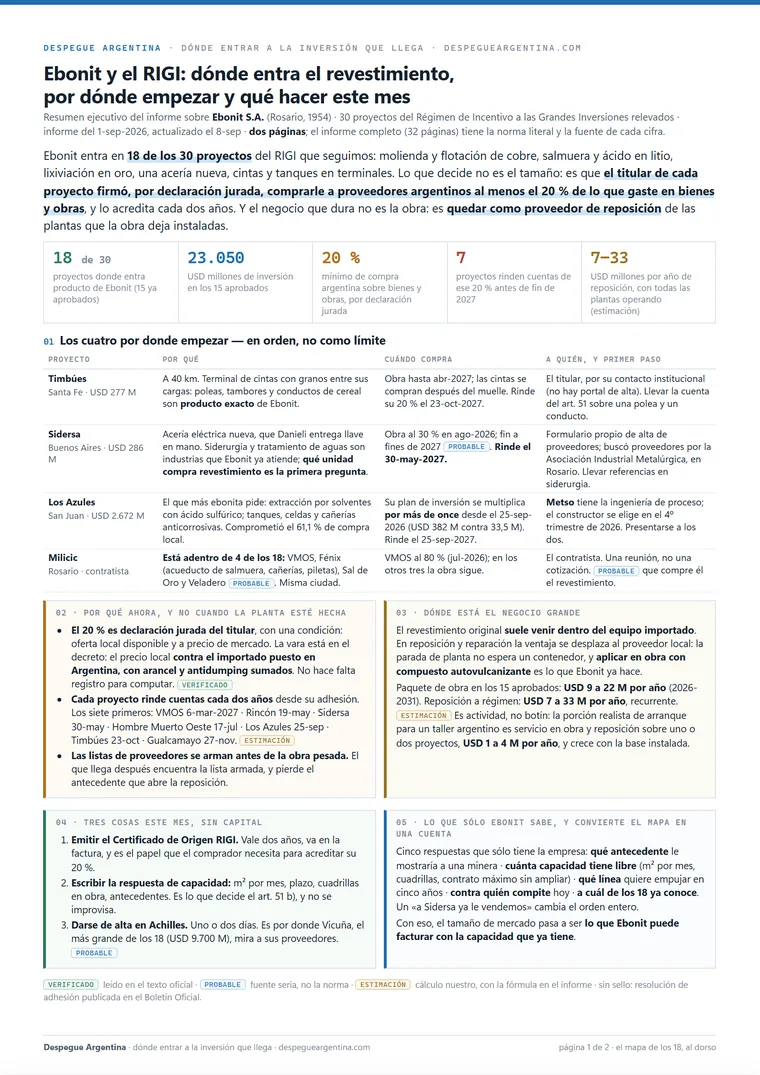
Page 1 of the example executive summaryOpen the report ↗A real analysis · a real company, open in full →

Ignacio Aredez
Analysis and curation: Ignacio Aredez
Head of Despegue
Method and track record →
  • 20+ years in technology, 15 of them in data and AI, for clients across Europe and the Americas
  • Certified in AI governance (ISO/IEC 42001)
  • Machine Learning (Google Cloud)
  • Registered expert with the European Commission
How to read the seals →
  verif primary source · prob primary source pending · unconf a source said it · estim our own calculation · thesis our reading · the date belongs to the datum, at the precision its source allows
This is not financial advice. The TAM is an estimate with a transparent method, not an official figure; the framing is labeled as thesis. Every figure carries its source. ← All opportunities in Neuquén