Despegue ← Catamarca OPPORTUNITY
11 more opportunitiesOther opportunities ▾
ESEN Where my company can get in
Catamarca · Lithium puna · brine laboratory and sample preparation
Four plants are producing and the sample still travels 1,000 km: the gap is the seal, not the technologythesis

Brine laboratory and sample preparation (Catamarca)

Estimated entry range for a supplier
USD 0.3-0.8 M/yr
in 2-3 years
Estimated market: USD 2-5 M/year
up to date · reviewed Sep 14, 2026
estim Jul 25, 2026midpoint ~USD 2.8 M/yearwindow openour reading
At a glance
Who buys
The operator, via its procurement department and its supplier registry
the 4 doors →
In which projects
Fénix, Hombre Muerto Oeste, Salar Tres Quebradas · and 1 more not yet approved
what each one invests →
When
What opens this market is not a construction project: it is four plants producing every day and, by our estimate, 80 % of the samples are process control. The deadline that runs against you is set by the provincial registry: it asks for two years of domicile before bidding. verif Sep 14, 2026 ↗
what to watch and where it stands →
The main barrier
The methods are published and the equipment can be bought. What blocks you is the accreditation, and accreditation takes time: it is granted per site, takes 12 to 24 months and can be lost. That is why you do not come in through the resource assay but through what does not need it. thesis
the whole entry map →
Where you get in
Do not start by fighting for resource analytics: that is decided by the professional who signs the technical report, not by procurement. You come in from the side, where the barrier is logistics and not brand:
the 4 routes →

Catamarca has four lithium plants in operation or commissioning and no laboratory accreditation for lithium in brines inside the province: the two that exist in the country are in Mendoza and in Jujuy, the Catamarca office of the only specialized laboratory is listed with no declared specialization, and one project's check assay went to a university in Chile. The signal that the market exists does not come from us: an operator built its own laboratory with ICP-OES in the province —when the operator internalizes, the market does not supply—. And the arithmetic says where to enter: brine exploration barely yields samples (a well gives ~22 assays, against hundreds from a copper porphyry), but the daily process control of four plants and the environmental monitoring of aquifers —a regulatory obligation, not an opinion— are paid for every day and do not switch off when construction ends.

A perpetual core: analytics scale with tonnes produced, not with capex — when the construction niches switch off, this one keeps going. The window that does close is the competitive one: 12-24 months until an incumbent accredits a scope in the province.

verif primary sourceestim our own calculationthesis our readingHow to read all five →

What the market is made of

The TAM is activity, not what you will invoice. In analytics the captive share takes a particular form: it is not captured by a global, it is captured by the client itself — the plant laboratory is done in-house by definition, and the assays feeding a 43-101 resource are chosen by the Qualified Person, who sends them to branded laboratories. Your real gap is what is left: preparation and custody, routine work on ponds and wells, water and environmental work, which does not go through the resource report and the QA/QC that crosses the border today.

How it splits, and against which total
Midpoint of the captive/addressable split (~60-70% captive, per the funnel) over the central TAM of ~USD 2.8 M/year. Our own estimate. estim
CaptiveUSD 1.8 M · 64%
Addressable (SAM)USD 1 M · 36%
CaptiveUSD 1.8 M64%non-addressable
each operator's in-house plant laboratory (one operator already built its own with ICP-OES and atomic absorption) + the resource check assays the Qualified Person sends to branded laboratories (Mendoza, Jujuy, Chile) + core porosity and metallurgical testwork abroad + export inspection at the Chilean port
Addressable (SAM)USD 1 M36%addressable
preparation, conditioning, custody and freight of everything that leaves the province today + routine work on ponds, wells and process water + water and environmental monitoring of aquifers (a regulatory obligation, and it does not go through the resource report) + junior and consultancy campaigns + operating the plant laboratory under contract
Non-addressable

~USD 1.8 M/year (~65% of the TAM): each operator's in-house plant laboratory (a documented pattern with a name: Minera Cordillera built its own with ICP-OES and AA), the 43-101/JORC resource check assays that the Qualified Person sends to branded laboratories (a Chilean university, a commercial laboratory in Santiago and the commercial laboratory in Mendoza and Jujuy), core porosity at an international laboratory, metallurgical testwork abroad and export inspection at the Chilean port (Antofagasta/Angamos), which happens outside the province.

Addressable share

~USD 1.0 M/year addressable by a local/domestic entrant: preparation, conditioning, custody and freight of everything that leaves the province today to have a number put on it.

See the full breakdown
routine assays of ponds, wells and process water; water and environmental work, which does not go through the resource report and has a written regulatory obligation; campaigns for juniors and for hydrogeological consultancies; the share of QA/QC that crosses the border today; and the plant laboratory operating contract. It is enlarged by the Re.P.E.M.'s roots requirement (a laboratory from Mendoza or Salta does not qualify: 2-year domicile, 50% local partners, 70% Catamarca payroll) and by the fact that invoicing from Catamarca counts toward the local-content commitments. ⚠️ HMW's 95.34% and Fénix's 60% are the share of what each project pays suppliers that it declares goes to local suppliers, not quotas by category: they enlarge the preference for invoicing locally, but a peso of local content is met just as well by buying concrete. Anyone selling this niche as 'HMW's 95% is my market' is inflating.
Entry range for a supplier

USD 0.25-0.6 M/year for ONE new entrant within 2-3 years (and USD 0.5-1.0 M/year only by year 3-4): preparation + custody + routine + water for 2-4 clients, based in Fiambalá or Belén/the capital with a preparation outpost in Antofagasta de la Sierra.

See how the range is built
With an accredited scope and a brand (joint venture/franchise) it rises to USD 0.6-1.4 M/year in year 3-4. AN UNCOMFORTABLE TRUTH, stated in full: USD 0.3-0.8 M/year is a 12-25 person laboratory and does NOT by itself pay for an ISO 17025/OAA scope (12-24 months of process, capex USD 1.5-3 M). Either you enter through preparation and water with small capex and grow with volume, or you enter with somebody else's brand. A plan that starts by buying the ICP-OES before having the first framework contract is badly sequenced.
▸ A competitive window, not a check: the specialized laboratory already has an address in Catamarca with no accredited scope, and an operator already has ICP-OES inside. If either of them moves, the wedge is left with preparation and water. And the clock that runs before all the others: the provincial registry requires two years of domicile — whoever establishes in 2026 qualifies in 2028.

Who really pays?

In laboratory work each door is decided by a different person, and one of the four is locked before you call. Worth knowing which:

If you sellRoutine assays, pond and well control, and the external QA/QC done in Chile today
→
The operator, via its procurement department and its supplier registry verif Mar 31, 2022 ↗

The Sal de Vida project technical report spells it out: brine chemistry is analysed at a commercial laboratory in Mendoza —declared independent of the operator— and the control duplicates are sent out of the country: to a university and a commercial laboratory in Santiago, in Chile, plus a third laboratory, which prepares in Mendoza and analyses in Santiago. Its Table 11-1 compares, lithium against lithium, the operator own laboratory with that of the commercial laboratory in Mendoza. Not one single assay from the largest lithium operation in Catamarca stayed in the province when that technical report was written, in March 2022, and the project changed owner afterwards. And there is a counterpart with an open door: the supplier development programme of Rio Tinto —today the owner of the project— publishes its own metrics: +50 suppliers trained, 800 hours of assistance, 290 improvement actions and a 90% acceptance rate.

If you sellThe analytics of environmental monitoring of aquifers, surface waters and wetland meadows
→
The hydrogeological consultancy that subcontracts — and also the State and the community verif Mar 31, 2022 ↗

A foreign consultancy signs off the brine resources, another does the wetland monitoring with two annual campaigns and an SME from the NOA the basin studies: the analytics of those campaigns are bought, not done in-house. On the other side, Aguas de Catamarca SAPEM monitors with a mobile laboratory and the Mining Code orders a provincial registry of consultants and laboratories to be created.

If you sellPreparation, conditioning, custody and consolidated freight of the sample
→
The receiving laboratory or the operator's geology department — the smallest ticket and the fastest prob 2026 ↗

It is a service with a public list price: 0.45 µm filtration USD 13.90 and acidification to pH<2 USD 3.05 per sample in the receiving laboratory's price list, plus solid preparation at USD 12.40. Today every operator does it on its own or sends it outside the province.

If you sellThe assays that feed a resource estimate (43-101 / JORC) — the locked door
→
Nobody in procurement: it is decided by the Qualified Person who signs the report verif Mar 31, 2022 ↗

A professional from a hydrogeology consultancy signed Sal de Vida's resources in 2022 verif, a Chilean consultancy that of Hombre Muerto Oeste verif and another qualified professional those of Fénix and Sal de Vida in Rio Tinto's 2025 annual report verif. Sal de Vida's check samples went to a university in Chile, which declares no ISO, to a commercial laboratory in Santiago (ISO 9001) and to a commercial laboratory in Mendoza (ISO 17025) verif. The signatory's reputation decides it more than price thesis: with no brand and no track record, this volume never reaches an entrant thesis.

▸
The lesson: the resource assay is decided by a geologist in Vancouver or in Santiago; the routine, the environment and the preparation are decided by someone 200 km from the salar. That is where you enter.

Which projects move this demand

USD 251 M Apr 6, 2026 ↗

Expansion (Phase 1B) of the historic Fénix lithium-carbonate project in the Salar del Hombre Muerto, operated by Rio Tinto via Minera del Altiplano…

see the project →

Lithium brine project in the Salar del Hombre Muerto (western zone), to produce 12,000 t/yr of lithium carbonate equivalent…

see the project →

Tres Quebradas stage 2: plant and infrastructure for 40,000 t/year of lithium carbonate via direct extraction (DLE), per art…

see the project →
USD 4,000 M Aug 18, 2025 ↗

Catamarca's largest copper project and the largest capital investment in the province. MARA integrates the Agua Rica deposit (Andalgalá)…

see the project →

When the window opens

In laboratory work the warning is not a price or an investment decision: it is an accreditation procedure, which takes months and can be followed. ⚠️ The 12 to 24 months used as the length of that procedure are our own reading of how the trade works, not a deadline written into any rule. These four numbers are the ones that give notice.

What to watchWhat changes when it happensStatus
Argentine accreditations with a scope of lithium in liquid brines
It is the whole market in one number. While there are two and both belong to the same company, the gap exists; the day a third appears —or one in Catamarca— this page changes sign.
two in the whole country as of 14 September 2026, counted against the complete registry: LE-273 in Palpalá (Jujuy) and LE-187 in Maipú (Mendoza), both Alex Stewart.
See the evidence
And zero accredited entities domiciled in Catamarca, of any kind, out of the registry's 341
verif Sep 14, 2026 ↗
The plants in production and their pace
80% of the samples are process control estim. Each plant reaching steady state adds between 25 and 60 samples a day estim, and that depends on no construction project.
four plants in operation or commissioning; Hombre Muerto Oeste already produces lithium chloride and is moving to its first sales verif Galan quarterly report, and the second stage of Tres Quebradas adds a plant of 40,000 tonnes a year by direct extraction, which it plans to operate from April 2029 verif Jul 29, 2026 ↗
The two provincial rules that require every well to be analysed
They are demand that waits for no construction project: one halts the environmental procedure if the analysis is missing, and the other has an expired deadline and a written sanction.
the December 2020 brine guideline requires a hydrochemical analysis and a technical report for every well and every monitoring well, and its article 3 suspends the environmental impact procedure until it is completed.
See the evidence
the September 2023 resolution requires every producing well to be instrumented within 60 days, a deadline that has expired
verif Dec 15, 2020 ↗
Environmental sanctions from the mining authority
It is the measure of how much not measuring costs. Every published fine widens next year's monitoring budget.
$254.1 million against Zijin-Liex for the brine spill into the Chaschuil river on 25 March 2026, according to neighbors the third in seven months.
See the evidence
⚠️ There is no series: they become known through the press
prob Mar 25, 2026 ↗
What signals the game has changed
The incumbent's response (killer no. 1, immediate)

The specialized laboratory ALREADY has the address in Catamarca: accrediting a lithium-in-brines scope there is a 12-24 month process, not a risky investment.

See the evidence
And Minera Cordillera ALREADY has ICP-OES + atomic absorption in the province: if it opens its capacity to third parties, the commercial gap closes without anyone new coming in. It is the same film as San Juan (Lenor entered in Apr-2026 with USD 4 M and that laboratory stated in May-2026 that it was considering setting up), where the window closed in weeks. Timing: immediate, residual window 12-24 months.
Operator internalization (the pattern, not the exception)

Daily process control is done in the plant by definition, and the precedent of internalizing the complete package already exists by name in the province.

See the evidence
An honest counter-reading: the same operator that internalizes needs external, independent QA/QC (its own QP requires it and the regulator asks for it) — but that is 5-10% of the volume, not 100%. Timing: structural.
The NI 43-101 / JORC resource-report gate

It does not break the market: it breaks the model. The assays feeding a resource estimate are chosen by the Qualified Person (a hydrogeology consultancy at Sal de Vida in 2022, a Chilean consultancy at HMW, a qualified professional at Fénix and Sal de Vida in Rio Tinto's 2025 annual report), not by procurement.

See the evidence
without accreditation AND reputation they never arrive — a Chilean university was used with no declared ISO, together with two laboratories that do have it. It forces the preparation / water / branded joint venture format. Timing: structural.
Lithium carbonate price (with a favorable asymmetry)

Q2 2026 averaged USD 22,043/t (+125% y/y) and closed at 19,400 verif: today the wind is at our back. A collapse dries up junior exploration first (Carachi Pampa was looking for investors for its pilot plant as of the Jul-2026 cutoff unconf) and stalls the phase 2s.

See the evidence
But here is the niche's core argument: a plant in operation runs its assays all the same at any price — the large segment (process control, ~⅔ of the TAM) is the least price-sensitive in the entire portfolio. Timing: continuous, sensitive 2027+.
See the remaining 5 risks
Delay or cancellation of stages

Tres Quebradas' 2nd stage already has its act: the resolution was published in the Official Gazette on Jul 29, 2026, with USD 594,136,000 of computable investment verif — the USD 709 M was the amount announced for Tres Quebradas prob press announcement of the approval, 14-Jul-2026.

See the evidence
Sal de Oro II as well: its resolution came out on Jul 31, 2026, with USD 207,936,427 of computable investment verif Resolución 1157/2026 against the USD 547 M published on the regime's official portal verif the regime's official portal. Kachi is pre-FID with its exploitation DIA pending. If those slip, the wellfields and the expansion samples slip — not the operating core, which is already producing. Timing: 2026-2028.
Ninth clause of the Salta-Catamarca agreement

The 50/50 split over the disputed strip is voided once Congress settles the boundary verif annexes to Salta's leyes 8523 y 8524.

See the evidence
If the strip is defined in Salta's favor, the clients on that half (Sal de Oro, Diablillos) stop counting toward Catamarca roots and the Re.P.E.M. stops being an advantage against them. It is already discounted: those projects are NOT in the TAM. Timing: an event with no date.
Social license (the only killer that also feeds a segment)

The 2021 amparo filed by Román Guitián (chief of the Atacameños del Altiplano), the Mar-2024 injunction over the Río Los Patos lifted 5-2 in 2026 and the case pending before the CIDH prob can stall specific campaigns.

See the evidence
Symmetrically: more water conflict = more demand for monitoring and for independent counter-sampling. Zijin-Liex's brine spill into the Chaschuil river (25-Mar-2026) proves it: the Ministerio de Minería de Catamarca imposed a fine of $254.1 million and, according to the neighbors quoted by the press, it was the third in seven months prob converging provincial press — the sanctioning resolution could not be opened in the provincial BO. Timing: continuous.
Puna scale and logistics (the risk that does not make it into business plans)

Antofagasta de la Sierra has 2,022 inhabitants and 0.1 inhab./km²: the technical staff is not there and has to be brought in on a 7x7 regime, or the laboratory has to be based in Fiambalá/Belén/the capital.

See the evidence
And the chain of custody is broken by the road: RP 43 was closed by snow on Jul 23, 2026 with −27 °C and 5 Fénix workers trapped above 4,500 masl prob. A sample that does not arrive in condition is a lost assay and a disputed invoice. Timing: seasonal, every year.
End of the construction window (almost DOES NOT apply: it is this niche's differentiator)

Unlike camps, ponds or earthmoving, this niche's core (process + environment + product) scales with TONNES PRODUCED, not with capex.

See the evidence
When the construction niches switch off this one keeps going, and it grows if Catamarca moves from the ~65,000 t projected for Dec-2026 to 100,000 t/year prob projections declared by the operators. It is a sustained niche, not a window one — and that is why its real killer is competitive, not cyclical.

The opportunity in depth

How to get inthe gap and the routes that open it
1

The lowest-capital door: preparing and taking custody of the sample at the salar. For a brine, "preparation" means filtering to 0.45 µm, acidifying to below pH 2, aliquoting, refrigerating, labelling and maintaining the chain of custody — and it has an open market price: the receiving laboratory charges it as an add-on of USD 13.90 + 3.05 per sample. Today every operator does it on its own, redundantly, or sends it to Chile. Capex USD 50-200 thousand.

2

The routine assays that do not go into a resource report. Lithium and potassium by atomic absorption or ICP-OES, major cations, chloride and sulfate, density and dissolved solids: pond control, well control, process water and raw water. The methods are published —they are no secret—, and the client is twofold: the junior projects and the hydrogeological consultancies that subcontract outside today. Capex USD 0.4-1.2 M.

3

Water and environmental work: the segment without the resource-report gate. Here no Qualified Person decides: there is a rule, there is a court that asked for continuous aquifer monitoring and there are real fines — $254.1 million for a brine spill into a river in March 2026. And the rule is more concrete than it looks: since December 2020 a provincial brine guideline requires a hydrochemical analysis of every brine well and every monitoring well, with its design and its technical report, and its article 3 states that no environmental impact report is processed until that is completed; since September 2023 every pilot or producing plant must install multiparameter meters and observation wells at each producing well, in real time where possible. Both generate samples every month and neither depends on a new project starting. And there is a formal door almost nobody uses: the Registro Único de Consultores Expertos Mineros y/o Ambientales, which has existed since 2011, opens registration only once a year, in the first quarter, and requires an office in the province with at least half of its professionals and technicians from Catamarca.

4

With proven execution, the seal. The accredited scope for "lithium in liquid brines" takes 12-24 months and carries the address of each laboratory, so, as we read it, a new site needs its own assessment. And it can be lost: the Mendoza site was suspended from March 2021 until August 2022, and the registry itself says so. The lowest-risk route is not to fight for it alone: it is a joint venture or franchise with a brand, a format the provincial supplier registry also pushes toward, since it admits joint ventures with a local majority.

What you needcapital, certification, tax regime and who pays
It is paid against sample delivered and against campaign, with no dead gap. What you need in order to enter — the full map, in the open:
Capital
From USD 50-200 thousand for preparation and custody, to USD 0.4-1.2 M for a routine laboratory, to USD 1.5-3 M with an accredited scope, LIMS and a backup instrument. A real reference from the field: in San Juan a domestic entrant put up USD 4 M for a complete geochemical laboratory — the brine one is a cheaper subset, it does not need fire assay.
Capability
The methods are published (lithium by atomic absorption, cations by ICP-OES, anions, sulfate by gravimetry). The hard part is the matrix: in brines the detection limits rise by up to three orders of magnitude, so you need dilution, matrix-matched standards and your own validation. And the profile no Catamarca organisation has had to sustain yet: an ISO 17025 quality manager — out of the 341 accreditations in the national registry, zero belong to an entity domiciled in Catamarca, so there is no local precedent of an audited quality system.
Regime
Re.P.E.M.: domicile in Catamarca with 2 years of seniority, 50% local partners (or a joint venture with ≥50% local), 70% Catamarca payroll and a semi-annual sworn statement. Then, homologation in the operator's supplier registry. Tax: 3.00% of Turnover tax in the first bracket —the same whether you classify as "technical testing and analysis" or as "mining support service"— plus Stamp tax on the purchase order.
Who pays
Three different doors and one locked: the operator (routine and QA/QC), the hydrogeological consultancy that subcontracts the analytics, the State and the community in monitoring — and the locked door, the resource assays, decided by the Qualified Person.
▸ You tell us where to see what your company does and we tell you whether we see a sign that it fits this opportunity, with the evidence behind it. See if my company fits this opportunity →
When you get paid, and what blocks it
It gets paid today, with no dead gap — but the money already flows elsewhere and that changes the sale. The four operations already pay for analytics (internal cost + external QA/QC + freight); environmental monitoring is already an obligation (biennial update of the DIA under art. 256; Fénix's permits require independent authorizations for brine extraction, water use and spent brine management verif); the spill into the Chaschuil river already produced an ARS 254.1 M fine. No FID or RIGI is needed for the invoice to exist. But unlike a niche with zero suppliers, here you do not create a flow: you divert one —from Mendoza, Jujuy, Chile and the operator's internal cost center—. The sales argument is not price: it is turnaround and custody (the geologist decides where the hole goes next with the result; the pond operator adjusts harvesting with the day's result) plus countable local-content compliance.Events that open a contract: every biennial DIA update and every new IIA; the Antofalla campaign (>=10 wells in 2026) and the start-up of Kachi; the ramp to nameplate capacity of the 4 plants; the launch of the Registry of consultants and laboratories under art. 261 subs. b if it happens; the start-up of Sal de Oro's 2nd stage, which would reopen wellfields —its RIGI resolution came out on July 31, 2026 and the one for Tres Quebradas 2nd stage on the 29th—; and the next environmental incident (this is not cynical: it is the documented trigger of monitoring demand).Commercial model: a framework contract by assay code with committed volume and a turnaround SLA (the industry standard format) · a monthly retainer per point/campaign for environmental monitoring · a per-sample rate for preparation, conditioning and consolidated freight · and the prize, the plant laboratory operating contract.The real bottleneck, in order of what stops you first:(1) Re.P.E.M. — legal domicile in Catamarca with 2 years of seniority (the bottleneck money cannot solve), 50% of partners domiciled in the province or a joint venture with >=50% local, 70% of the professional/technical/administrative payroll from Catamarca, municipal license + Rentas and a semi-annual sworn statement; the registry has 229 active (May-2026) with 75 of 194 in the capital and only 12 in Antofagasta de la Sierra;(2) homologation in the operator's supplier registry — Rio Tinto runs a formal program with published metrics (+50 suppliers trained, 800 hours, 290 improvement actions, +60% in quotations, a 90% acceptance rate verif), with hard QA/QC auditing (blanks, duplicates, standards, traceability);(3) ISO 17025 accreditation with an OAA scope for 'lithium in liquid brines': 12-24 months, and each accreditation carries the laboratory's address verif, so a new site would not inherit it from head office thesis;(4) capital: USD 50-200k (preparation and custody) → 0.4-1.2 M (routine with AA/ICP-OES, unaccredited) → 1.5-3 M (accredited scope, LIMS, backup instrument, a building in the Puna); a real reference: Lenor put up USD 4 M for a complete geochemical laboratory with fire assay in San Juan, and the brine one is a cheaper subset;(5) people: the talent pool is UNCA but there is no pool of commercial laboratory experience and Minera Cordillera is already absorbing what is available (40 people, 89% local) — the first supervisors are imported from Mendoza/Jujuy/Chile;(6) altitude and weather: +3,000-4,300 masl, −30 °C, winds of 20-120 km/h, roads that close, and we found no legislation setting fitness criteria above 3,500 masl unconf.Tax cost (primary source opened today, and it kills a false hope): in Annex I of Ley Impositiva 5.927 code 712000 'Technical testing and analysis' pays 3.00/3.90/4.80% of Turnover tax, identical to the 99000 for mining support services — there is no classification arbitrage; the only lower shelf is 721010 R&D in engineering and technology (2.50/3.25/4.00%), and it is not a trick: Minera Cordillera's laboratory in fact has an R&D area. Against the 0.75% paid by whoever extracts. Plus 1.5 % Stamp tax on the mining supplier's purchase order (art. 26 subs. 2; the 2 % of subs. 1 taxes the acts on mining rights, which are not the supplier's). On a service with a 25-35% gross margin, that is 4.5-5 points of revenue that have to go into the price, not be discovered later. A laboratory at the wedge's scale sits comfortably in Bracket I (cap ARS 3,255,000,000 of 2025 revenue) and whoever starts activity from Jan 1, 2026 pays Bracket I for their entire first fiscal year.Time to first invoice estim: 4-9 months (preparation, custody, freight and unaccredited routine, if you are already established); 12-18 months (routine laboratory built and homologated); 24-36 months (OAA scope and a first contract with a 43-101 destination). And before all of that runs the Re.P.E.M.'s 2-year domicile clock: that, and not the ICP-OES, is the item to start today.
Who you compete againstwho is already there and what share they take
Who is
already in
Market
split
The operators' in-house laboratories (Rio Tinto at Fénix and Sal de Vida, Zijin-Liex at 3Q, Galan at HMW, Minera Cordillera Litio/Arex)~55-70% of the TAM estim

The main competitor is the client itself. Minera Cordillera set up its laboratory in the province with ICP-OES + atomic absorption, 40 people and 89% local staff verif; And the pattern repeats: the operator that brings its analytics in-house does not go out to compete for third-party work, but it takes the volume of daily process control, which is the one that pays every day. Threat: high (it has already happened).

Specialized commercial laboratory with accredited sites in Mendoza and Jujuy~15-25% estim

Maipú-Mendoza with OAA LE-187 (scope verbatim from the official registry: "Determination of gold in minerals and of lithium and potassium in liquid brines"; the entity was suspended from Mar 31, 2021 to Aug 30, 2022, a fact the registry itself declares) and Palpalá-Jujuy with OAA LE-273, scope "Determination of lithium in liquid brines" verif.

See the evidence
THE figure that defines this niche, by a count of the complete registry (337 entities, 295 accreditations in force): in the whole of Argentina there are exactly TWO OAA accreditations with a scope for testing lithium in brines, one in Maipú (Mendoza) and the other in Palpalá (Jujuy), and both belong to this same group. It is not 'the market leader': it is the entire accredited market. Neither of the two is in Catamarca, and this firm's Catamarca office does NOT appear in the OAA registry with a scope of its own verif. The one that can close the gap fastest: it already has the address, it is missing the scope. In May-2026 it stated it was considering setting up in San Juan prob -- the firm is moving. Threat: high.
Process Chemical Control Laboratory - Mining Department, Faculty of Technology and Applied Sciences, UNCA~0% of the paid market today; it is installed capacity, not a commercial offering

THE ONLY BRINE ANALYSIS CAPABILITY domiciled in Catamarca that could be evidenced. UNCA opened it on May 6, 2024 at its Faculty of Technology and Applied Sciences (Mining Department) and states, in its own institutional communication, that it enables testing on "mineral concentrates, brine or water" and that the university would start offering "new services to the mining industry such as audits and controls" verif. Equipment: an optical ICP from the Equipar Ciencia program that analyzes the multi-element composition of brines and liquids, declared unique within UNCA, plus supporting instruments financed under the National Tax Credit Regime through a mining supplier domiciled in San Fernando del Valle de Catamarca -- under the project "Strengthening Infrastructure for SME Training" prob. What it means for the entrant, and this is what makes it a datum and not a color note.

See the evidence
(a) it is NOT accredited by the OAA -- no Catamarca entity appears in the national registry -- so it does not compete for the assay that requires a seal, which is where the price is; (b) the building was paid for by an operator (Lition Energy, which operates in the Salar del Hombre Muerto) and the instruments by a supplier via tax credit: the only local capability to measure brine was financed by demand, not by the market, which confirms there is unmet need and NOT that there is supply; (c) it is installed capacity, not a commercial offer: trained staff, an installed ICP and a university that says it wants to sell services.
Chilean laboratories doing the check assays (a university and a commercial laboratory)~5-10% estim

Check assays and duplicates for Sal de Vida's QA-QC verif. It is the leg that crosses the border: the sample ends up in Antofagasta or in Santiago. The university does not declare ISO and was used anyway, together with a commercial laboratory in Santiago (ISO 9001) and another in Mendoza (ISO 17025) verif: what decides the resource report is the signatory's trust, not just paperwork thesis.

See the remaining 5 players
International core-porosity laboratoryniche (core porosity)

Porosity analysis of Sal de Vida's core verif. It does not compete in brine and is not locally substitutable in the short run.

CAPPROMIN members in environmental services (4, including 'laboratory service') and professional services (7, including 'sampling, processing and metallurgical and chemical analysis of samples')<5% estim

The mining suppliers' chamber's roll (2023 count) lists them verbatim: the gap is one of scale, certification and capability, not of existence. None declares accreditation.

Hydrogeological and environmental consultancies (analytics subcontracting channel)a channel, not a competitor

They subcontract the analytics of their campaigns: they are a client-channel. Entering through here is faster than through the operator's procurement department.

Lenor Group (San Juan)0% in Catamarca unconf

Chimbas, San Juan: USD 4 M, 8,000 m², 30→110 jobs, OAA accreditation, opened Apr 29, 2026 verif. Its initial capacity is about 5,000 samples/month prob. The official release presents it as reaching 'all the cordillera provinces' prob: it is the precedent that a domestic entrant can win this race, and the threat that it wins it before a local does.

Aguas de Catamarca SAPEMpublic, not commercial

A mobile laboratory in Villa de Antofagasta, Laguna Blanca and El Peñón prob. A partner or client for water monitoring, not a competitor.

The jobs it createsEmployment calibrated with two real cases, not with wishes: Minera Cordillera Litio's laboratory has 40 people between administration and laboratory, 89% of them from the province and —the figure that matters most— its two areas (R&D and ICP analysis) are led by local chemical engineers verif; in San Juan, Lenor will employ 30 and projects 110 verif. An entrant at the wedge's scale: 12-25 jobs estim; with an accredited scope and water work, 30-50. Few in number and high in quality: formal employment, annualized (not seasonal), technical and indoors, with no 14x14 mine regime if it is based in the valley.Trades with a concrete route: sample preparer/conditioner —the entry door into the mining ecosystem WITHOUT a degree and with no prior experience (0.45 µm filtration, acidification, aliquoting, labelling, chain of custody); learned in weeks and the equivalent of the drilling assistant but indoors—; laboratory technician and chemical technician; ICP-OES and atomic absorption operator; ISO 17025 quality manager (a scarce, well-paid profile, today almost non-existent in the province); field and hydrogeology sampler (piezometers, flow gauging, wetland meadows); sample driver-custodian trained in hazardous substance handling — exactly the deficiency the Ministry penalized in the Chaschuil spill.Training and linkages: the infrastructure already exists and is measured — Allkem FY21 delivered +43 industrial technical training courses in Antofagasta de la Sierra with +600 attendees verif; >70% of the participants in Arcadium's 2017-2023 apprenticeship contracts were hired permanently prob; CAPPROMIN + ABECEB put >140 SMEs through the quoting and costing modules prob. What is missing is the laboratory course: it is a sellable product for UNCA or a technical school, not a public works project. Downstream it drags sample freight and courier services that leave the province today, industrial gases (argon), consumables and certified standards, calibration and metrology, instrument maintenance and ultrapure water.A systemic effect worth more than the jobs: the Río Los Patos conflict (chief Román Guitián's 2021 amparo action, the 2024 injunction, lifted 5-2 in 2026, the case pending before the IACHR) is argued today with studies that all sides commission outside the province. An accredited laboratory based in the province serves all three sides: the State (enforcing the biennial DIA and verifying royalties with an independent assay), the community (its own credible counter-sample, not a company report) and the company (a technical defense with traceability). It is trust infrastructure in a province where the litigation did not close, it paused.What does not add up, unvarnished: these are dozens of jobs, not hundreds —it is the highest-qualification and lowest-headcount niche of the whole chain— and they will not be in the salar's town (Antofagasta de la Sierra: 2,022 inhabitants, 0.1 inhab./km²) but in Fiambalá, Belén or the capital, with a preparation outpost at the salar. If the internalization pattern repeats —and it already has—, the B-side shrinks to preparation, custody and freight: real, but bounded.

How we
calculate it

The number is our own estimate. The calculation, step by step, is below.

The full calculation, step by step
Annualization window: NOT APPLICABLE — this niche has no window. Assay work scales with tonnes produced, not with capex: it is a perpetual core and stays switched on when the construction niches wind down. The only window that does run here is competitive and short —12 to 24 months until an incumbent gets accredited— and it is not an annualization window. It is stated explicitly because Catamarca has three different ways of annualising and a perpetual TAM compares with none of them.Samples/year x price per assay package, across 4 segments, with list prices read in the Actlabs 2026 global price list (a stated proxy, +-20-30% vs non-public Argentine pricing) and quantities as assumptions labeled one by one.Prices (Actlabs 2026 price list in USD, with a 10-20% volume discount [assumption]): brine characterization = Code 8 Li in brine 34.80 + Code 6 ICP-OES MB 43.50 + anions 7 69.20 + alkalinity 22.85 + TDS 22.85 + filtration 13.90 = 207.10 list -> USD 100-185 used (central 140); control routine = Code 8 + Cl/SO4 = 81.15 -> USD 25-40 (central 32); monitoring water = Code 6 dissolved 70.45 + anions 69.20 + physicochemical 62.05 + filtration 13.90 = 215.60 -> USD 120-215 (central 165); solids = RX1 12.40 + Li 4-acid ICP-OES 15.65 = 28.05 -> USD 25-35 (central 30).Quantities: (A) 35-85 brine wells/year in the province (Antofalla/Albemarle >=10 declared for 2026 prob; Kachi 0-10 [assumption, pre-FID with the DIA pending]; juniors and minors 5-20 [assumption over the 17 projects the Mining Chamber publishes]; wellfields and monitoring wells of the 4 operations + stage 2s, 20-40 [assumption]) x 20-25 assays/well (verified anchor: HMW = 31 wells / 9,043 m / 697 brine assays, JORC, consultant WSP Chile = 22.5 assays/well) + 400-900 samples from pumping test series [assumption] = 1,200-3,000 assays/year -> USD 0.12-0.56 M. (B) Process control and product QC of the 4 operations (Fénix 38 kt, 3Q 20 kt, Sal de Vida 15 kt, HMW 4-5.2 kt): 25-60 samples/day/operation [assumption calibrated on the verified NI 43-101 flowsheet: ~20 pond cells + 8-20 wells + 10-20 plant streams + batch QC] x 350 days x 4 = 35,000-84,000 samples -> USD 0.9-3.4 M; validated by a second independent route (headcount): 403 USD/t of labor and 170 employees in steady-state operation [both verified in the TR] -> USD 35,500/employee/year; laboratory = 5-7% of the headcount [assumption] = 8-12 people = USD 0.28-0.43 M of payroll; x2 for consumables, standards, gases and depreciation [assumption] = USD 0.6-0.9 M per 15 kt operation; scaled sublinearly to 3.0-3.5 equivalent units = USD 1.8-3.2 M. The two routes overlap -> we publish B = USD 1.5-3.2 M (central 2.1). (C) Environmental monitoring: 6-7 sites (4 operations + 2-3 explorations with baseline + public monitoring) x 20-60 points [assumption, calibrated on the 5 observation wells Albemarle declares and on Knight Piesold's 2 annual wetland campaigns] x 4-12 times/year [assumption; the DIA is updated every 2 years under art. 256 and the EGIA calls for continuous monitoring] = 900-4,900 samples -> USD 0.11-1.05 M. (D) Solids (core and halite crust, baseline soils and sediments, metallurgical head samples, batch certificate of analysis for the product): 3,000-12,000 samples [assumption] -> USD 0.08-0.42 M. Total strict sum 1.81-5.23, central 3.01 -> we publish USD 2-5 M/year, central ~3.0.Cross-check 1 (converges): laboratory = 1-2% of site cash cost [assumption] x 3,146 USD/t verif x 65,000 t projected for Dec-2026 prob = USD 2.0-4.1 M.Cross-check 2 (diverges, and it is declared): 2-4% of the national lithium exploration budget (USD 127 M, 2024 verif) x 25-40% Catamarca = USD 0.6-2.0 M from exploration alone, 2-4x my segment A; the explanation is that the 2-4% benchmark was calibrated on rock geochemistry (hundreds of samples per hole) and brine yields ~22.Cross-check 3 (a real case): Minera Cordillera's in-house laboratory has 40 people between administration and laboratory -> a single player already spends on the order of USD 0.5-1.0 M/year, ~1/3 of the central figure.What does not go into the number (no double counting): Sal de Oro (Salta reports it as its own and its hydroxide plant is in Gral. Guemes, Salta), Diablillos (Ag-Au on the shared strip, and its analytics are rock geochemistry), MARA (capex on hold, no environmental approval), Rincón (Salta), the fees of the hydrogeological and environmental consultancies (= a different niche), limnology and modeling, and export inspection at the Chilean port. If MARA gets going, this TAM changes scale and has to be recalculated, not extrapolated.

Concentration This is not a supplier oligopoly: it is SELF-SUPPLY. Of the truly commercial market (excluding in-house laboratories), a single firm with two sites —neither of them in Catamarca— holds the majority: estimated HHI >4,000 estim. And the structure has an asymmetry that defines the niche: the barrier is the seal, not the physics —the analytical methods for a brine are neither secret nor exclusive—, but each OAA accredited scope carries the laboratory's address verif accreditation scope LE 284, and the view that this firm cannot extend the Maipú (LE187) or Palpalá (LE273) accreditation to its Catamarca address without an assessment of its own is our reading thesis. That 12-24 month process is, exactly, the size of the entrant's window. No incumbent publishes volumes by province: every share is our own estimate and is declared as such.

The rule that moves it

The regulatory driver of this niche is twofold and provincial: the Re.P.E.M. (Registry of Suppliers to Mining Companies) decides who can invoice a miner in Catamarca —and its requirement of two years of domicile leaves out, today, any laboratory from Mendoza, Salta or San Juan—; and the provincial Mining Code turns monitoring into a recurring obligation: an update of the Environmental Impact Declaration every two years (art. 256) and a Registry of consultants and laboratories that art. 261 subs. b orders created.

See the underlying reading

The underlying policy that opens up this demand. It is the same inference declared by the rules and the program pillars pushing in this direction.

the RIGI promise is kept + without controls, supply responds to the boom
enables
Re.P.E.M.: Catamarca's mining local-content rule is a resolution, not a law
See the rule →
The Re.P.E.M. (Res. S.E.M. 498/2014) is at once what lets you in and what holds you back in this niche: it requires legal domicile in Catamarca with 2 years of seniority, 50% of partners domiciled in the province (or a joint venture with ≥50% local) and 70% Catamarca payroll, with a semi-annual sworn statement.
See the full legal grounds
On the good side, it enlarges the addressable market of whoever is established: a laboratory from another province simply cannot bid against the 70% of contracting the provincial resolution requires from every miner. ⚠️ And it should not be confused with the RIGI commitment: that one counts goods and works, not services, so the 95.34% at Hombre Muerto Oeste and the 60% at Fénix do not count a laboratory assay. The lever in this category is the provincial one, not the national one. On the bad side, the 2-year domicile clock is the barrier capital cannot jump: whoever wants to be there when 3Q Phase 2 and Sal de Vida Stage 2 are under way has to establish now.

Where the number comes from

~USD 2.8 M/year at the midpoint; the full band is USD 2-5 M/year depending on the plants' pace and the monitoring requirement

See the calculation, the variables and how it was validated

The TAM is built from two variables you can watch: how many samples the Catamarca Puna generates per year and how much the assay package for each sample type costs. Change one and the number is recalculated.

~68,000 samples and assays/year × ~USD 44 of blended price=~USD 2.8 M/year at the midpoint; band USD 2-5 M/year
Samples and assays per year~40,000-100,000 (midpoint ~68,000)annual review
80% are process control from the four plants (25-60 samples/day each, over the published flowsheet: pond chain, wellfield, liming, softening, ion exchange, crystallizers, product). The rest: ~2,500 of environmental monitoring of aquifers and waters, ~1,900 of exploration and wellfield brine, ~7,500 solids. It moves with every plant that ramps up and with every drilling campaign.
Price of the assay packageUSD 25 (routine) to 215 (complete water); blended ~USD 44annual review
Anchored in a global laboratory's 2026 price list, opened and read: lithium in brine by ICP-OES USD 34.80 · brine multi-element package USD 80.05 · anions by ion chromatography USD 69.20 · solid preparation USD 12.40 · 0.45 µm filtration and acidification USD 13.90 + 3.05 (that is what "preparing" a brine means). It is a global list: Argentine pricing is not public and may differ by ±20-30%.
Assays a brine well yields~22structural
The figure that orders the whole analysis and that almost nobody looks at: Hombre Muerto Oeste's JORC resource was built with 31 wells, 9,043 meters and 697 brine assays. A copper porphyry yields hundreds of samples per hole. That is why in brine lithium the laboratory business is NOT in exploration: it is in the plant that produces every day.

A robustness check by an independent route: if the plant laboratory is 1-2% of site cash cost (USD 3,146 per tonne, a figure from its own technical study) over the ~65,000 tonnes the province projects for the end of 2026, analytical spend comes to USD 2.0-4.1 M/year — above the midpoint of the range. And a cross-check that does NOT close, and we say so: the benchmark of "analytics = 2-4% of the exploration budget" would give 2 to 4 times our exploration segment, because that benchmark was calibrated on rock geochemistry, not on brine.

The number rests on a few variables. The formula shows how it moves when each one changes; and each variable carries its freshness seal — how often it is worth revisiting. estim

How solid the number is estim

The anchor for the number is a real list price we opened and read: a global laboratory's 2026 price list publishes USD 34.80 for a lithium-in-brine assay by ICP-OES, USD 80.05 for the brine multi-element package and USD 12.40 for preparing a solid sample prob the laboratory's public price list — and it warns that in brines the detection limits are raised up to 1,000 times prob ídem, which is exactly why this is a specialty and not "a laboratory". On the quantities side, the anchor is a verified field figure: Hombre Muerto Oeste's resource was built with 31 wells and 697 brine assays — that is where the assays a well yields comes from. We multiply samples by price across four segments and cross-check it with an independent route: the headcount and labor cost of a 15,000 t/year plant prob Sal de Vida technical report, which are in its technical study. The annual total is our own estimate and we say so.

Coverage: the register of accredited bodies of the Organismo Argentino de Acreditación, the country's only accreditation body (341 accreditations, counted one by one), and the INTI's open registry of laboratories (332 records with a province) · Sep 14, 2026 · not reviewed: accreditation is voluntary and the provincial register of mining suppliers does not publish a list of names: what is stated is that no Catamarca entity appears in the accreditation register, not that there are no laboratories in Catamarca

How to cite this figure: Despegue (2026). Brine laboratory and sample preparation (Catamarca) · Catamarca. despegueargentina.com/en/catamarca/laboratorio-salmueras-muestras · terms of use

Neighbouring markets2 markets in the same group, from USD 3 to USD 61 M a year

First step · free
The first read of your company

We look at what your company does and tell you whether we see a sign that it fits this market, with the evidence behind it. If we do not see one, we say so too and name the condition that would change it. One page as a dated PDF, within 48 working hours.
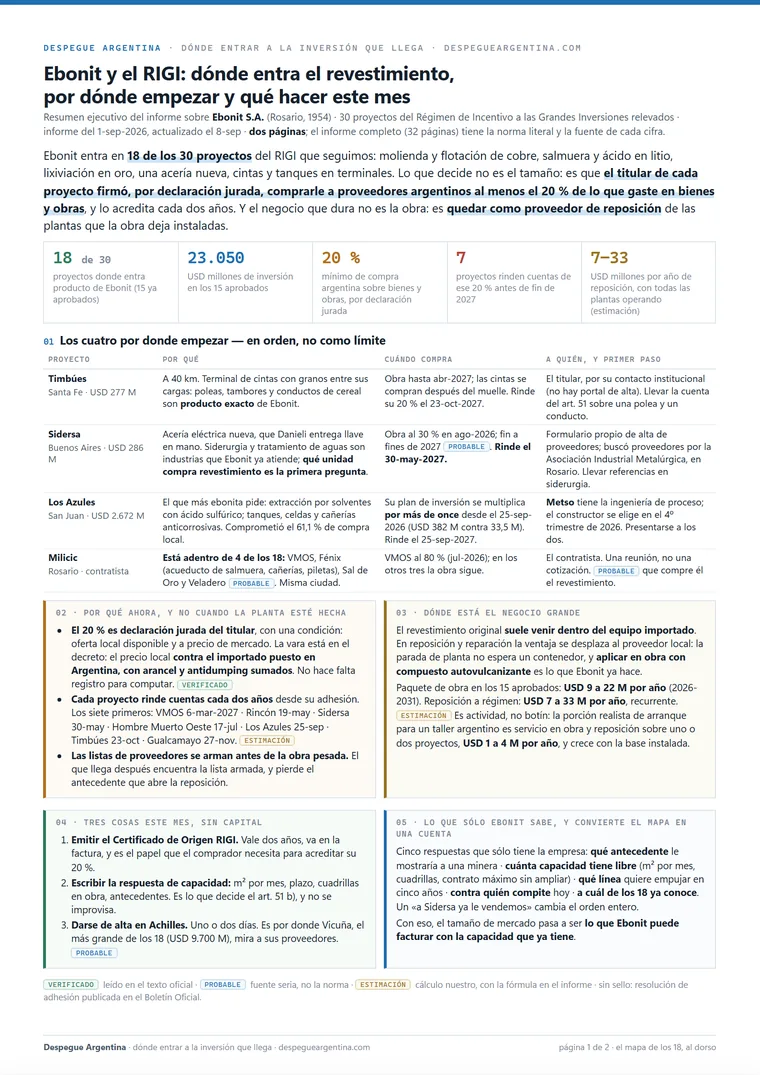
Not here for a company? Invest · Work (in Spanish) · Start a business (in Spanish) · Institutions
Page 1 of the example executive summaryOpen the report ↗A real analysis · a real company, open in full →
Ignacio Aredez
Analysis and curation: Ignacio Aredez
Head of Despegue
Method and track record →
  • 20+ years in technology, 15 of them in data and AI, for clients across Europe and the Americas
  • Certified in AI governance (ISO/IEC 42001)
  • Machine Learning (Google Cloud)
  • Registered expert with the European Commission
How to read the seals →
  verif primary source · prob primary source pending · unconf a source said it · estim our own calculation · thesis our reading · the date belongs to the datum, at the precision its source allows
This is not financial advice. The TAM is an estimate with a transparent method, not an official figure; the framing is labeled as thesis. Every figure carries its source. ← All opportunities in Catamarca