In force since Apr 13, 2026
RIGI: the «long maturity» cap rises from 30% to 35%
Resolution 484/2026
in forceNATIONAL
RIGI and investment
Resolution 484/2026 raises from 30% to 35% the cap on the ratio defining a long-maturity investment under the RIGI. What it measures, who it lets in, and why it loosens rather than tightens.
The other rules on this subject32
What changed and who it applies to
What changed
Raises from thirty per cent (30%) to thirty-five per cent (35%) the cap on the ratio that defines when a RIGI investment counts as «long maturity». The ratio compares the present value of the expected net cash flow —excluding investments— over the first three years from the first disbursement against the net present value of the capital investments planned for that same period. A project that recovers cash quickly produces a high ratio; the cap is what leaves it outside the category. verif Apr 13, 2026 ↗
In force
Published in the Official Gazette on 13 April 2026. verif Apr 13, 2026 ↗
Who it applies to
Every holder of a project seeking to join the RIGI, in any of its sectors: this is not a sector-specific rule. It particularly benefits projects that recover their investment relatively fast —those previously producing a ratio between 31% and 35%— since those were the ones excluded from the long-maturity category. For a satellite supplier the effect is indirect but concrete: every project that enters the regime is a purchasing chain switching on. verif Apr 13, 2026 ↗
The norm
Resolution 484/2026 of the national Ministry of Economy, published in the Official Gazette on 13 April 2026 (notice 340620). It amends the ratio threshold set in the RIGI implementing rules (Law 27,742, Title VII, and Decree 749/2024). verif Apr 13, 2026 ↗
Our reading
This is the third signal in four months that the Government is widening the RIGI rather than defending it: Decree 105/2026 stretched the accession window by a year and lowered the offshore exploration floor, and this resolution loosens the filter that decided who counts as «long maturity». It runs between that decree and the approval of Rincón de Aranda, and it applies to every sector. Read through the framework (R3 stability · R4 deregulation), the regime behaves as State policy rather than an experiment being walked back. What to watch is the same as with the extension: that loosening the filter is a scope decision and not a symptom that accessions are coming in slower than expected — the series of approved projects answers that, not the rule itself. thesis
Analyze this rule for my company
Impact by province, pending. Once we measure how this rule lands in each province, it shows up here.
First step
Tell us what your company does
Your website is enough to start. We look at what the company does and reply with the projects and the buyers worth looking at.
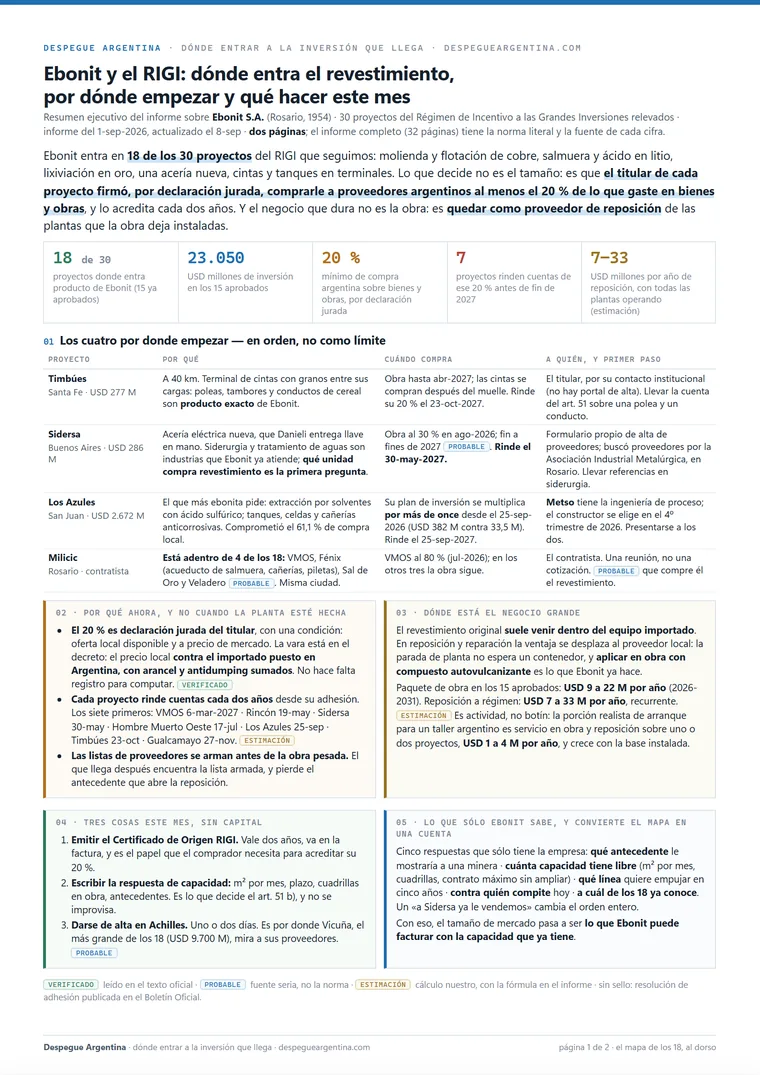 Open the report ↗A real analysis · a real company, open in full →

Analysis and curation: Ignacio Aredez
Head of Despegue
Method and track record →- 20+ years in technology, 15 of them in data and AI, for clients across Europe and the Americas
- Certified in AI governance (ISO/IEC 42001)
- Machine Learning (Google Cloud)
- Registered expert with the European Commission
How to read the seals →
verif primary source · prob primary source pending · unconf a source said it · estim our own calculation · thesis our reading · the date belongs to the datum, at the precision its source allows