In force since Aug 23, 2024
RIGI: what paperwork you have to file afterwards
Decreto 749/2024
in forceNATIONAL
RIGI and investment
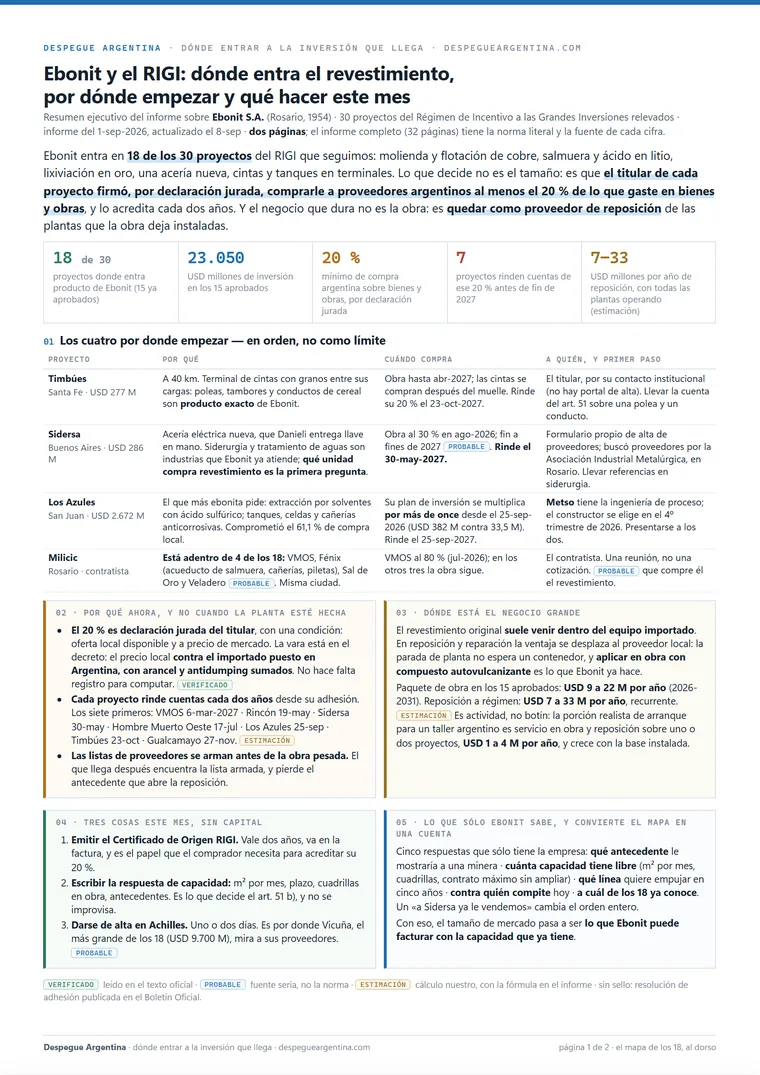
Art. 47 of Decreto 749/2024 requires a local supplier plan worth 20% of the investment, certified every two years from the date of entry.
The other rules on this subject32
Enhanced RIGI for new activities: data centers, AI and semiconductors (half-sanctioned)Half-sanction by the Chamber of Deputies (24-Jun-2026) · in the Senate, without a committee report and without a datepending
What changed and who it applies to
What changed
The RIGI Regulation does not end at approval: it leaves the project holder with three obligations you have to keep proving with paperwork. (1) Article 47, subsection l) of Annex I requires filing, when applying to join the regime, a Local supplier development plan committing a minimum of 20% of the total investment in GOODS AND WORKS to local suppliers; the 20% is calculated on the investment amount earmarked for paying suppliers of goods and works —not on the total investment, nor on the amount earmarked for suppliers as such—, and services fall outside that base. The commitment is conditional: it applies «siempre y cuando la oferta de Proveedores locales se encuentre disponible y en condiciones de mercado en cuanto al precio y calidad» (only where the local supply is available and on market terms as to price and quality), and article 51 sets that bar —the local supplier's ex-works price may not exceed the CIF value of the imported good plus its import duty and its anti-dumping duty—. Article 49 says which contracts count towards that 20%: those with local suppliers of goods and/or works tied to the project «que se encuentren o no inscriptos en el RIGI» (whether or not they are registered with the RIGI), and it leaves out anything supplied by companies related to the holder, unless they are the only ones able to meet that demand. (2) Article 50 requires certifying compliance with that plan in biennial periods counted from the project's accession date, in the form and under the conditions set by the Enforcement Authority. (3) Article 23 requires the SUPPLIER registered under the regime to invoice holders of RIGI projects a minimum percentage of its total annual billing, and to file, before 31 March each year, a sworn statement accompanied by a certification from a licensed public accountant. verif Aug 23, 2024 ↗
In force
Published in the Official Gazette on 23 August 2024. In force today: the text consulted on 19 August 2026 on the official argentina.gob.ar/normativa surface is the updated text, and it incorporates the amendments introduced by Decreto 105/2026, which extended the accession window to 8 July 2027. verif Aug 23, 2024 ↗
Who it applies to
Holders of approved RIGI projects, who are the ones that must certify compliance with their supplier plan every two years from their accession date, and companies registered as suppliers to the regime, which file an annual sworn statement before 31 March with a licensed accountant's certification. It reaches indirectly every local supplier of goods and works: the committed 20% is the door through which the regime brings them in. verif Aug 23, 2024 ↗
The norm
Decreto 749/2024 of the national Executive, Annex I, implementing the Régimen de Incentivo para Grandes Inversiones (RIGI, the large-investment incentive regime; Ley 27.742, Title VII). Articles cited: 23 (minimum billing and the supplier's annual sworn statement), 47 inciso l) (local supplier development plan), 50 (biennial certification) and 51 (market price and availability of local supply). verif Aug 23, 2024 ↗
Our reading
Public discussion of the RIGI stops at approval, and that is exactly where the obligations you have to prove on paper begin. Three things the text says and the press summary does not: the 20% of local procurement is calculated on goods and works, not on total investment, and it leaves services out of that base; certification is not a one-off, it repeats every two years counted from each project's accession date, so every project has its own calendar; and Article 51 sets the yardstick for judging whether local supply existed, which is the question that decides whether an exclusion was justified. For a local supplier that orders the priorities: whoever supplies goods and works comes in through the national 20% door, and whoever supplies services comes in through the provincial local-content regimes, which have a different calculation base and different percentages. They are two separate regimes and the project holder reports on both. And there is a fourth thing, one that changes a concrete decision: to count towards that 20% the supplier does not need to be on any register. Article 49 counts contracts «que se encuentren o no inscriptos en el RIGI» — whether or not they are registered — so signing up to RIGI Proveedores is not the way in to local procurement: it serves a different purpose, importing inputs with a customs benefit. What can leave a company out of that count is being related to the project holder, and there the exception is narrow — only if it is the only one able to supply that. thesis
Analyze this rule for my company
Where it lands, province by province3
Catamarca It concentrates three of the country's earliest accession dates (El Quemado, Fenix and Hombre Muerto Oeste), making it one of the first provinces where biennial certification stops being theory. The Re.P.E.M. register is what defines which local supplier counts. favorable stability → long-term investment thesis
San Juan Los Azules (accession 25 Sep 2025) and Veladero phases 8 and 9 have to prove they meet the national 20% on goods and works and, in parallel, the 60% procurement requirement of Ley 2827-M, which only counts suppliers listed in RE.PRO.MIN and demands substantiated technical justification to exclude a category. They are two different calculation bases on the same project. favorable stability → long-term investment thesis
Río Negro The provincial regime is the most demanding measured so far (80% of workers and suppliers locally based, save for duly substantiated cause), and it coexists with the national 20% on goods and works. For a Rio Negro supplier the provincial door is wider than the national one. favorable stability → long-term investment thesis
First step
Tell us what your company does
Your website is enough to start. We look at what the company does and reply with the projects and the buyers worth looking at.
 Open the report ↗A real analysis · a real company, open in full →

Analysis and curation: Ignacio Aredez
Head of Despegue
Method and track record →- 20+ years in technology, 15 of them in data and AI, for clients across Europe and the Americas
- Certified in AI governance (ISO/IEC 42001)
- Machine Learning (Google Cloud)
- Registered expert with the European Commission
How to read the seals →
verif primary source · prob primary source pending · unconf a source said it · estim our own calculation · thesis our reading · the date belongs to the datum, at the precision its source allows