Not in force yet
Enhanced RIGI for new activities: data centers, AI and semiconductors (half-sanctioned)
Half-sanction by the Chamber of Deputies (24-Jun-2026) · in the Senate, without a committee report and without a date
pendingNATIONAL
RIGI and investment
Approved by Deputies on Jun 24, 2026 and stuck in the Senate: a reinforced regime for investments from USD 1,000 M in activities that do not exist yet.
The other rules on this subject32
What changed and who it applies to
What changed
A text with first-round approval (Jun 24, 2026): a reinforced regime for 'new economic activities' — those not developed, produced or provided in the country (the scope is by NOVELTY of the activity, with objective regulatory criteria; there is no sector list in the articles — data centers, AI, semiconductors, lithium batteries, green hydrogen or reactors are the examples the ruling party cites). Minimum investment USD 1,000 M per project (20% committed in the first 2 years), income tax at 15%, dividends 3.5% from the fourth year, employer contributions 10%, tiered free availability of foreign exchange 20/40/100% over 3 years from the first export, and exemption from import/export duties. Added by the Chamber of Deputies (it was not in the original bill): a local-supplier development plan with a local-contracting commitment of at least 20% of the amount destined for suppliers, provided there is local supply available on market terms (art. 17 subs. o), plus a public registry of projects. verif Jun 24, 2026 ↗
In force
Not in force: with first-round approval in the Chamber of Deputies (Jun 24, 2026), pending consideration and definitive enactment in the Senate. verif Jun 24, 2026 ↗
Who it applies to
World-scale investors with projects >USD 1,000 M in activities that are NEW to the country: Art. 4 of the enacted text defines scope by the novelty of the activity, with objective criteria and measurable parameters left to the implementing regulation. The sectors named in the debate and in the press (hyperscalers/AI, semiconductors, batteries, hydrogen, nuclear) are NOT in the articles and are not its normative scope. First declared candidate: Meitner Energy (Ansari Group, US + INVAP 40%) — ACR-300 modular nuclear reactor (SMR, ~300 MW) at the Atucha site, ~USD 1,200 M and ~2,000 direct jobs; an initiative filed on Jul 2, 2026 and announced by the Ministry of Economy, subject to ARN licensing and to the bill's enactment in the Senate. Flagship project at a larger scale: OpenAI's letter of intent (Stargate Argentina) for a 500 MW data center in Patagonia, ~USD 25,000 M (Oct-2025; intention, NOT FID). On the local side: supplier SMEs — the approved text requires committing at least 20% of spending to domestic suppliers when there is local supply on market terms. verif Jun 19, 2026 ↗
The norm
First-chamber approval in the Chamber of Deputies on Jun 24, 2026 (130 in favor · 106 against · 7 abstentions); sent to the Senate for final passage. It complements and reinforces the RIGI (Ley 27.742). verif Jun 24, 2026 ↗
Our reading
It opens a new RIGI strand — data centers, AI and semiconductors — that demands exactly what Patagonia has: energy going spare where it has no way out and a cold climate for cooling (R3 · stability → long-term investment). No single province leads on everything: the stranded wind surplus is in Chubut and Santa Cruz, the cold is in Tierra del Fuego, wellhead gas is in Neuquén and the submarine cables land in Buenos Aires. It already has first-round approval in the Lower House (Jun-2026); the signal to watch now is the Senate — and capital is already queuing up: the first candidate has a name, Meitner Energy's SMR reactor at Atucha (~USD 1,200m, with INVAP as a 40% partner), filed days after the vote; the largest flagship project (Stargate/OpenAI, USD 25,000m) is for now a letter of intent. The approved text adds a key piece for the satellite thesis: every project must commit at least 20% of its supplier spend to local suppliers (where supply exists on market terms) — a floor of guaranteed demand for whoever sets up in the chain. Where it is stuck, and it is what matters most to us (18-Sep-2026, prob: there is no act, this is a reconstruction of the parliamentary process): the file remains in the Senate without a committee report and without a date in its three committees, and what is blocking the agreement is the floor for purchases from local suppliers — the government offers 20% and its allies ask for 40%. There is a second point at the same table: at the 2-Sep plenary, three allied senators (Abad, Espínola, Goerling) did not sign the committee report and asked for a preference margin, so that a national supplier's bid counts as competitive even if it costs up to 15% more than the imported one prob. They are two different levers: the floor says how much is bought at home; the margin says at what price the home supplier wins. In other words: the argument holding up the regime is precisely the one that defines how much work stays in the country. thesis
Analyze this rule for my company
Where it lands, province by province5
Neuquén Wellhead gas makes this the country's only case where the fuel that would power the data center sits underneath the site, with no transport in between — and an operator is already building that model in the basin. New potential demand for power generation and satellite services, beyond oil and gas for export. favorable stability → long-term investment thesis
Río Negro Cold, dry steppe all year round — which is what makes cooling cheap, and cooling is the cost you always pay — plus the pipeline carrying Vaca Muerta gas and an outlet to the sea. A candidate for this class of project; it would diversify its profile beyond LNG. No announced data center has a confirmed site: pinning one to a named province would get ahead of the facts. favorable stability → long-term investment thesis
Chubut This is where our analysis places world-class energy for this demand: the country's best wind, with generation that is currently curtailed because the northbound line falls short. A data center built next to the wind farm does not need that line — it consumes the surplus on site. Province with no dossier of its own here: this is a reading of the map, with no figures. favorable stability → long-term investment thesis
Santa Cruz Same mechanism as Chubut — wind to spare and insufficient evacuation — with the added advantage of cheap land and full RIGI adherence, and the drawback of being further from users and from fibre. Province with no dossier of its own here: this is a reading of the map, with no figures. favorable stability → long-term investment thesis
Tierra Del Fuego The lowest cooling cost in the country: it is the coldest province, and cooling is an expense that recurs every year and never amortises. Against it: its electricity system is isolated from the national grid. Province with no dossier of its own here: this is a reading of the map, with no figures. favorable stability → long-term investment thesis
First step
Tell us what your company does
Your website is enough to start. We look at what the company does and reply with the projects and the buyers worth looking at.
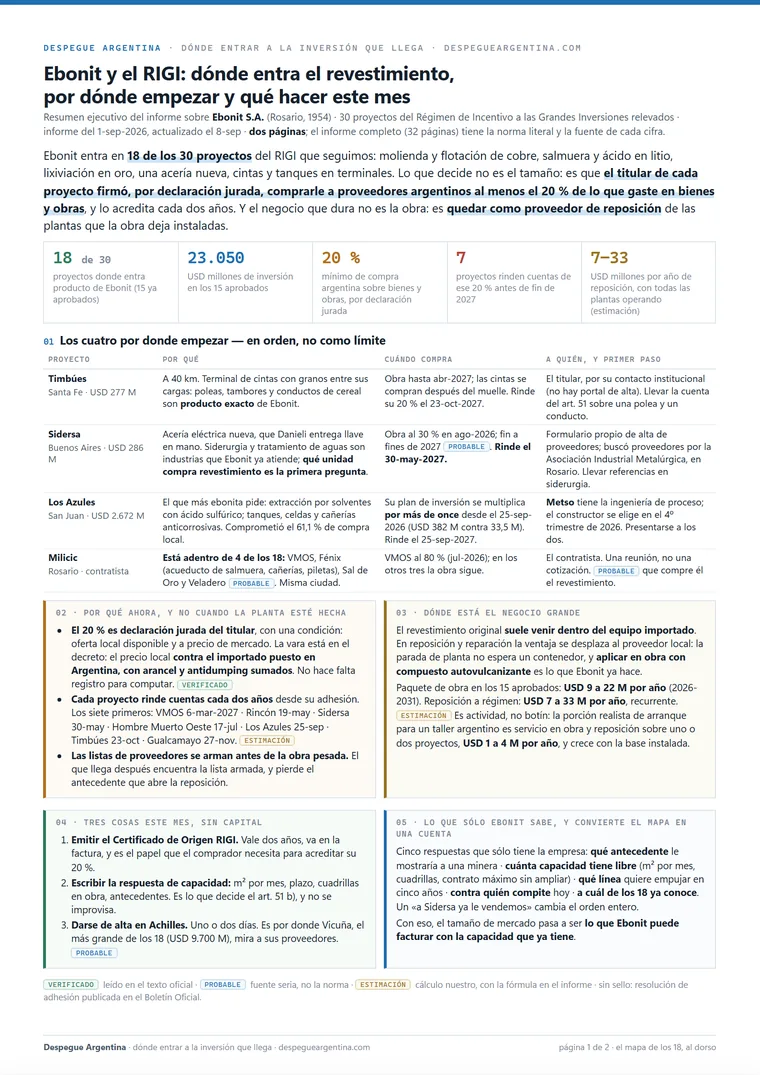 Open the report ↗A real analysis · a real company, open in full →

Analysis and curation: Ignacio Aredez
Head of Despegue
Method and track record →- 20+ years in technology, 15 of them in data and AI, for clients across Europe and the Americas
- Certified in AI governance (ISO/IEC 42001)
- Machine Learning (Google Cloud)
- Registered expert with the European Commission
How to read the seals →
verif primary source · prob primary source pending · unconf a source said it · estim our own calculation · thesis our reading · the date belongs to the datum, at the precision its source allows