In force since Jul 8, 2026
Meat plants: the Technical Director is no longer required
SENASA Res. 592/2026 (Official Gazette, Jul 7, 2026)
in forceNATIONAL
Market deregulation
Res. SENASA 592/2026 removes from Decreto 4238/68 the Technical Director requirement for meat and slaughter plants across the country.
The other rules on this subject40
Mega-DNU 70/2023: repeals the Rentals, Shelves and Supply lawsDecreto 70/2023 (DNU-2023-70-APN-PTE)in force
The IGJ digitizes companies' financial statementsIGJ General Res. 9/2026 (RESOG-2026-9-APN-IGJ#MJ), Official Gazette Jul 2, 2026in force
What changed and who it applies to
What changed
SENASA repeals Item 1.7 of Chapter I and Item 9.2 ('Technical Director. Mandatory Technical Director requirement') of Chapter IX of the Regulation for the Inspection of Products, By-products and Derivatives of Animal Origin (Decreto 4238/68). It removes the mandatory requirement to have a Technical Director at facilities where animals are slaughtered and processed (meatpacking plants and animal-origin product/by-product plants). Stated reason: the current system of licensing, permanent official inspection, documented procedures, facility self-control and the operators' primary responsibility (Ley 27.233) 'makes the continuation' of that mandatory role 'unnecessary'. verif Jul 7, 2026 ↗
In force
Took effect the day after its publication in the Official Gazette: 07/08/2026. verif Jul 8, 2026 ↗
Who it applies to
Meatpacking plants and facilities that slaughter/process products, by-products and derivatives of animal origin nationwide (abattoirs, meat-processing plants) — a sector with strong weight in Argentine exports. It lowers a fixed structural cost (the Technical Director position stops being mandatory) without touching the licensing system, official inspection, or the operator's primary responsibility for safety. verif Jul 7, 2026 ↗
The norm
Resolución 592/2026 of SENASA (RESOL-2026-592-APN-PRES#SENASA), signed on Jul 6, 2026 and published in the Boletín Oficial on Jul 7, 2026 (No. 47729/26). verif Jul 7, 2026 ↗
Our reading
It lowers a real structural cost (a mandatory professional role) without touching the substance of oversight: the combination of licensing + official inspection + self-control + the operator's primary responsibility stays intact — it's that safety net that underpins the deregulation. Same logic as other sector-level trims by the government (R4 · opening and deregulation): separate the safety/health substance —untouched— from the administrative load around it. thesis
Analyze this rule for my company
Where it lands, province by province1
Río Negro Río Negro's livestock and fishing depend on plants certified inside the Patagonian foot-and-mouth-free zone without vaccination, the status that allows bone-in cuts where the rest of the country cannot enter. At that regional scale a compulsory professional post is a large fixed cost: removing it lowers the structural floor without touching licensing, official inspection or operator liability. favorable cheaper to respond: investing takes time, held-back supply shows up at once thesis
First step
Tell us what your company does
Your website is enough to start. We look at what the company does and reply with the projects and the buyers worth looking at.
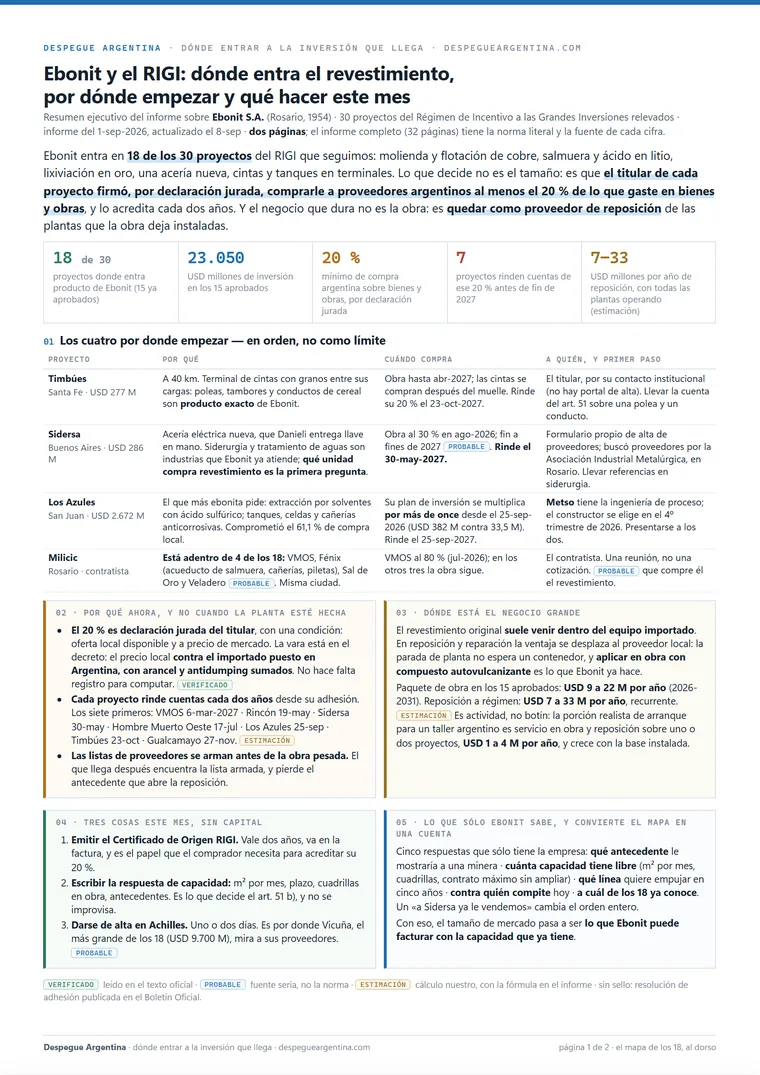 Open the report ↗A real analysis · a real company, open in full →

Analysis and curation: Ignacio Aredez
Head of Despegue
Method and track record →- 20+ years in technology, 15 of them in data and AI, for clients across Europe and the Americas
- Certified in AI governance (ISO/IEC 42001)
- Machine Learning (Google Cloud)
- Registered expert with the European Commission
How to read the seals →
verif primary source · prob primary source pending · unconf a source said it · estim our own calculation · thesis our reading · the date belongs to the datum, at the precision its source allows