Geochemical laboratory and sample preparation in San Juan
Every metre drilled in San Juan leaves samples that someone prepares and someone assays, and they are two different businesses. The technical report of the province's largest project publishes the full table of the laboratories it has used since 2009, and it says something no page was telling: all the primary analysis laboratories are in Chile or in Peru. In Argentina only sample preparation was done —in Mendoza since 2019, and in the city of San Juan in 2012 and 2013—. There is the real gap, and it is not the one that was being published: it is not that there was no laboratory —SGS publishes one in Chimbas and in April 2026 Lenor put USD 4 million into another, a few blocks away— it is that the analysis a resource report requires is not done in the country. And what is sold is not price: it is time, because each result decides where the hole goes next.
On this page
What the market is made of
The TAM is analytical activity, not capturable spoils. Feasibility metallurgical testwork is resolved in Chile or Perth, the grade control of operating mines is internalized by Veladero and Gualcamayo, and the Chilean side of Filo del Sol is left out: that is captive. Your real gap is the preparation and exploration geochemistry of the Argentine programs, plus water and geotechnics —all billable from San Juan—: the addressable segment.
USD 2.5-5.5 M/year (~35-45%): FS metallurgical testwork in Chile/Perth (global laboratories; Nuton is proprietary), international umpire/settlement, grade control internalized on-site (Veladero/Gualcamayo), the Chilean side of Filo del Sol
USD 4.5-8 M/year: prep + exploration geochemistry of the Argentine programs + water/environmental + geotechnics + Hualilán toll-milling settlement. The Local Mining Development Law (60% procurement, 'competitive market terms' valve) enlarges it: an assay billed from SJ counts toward the target, one from Mendoza does not. Lenor's entry proves the SAM was real — and starts to occupy it
For a new entrant post-Lenor: USD 1-2 M/yr as an advanced sample-preparation laboratory + water; USD 2.5-4.5 M/yr if entering with a global brand (a partnership with a local partner, or a franchise — 43-101 analytics remains vacant). The wedge shrank by about a third because of Lenor
Who really pays?
The obvious name —'the mine'— is not a single door. The laboratory's money comes in through different channels depending on the type of assay, and each is billed to a different client. In exploration the operator contracts directly — not via the firm that manages the works:
A per-campaign framework contract with the operators and juniors exploring in the province — prices by assay code, a committed turnaround time, monthly billing Sep-May. Exploration is handled by the project owner, not by the firm that manages the plant works.
The water baselines and monitoring of Josemaría, Los Azules and El Pachón: Josemaría's environmental file went from 515 to 1,200 litres per second of water required in peak production periods, according to the provincial press. A segment with no NI 43-101 lock.
When Vicuña and Los Azules operate, process control is tendered by the mine (the globals operate it under contract on the premises) and the export-concentrate settlement/umpire (~395 kt Cu/year from Vicuña) goes to the international chain, where a global laboratory is already strong in export inspection.
Which projects move this demand
The largest mining project in Argentine history by announced investment, and, according to the operator…
see the project →Leach-based copper cathode project in Calingasta (San Juan). Company/press figures (probable, outside the resolution)…
see the project →Phase 1 of one of Argentina's two largest undeveloped copper deposits, alongside Vicuña: a resource declared by Glencore of ~6,000 Mt @ 0.43% Cu, 2.2 g/t Ag and 130 g/t Mo…
see the project →When the window opens
Every metre drilled leaves samples that reach the bench one to three months later. These four numbers give notice earlier.
See the evidence
See the evidence
Killer #1 has already partly operated: Lenor entered (Apr-2026) and Alex Stewart is evaluating setting up (May-2026). If Alex Stewart executes, a third entrant is left with only niche prep and water. A speed race already started — residual window 2026-2027
With Vicuña/Los Azules in full construction (2027-2029) greenfield meters fall and the mix migrates to geotechnics/infill; the sample peak is 2026-2028; the bridge to the perpetual core (operation labs 2029-2030+) requires surviving the transition
Vicuña final investment decision end-2026; El Pachón's RIGI was still unapproved as of 25-Jul-2026 —it does not appear in the official spreadsheet of approved projects on the RIGI portal verif the official roster of projects counted item by item— (construction 2029).
See the evidence
Structural: without accreditation + reputation, resource samples never reach an independent local lab (not even Lenor today); it forces the prep or franchise format; accreditation takes, we estimate, 12-24 months
See the remaining risk
Litigation can halt specific campaigns; symmetric: more water conflict = more demand for water monitoring (the only killer that feeds a segment). Continuous
The opportunity in depth
The opportunity in depth
An advanced sample preparation laboratory in the northern corridor (Rodeo/Iglesia). Lenor ended up in Chimbas, 150-250 km from the drill holes of Vicuña, Lunahuasi and Veladero; a preparation outpost —drying, crushing, pulverising— cuts 1-3 days and ~80% of the transported weight, and ships the pulp to both Mendoza and Chimbas. Anchor client: the operator with 55,500 m awarded for 2026-2027 and a junior that drills with no infrastructure of its own.
Resource-grade analysis still has no local owner, and now there is something to prove it with: in the table of laboratories of the province's largest project, all the primary analyses were done in Chile or in Peru. Enter in partnership or franchise with a global brand, or be the local partner of the landing a laboratory network with seven sites in the country has reportedly said it is evaluating. The provincial register, once it exists, pushes structurally toward that format.
The water and environmental laboratory, with no 43-101 lock and growing demand from the water conflict: a triple client —operators (compliance), the provincial State (royalty auditing) and communities (an independent check sample)—. Lenor also listed it, so the window calls for speed.
When you get paid, and what blocks it
already in
split
Its largest laboratory in the country is in Mendoza, opened in 2019; its website lists 7 sites —Mendoza, Buenos Aires, Santa Fe, Catamarca, Jujuy, Perito Moreno and San Julián—, none in San Juan verif; it reportedly said in May-2026 that it is 'considering setting up in the province' unconf — the #1 competitive signal to watch
The standard of the Canadian juniors, and it does have a facility in Argentina: the technical report of the province's largest project names it in Mendoza, doing sample preparation from 2019 up to the report's effective date verif — even though its own website returns an error on that page. Its primary analyses, by contrast, are done in La Serena, Santiago and Lima.
It has a laboratory in San Juan and its own directory publishes it, in the Chimbas industrial park. verif. ⚠️ What the directory does not say is which assays it runs: the entry says «Laboratorio» and nothing more. And in the province's largest project its participation is dated and narrow: the table of laboratories records it in the city of San Juan only in 2012 and 2013, and only for sample preparation. ⇒ it is there, and we do not know with what scope.
Opened on 29-04-2026 in Chimbas, on an 8,000 m² site, with a USD 4 M investment, 30 jobs and a target of 110, geochemical, metallurgical and environmental assays, accredited by the OAA verif. The 7.5 hectares, the 2,000 m² of laboratories and an initial capacity of 5,000 samples per month circulate with no open source unconf; no ISO 17025 geochemistry or confirmed 43-101 track record
See the remaining player
No commercial scale; a talent pool of technicians that the entrant already absorbs
The jobs it createsDirect jobs: sample-preparation laboratory 15-30 positions; full analytical lab 40-80 estim. Formal annualised employment, indoors and with no altitude regime.the detail on jobs and trades
calculate it
The number is our own estimate. The calculation, step by step, is below.
The full calculation, step by step
Concentration Concentrated, and now it is known exactly where. The technical report of the province's largest project publishes the table of the ten laboratories it has used since 2009: all those for primary analysis are in Chile or in Peru —La Serena, Santiago, Copiapó, Lima— and the two Argentine ones did preparation: Mendoza since 2019 and the city of San Juan in 2012-2013. In the province there are today at least two published laboratories, both in Chimbas: a multinational's, which its own directory lists without stating a speciality, and a new firm's, which opened on 29 April 2026 with USD 4 million. The board moved for the first time in a decade, and a laboratory network with seven sites in the country reportedly said that it is evaluating entry unconf. ⚠️ No incumbent publishes volumes by province: every share is our own stated estimate.
The rule that moves it
This niche's driver is provincial: San Juan's Local Mining Development Law reserves part of procurement for the local supplier and turns provincial qualification (RE.PRO.MIN) into an advantage: every assay billed in San Juan scores.
See the underlying reading
The underlying policy that opens up this demand. It is the same inference declared by the rules and the program pillars pushing in this direction.
the RIGI promise is kept + without controls, supply responds to the boomSee the full legal grounds
Where the number comes from
~USD 5 M/year for exploration geochemistry; with water, operation assays and geotechnics, the TAM reaches ~USD 7-14 M/year
See the calculation, the variables and how it was validated
The figure is built from the bottom up, from three variables you can watch campaign by campaign. The calculable leg is exploration geochemistry: how many meters are drilled, how many samples each meter leaves and how much each one costs to assay.
Exploration geochemistry is the core calculable with a formula. The water/environmental, operation-assay and geotechnics segments (~USD 4-5 M additional) depend on contracts, not on the formula. The top-down contrast —analytics ≈ 2-4% of the province's exploration budget— gives USD 7-24 M, and the USD 7-14 M band sits in its lower part.
The number rests on a few variables. The formula shows how it moves when each one changes; and each variable carries its freshness seal — how often it is worth revisiting. estim
The figure starts from the meters drilled, which can be tracked campaign by campaign: the published drilling programs —Vicuña 55,500 m awarded for 2026-2027, Lunahuasi's phase 4 with 27,318 m, Los Azules with just over 5,600 m in the last campaign— set the volume, and each meter leaves of the order of 0.6-1.0 samples that a laboratory prepares and assays (our assumption: there is no public data by project). On those meters we estimate the assay demand by code price and turnaround time. The total is our own estimate and we say so plainly: the market today is small (~USD 10 M/year) and jumps from 2030, when the process control of the mines in operation is added.
Coverage: the laboratory table that the technical report of the province's largest project publishes in full —ten entries, with the year and purpose of each one— and the rolls of the two mining suppliers chambers: 187 members of CASEMI and 40 published by CAPRIMSA · Sep 14, 2026 · not reviewed: the register that would really count cannot be listed: the accredited-bodies search of the Argentine accreditation body returns no listing and does not allow filtering by province; and the operators do not publish which laboratory each campaign uses
How to cite this figure: Despegue (2026). Geochemical laboratory and sample preparation in San Juan · San Juan. despegueargentina.com/en/san-juan/laboratorio-geoquimico-preparacion-muestras · terms of use
Neighbouring markets3 markets in the same group, from USD 18 to USD 180 M a year
We look at what your company does and tell you whether we see a sign that it fits this market, with the evidence behind it. If we do not see one, we say so too and name the condition that would change it. One page as a dated PDF, within 48 working hours.
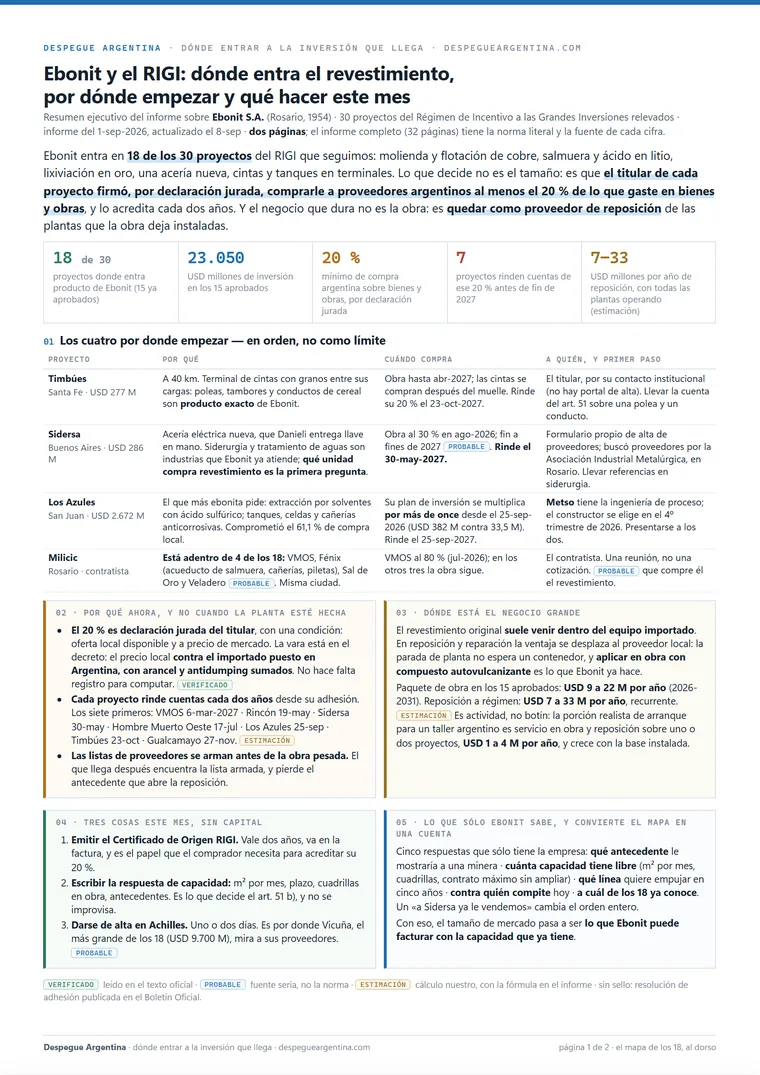 Open the report ↗A real analysis · a real company, open in full →
- 20+ years in technology, 15 of them in data and AI, for clients across Europe and the Americas
- Certified in AI governance (ISO/IEC 42001)
- Machine Learning (Google Cloud)
- Registered expert with the European Commission