Industrial O&M of the Punta Colorada terminal, tanks and monobuoys
The Punta Colorada export terminal —6 tanks of 120,000 m³, 2 SPM mooring buoys, hundreds of km of coastal pipeline— comes online in 2027 and will demand industrial maintenance for more than twenty years: tank integrity, cathodic protection, coatings, subsea inspection. The providers we identified come from Neuquén and the Comahue, and we did not identify a certified maintenance base on the Río Negro coast. The gap is a certified maintenance base in the Atlantic zone — it does not pay until start-up, but whoever gets certified and sets up there in 2026 arrives right on time for the recurring contract.
Does NOT pay until commissioning: it is about positioning before start-up for the perpetual recurring contract, not invoicing yet. ⚠️ And start-up moved forward: connection at Allen on 15 December 2026 and full capacity in July-September 2027, against the 2028 the roadmap stated until March.
On this page
What the market is made of
The market splits in two: the subsea part, captive to the international specialists, and the onshore part —tanks, cathodic protection, coatings—, which is the ground where a Río Negro supplier can get in.
The monobuoy/subsea/PLEM slice (international subsea + specialized diving/ROV) + any turnkey terminal-operation bundle that VMOS awards to a big operator/EPC + the inspection where the operator standardizes on a global certifier. ~40-50% of the TAM (block 2 and part of 4). estim
The onshore terminal slice: API 653 tanks (support/cleaning/coatings), CP, coatings/anticorrosive, field NDT, scaffolding, lifting, instrumentation/valves, maintenance pigging + CP of Río Negro pipelines. ~50-60% of the TAM ≈ USD 8-18 M/year at steady state. estim
A certified coastal workshop/base that establishes before start-up takes a portion of the SAM via Ley 5805 + proximity: realistic ~USD 3-8 M/year in 2-3 years, growing with the ramp and the 2nd wave (Argentina LNG if it takes FID). thesis
Who really pays?
O&M money comes in through different doors — and the subsea slice's door is technically closed. Yours:
It is the one that will pay, whether it operates itself or hires a third party: as of 14 September 2026 we found no published long-term maintenance operator, so the onshore contract appears open. If it bundles a turnkey deal with a large contractor, the door narrows.
diving, subsea robots and subsea hoses: DOF holds the installation contract for the SPMs, diving included prob, and the 20-year maintenance is dominated on technology by international specialists: you get in as a partner of a local shipowner, not head-on thesis.
the ~880 km of Río Negro pipeline (VMOS + San Matías) — a cathodic-protection provider from Comahue already holds a business licence in Sierra Grande; the locally established player competes on proximity and on the local-content rule of Ley 5805, which also covers services.
Which projects move this demand
437-kilometer, 30-inch export pipeline between Allen and Punta Colorada, with a marine terminal of six tanks and two monobuoys some seven kilometers offshore, in the San Matías Gulf…
see the project →Floating LNG project to export Vaca Muerta gas. Although the plant is in Río Negro, it monetizes Neuquén gas: it is key to the evacuation/monetization thesis for associated gas…
see the project →The largest project submitted to the RIGI: USD 51,000 million over the whole life of the project…
see the project →When the window opens
This market does not pay until start-up, so what has to be watched is when it starts. These are the events that open the window:
See the evidence
See the evidence
There is no maintenance to sell until commissioning: the first tanks and a monobuoy in 2027, and full steady state brought forward to July-September of that same year.
See the evidence
If the operator assembles an integrated operation+maintenance contract with a single big player (global EPC/operator), it closes the door, leaving the local entrant only the subcontract slice. Open definition today; it closes when the framework contract is signed. thesis
Without local critical mass, the Comahue service keeps the business 'at a distance' and the Río Negro entrant doesn't reach scale. Ley 5805 pushes against it, but its enforcement is only just starting. Permanent if no one bases locally. thesis
The 2nd-wave upside (more coastal assets) depends on an uncommitted H2-2026 pre-FID — do NOT count it as base. estim
The opportunity in depth
The opportunity in depth
Certified coastal shop/base (API 653, NDT, marine coatings) that captures the Río Negro local-content buy and eliminates the cost of bringing the crew in from Comahue.
Recurring cathodic protection and coatings for the aggressive marine environment — demand created by the physics of the site.
Local partner for the subsea slice via a partnership with the local shipowner: support diving, marine logistics, onshore base — don't take on the international ROV head-on.
When you get paid, and what blocks it
already in
split
A cathodic-protection provider from Comahue is among the energy companies that obtained a business licence in Sierra Grande in 2026 prob; which contract it holds in the corridor is not published in any source we opened unconf. It is the provider a Río Negro entrant has to stand apart from, on proximity and on the local-content rule of Ley 5805. thesis
National shipowner with an ocean-going tug, working on the installation on the LNG side unconf; it could extend to monobuoy support. thesis
Strong in certification and auditing; weaker in the field crew and day-to-day O&M.
DOF holds the installation contract for the two monobuoys, which its own release places in the USD 25 to 50 M band and which includes diving services prob. The twenty-year maintenance of the two monobuoys has no published award unconf, and on technology it is dominated by international subsea specialists and professional diving. thesis
See the remaining 2 players
We found no published long-term maintenance operator: the contract appears open unconf. If it assembles a turnkey package with a large contractor or operator, it narrows the door for the local entrant. thesis
We did not identify one with a certified maintenance base on the coast: the provincial register's roster cannot be consulted unconf. That void is the gap.
The jobs it createsPermanent, non-seasonal technical employment in Sierra Grande and San Antonio Oeste for more than twenty years: inspectors, industrial painters, scaffolders, instrument technicians, divers and cathodic protection technicians — well-paid, exportable trades that reconvert the capacity freed up by the construction peak.the detail on jobs and trades
calculate it
The number is our own estimate. The calculation, step by step, is below.
The full calculation, step by step
Concentration Bifurcated. High/captive in the monobuoy/subsea slice (international subsea + diving/ROV: technology, vessels and certification close the door). LOW/fragmented in the onshore terminal slice (API 653 tanks, CP, coatings, NDT, scaffolding, lifting, instrumentation): today atomized and served from Neuquén/Bahía Blanca, with no dominant player and no certified local maintenance base that we identified in Río Negro. thesis
The rule that moves it
The federal opening agenda reinforces this niche.
See the underlying reading
The underlying policy that opens up this demand. It is the same inference declared by the rules and the program pillars pushing in this direction.
stability → long-term investmentSee the full legal grounds
See the full legal grounds
Where the number comes from
~USD 15-30 M/year at steady state, from 2027; a coastal shop wedge ~USD 3-8 M/year
See the calculation, the variables and how it was validated
The number is estimated two ways on the terminal's capex, because there is still no local rate nor signed contract.
The second method —bottom-up by service line (6 API 653 tanks, 2 SPMs, CP of ~880 km of pipeline, NDT, coatings)— gives ~USD 12-26M/year and converges with the first. The physical units are verified in the dossiers; the price per service is a benchmark, not a local rate.
The number rests on a few variables. The formula shows how it moves when each one changes; and each variable carries its freshness seal — how often it is worth revisiting. estim
The market does not pay yet —the terminal does not operate until 2027— so it is sized by two routes that converge: on the terminal's capex (~USD 1,500 M × 1-2 % of maintenance that gets outsourced) and service by service (integrity of 6 tanks, maintenance of 2 SPMs, cathodic protection of ~880 km of pipeline). Both give ~USD 12-30 M/year as an order of magnitude, and the figure is published that way, with no midpoint: maintenance intensity over capex is an international benchmark, not a published local rate, and the terminal's capex is order-of-magnitude. What has a source are the physical units —6 tanks, 2 SPMs—; the price has none.
Coverage: the member roster of the Cámara de Servicios Petroleros (33 companies), the Río Negro metalworking supply identifiable by name, and the only public total of Río Negro's Register of Suppliers: 476 companies registered and 308 enrolled as of 1 July 2026 · Sep 14, 2026 · not reviewed: the Register of Suppliers' roster cannot be consulted and does not publish categories, and the terminal's maintenance has no published award yet: so the gap stays unconfirmed
How to cite this figure: Despegue (2026). Industrial O&M of the Punta Colorada terminal, tanks and monobuoys · Río Negro. despegueargentina.com/en/rio-negro/om-terminal-punta-colorada · terms of use
Neighbouring markets3 markets in the same group, from USD 1,6 to USD 50 M a year
We look at what your company does and tell you whether we see a sign that it fits this market, with the evidence behind it. If we do not see one, we say so too and name the condition that would change it. One page as a dated PDF, within 48 working hours.
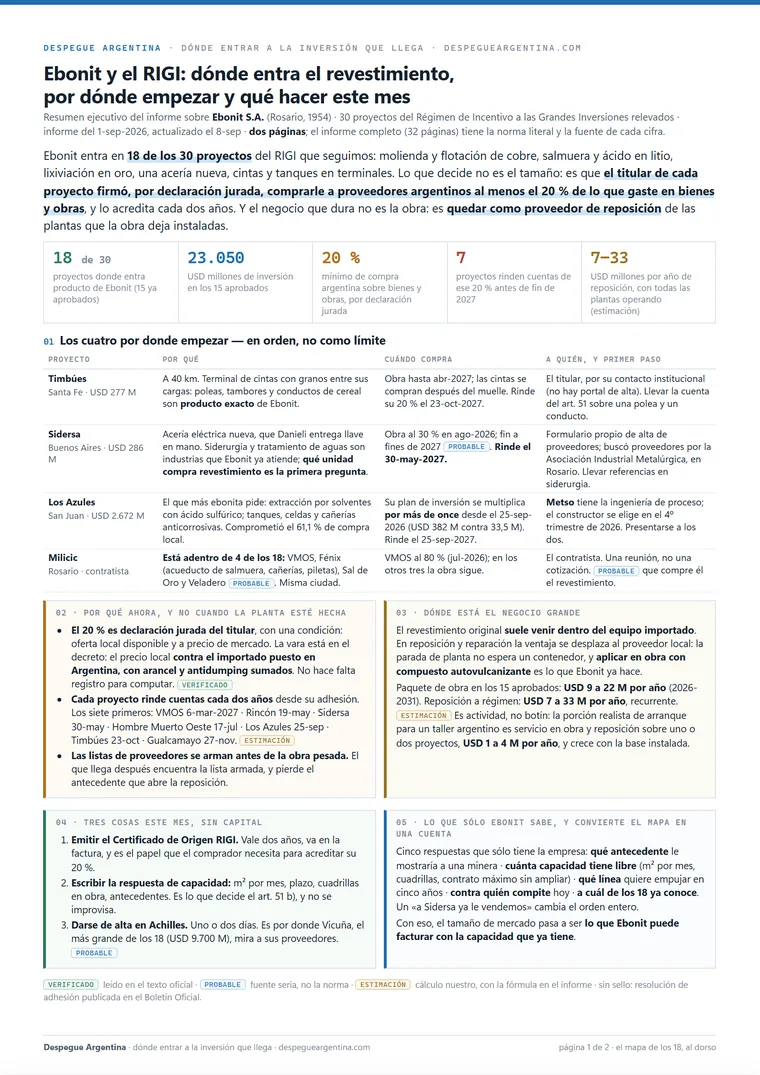 Open the report ↗A real analysis · a real company, open in full →
- 20+ years in technology, 15 of them in data and AI, for clients across Europe and the Americas
- Certified in AI governance (ISO/IEC 42001)
- Machine Learning (Google Cloud)
- Registered expert with the European Commission