Not in force yet
The "lock on the State": fiscal balance by law
Ley 27.798 (2026 Budget), art. 1 — in force; the permanent "lock on the State" still a bill
pendingNATIONAL
Fiscal and monetary anchor
Art. 1 of Ley 27.798 requires closing 2026 with balance or surplus, but it rules only that year: the permanent rule is still a bill.
The other rules on this subject23
Fiscal Package: asset amnesty, moratorium and tax cutsLey 27.743 (Official Gazette Jul 8, 2024)in force
Fiscal anchor: surplus two years in a rowExecutive execution policy on the extended budget (Decreto 1131/2024)in force
Payment to the creditors who stayed out of the swap: closing the 2001-default lawsuitsLey 27.818 (promulgated by Decreto 564/2026, Official Gazette Jul 1, 2026)in force
What changed and who it applies to
What changed
A measure split in two. (1) IN FORCE: art. 1 of Ley 27.798 (2026 Budget) requires execution to close Fiscal Year 2026 with a BALANCED or SURPLUS financial result — but that clause applies ONLY to 2026, it does not institute a permanent rule. (2) STILL A BILL (not in force): the "fiscal rule" as a permanent institute — automatic spending adjustment if revenue falls or spending rises, extension to the entire National Public Sector and criminal sanctions (1-6 years for spending without accredited resources; 3-10 years for irregular BCRA issuance; nullity of violating acts) — lives in the National Commitment for Fiscal and Monetary Stability bill, which was NOT approved: it failed in the Chamber of Deputies on Dec 17, 2025 (it was not put to a vote). The name "lock on the State" describes that stronger half, still without legislative enactment. verif Jan 2, 2026 ↗
In force
The in-force component (art. 1 Ley 27.798) applies from the publication in the Official Gazette on Jan 2, 2026 and only for fiscal year 2026. The permanent component ("lock on the State") has no validity: it remains a bill. verif Jan 2, 2026 ↗
Who it applies to
In-force component: the National Administration, required to execute 2026 with balance or surplus. Projected component: it would reach the entire National Public Sector, the officials who authorize spending without accredited resources and the BCRA authorities for irregular issuance, in addition to disciplining the Legislative Branch (any law with additional spending would require its financing in the following year's budget). prob Dec 9, 2025 ↗
The norm
IN FORCE: Ley 27.798 (2026 National Administration Budget), art. 1 — it requires a balanced or surplus financial result at the close of fiscal year 2026; total spending $148,069,293,526,549 and estimated financial surplus $2,734,029,655,055. BILL (not law): Ley de Compromiso Nacional para la Estabilidad Fiscal y Monetaria (National Commitment to Fiscal and Monetary Stability: automatic structural adjustment plus criminal penalties), which fell in the Chamber of Deputies on Dec 17, 2025 for lack of treatment. verif Dec 26, 2025 ↗
Our reading
The fiscal anchor already has the form of a law: the 2026 Budget requires by art. 1 closing the year with balance or surplus (R1/R6, fiscal anchor). The most ambitious part — shielding zero deficit permanently and penalizing spending and irregular issuance — is still a bill: it failed in the Chamber of Deputies in December 2025. The direction is the promised one; what is missing is turning annual discipline into a structural rule. What we watch is the legislative arithmetic, not the Executive's will. thesis
Analyze this rule for my company
Where it lands, province by province1
Neuquén Institutionalizing the surplus reduces the risk of a populist reversal of spending and sustains the fall in country risk: long-term predictability that the Neuquén megaprojects and their supplier chain value. favorable lowers country risk thesis
First step
Tell us what your company does
Your website is enough to start. We look at what the company does and reply with the projects and the buyers worth looking at.
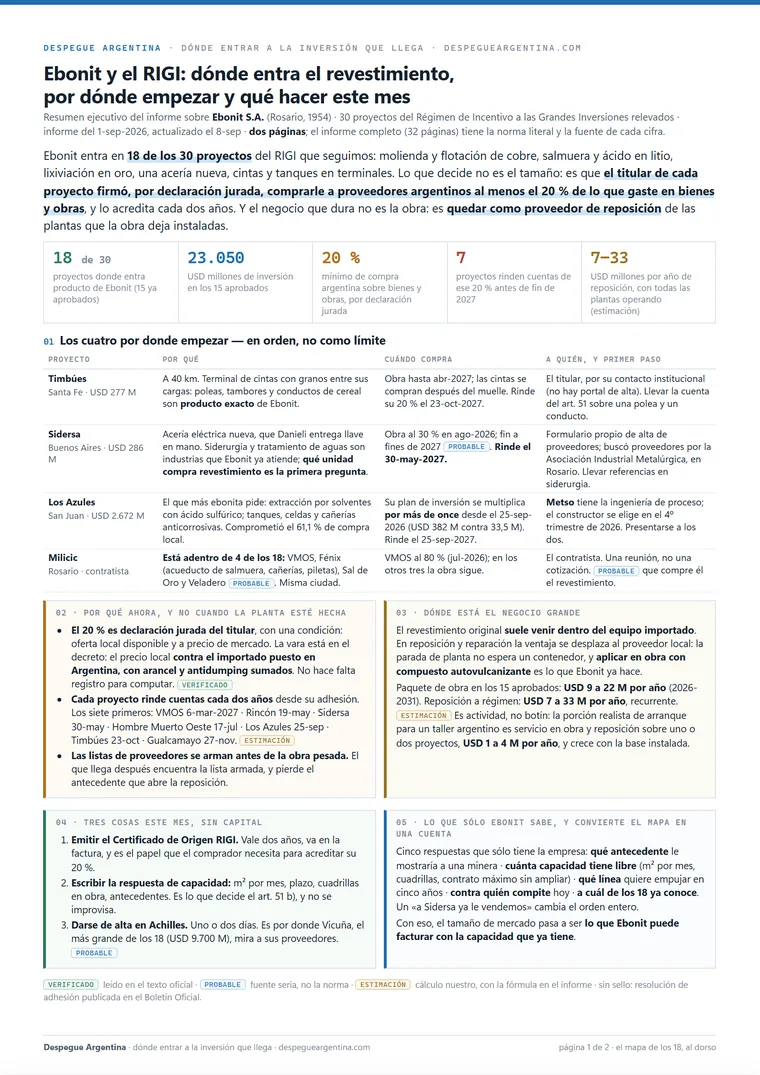 Open the report ↗A real analysis · a real company, open in full →

Analysis and curation: Ignacio Aredez
Head of Despegue
Method and track record →- 20+ years in technology, 15 of them in data and AI, for clients across Europe and the Americas
- Certified in AI governance (ISO/IEC 42001)
- Machine Learning (Google Cloud)
- Registered expert with the European Commission
How to read the seals →
verif primary source · prob primary source pending · unconf a source said it · estim our own calculation · thesis our reading · the date belongs to the datum, at the precision its source allows