Not in force yet
Tax reform: the "Súper IVA" arriving in stages
Executive announcement/design, no law or decree number (not submitted to Congress as of Jun-2026)
pendingNATIONAL
Fiscal and monetary anchor
As of June 2026 it is not a rule: no law, decree or file. What was announced unifies VAT and cuts corporate income tax from 30% to 27%.
The other rules on this subject23
Fiscal Package: asset amnesty, moratorium and tax cutsLey 27.743 (Official Gazette Jul 8, 2024)in force
Fiscal anchor: surplus two years in a rowExecutive execution policy on the extended budget (Decreto 1131/2024)in force
Payment to the creditors who stayed out of the swap: closing the 2001-default lawsuitsLey 27.818 (promulgated by Decreto 564/2026, Official Gazette Jul 1, 2026)in force
What changed and who it applies to
What changed
A tax-simplification program the Executive has been announcing but which as of June 2026 is NOT a rule: it was not submitted to Congress as a bill nor is there a law, decree or file number for the 'comprehensive reform' as a single package. Announced/in-design components: (1) a 'Super VAT' or unified VAT, which would replace provincial Turnover Tax (~78% of the provinces' own revenue in 2025) with a scheme where the Nation retains 9% of VAT revenue and each province sets a provincial rate of up to 12% (total cap 21%, the current level), 'to generate tax competition between provinces' (figures per Chequeado, Nov 1, 2025); (2) a corporate income-tax cut (30%→27% and 35%→31.5%, from 2026) and a simplified regime for natural persons — but these components travel within the Labor Reform bill (tax chapter submitted to the Senate in Dec-2025), not in a standalone 'comprehensive' one; (3) elimination of internal taxes on a broad list of goods (also within the Labor Reform tax chapter, e.g. electronics); (4) elimination of the check tax 'when the fiscal surplus is consolidated'. Caputo explicitly ruled out a single-package reform: the Government advances 'in installments', first legal persons and then natural persons, 'as the numbers allow' (a statement gathered by El Cronista, not by the Chequeado primary source). The declared intention was to send the tax piece from 2026 on, but it did not materialize as a standalone rule. The most novel component (Super VAT) is the least advanced: it requires revenue-sharing reform and the agreement of each provincial legislature. unconf Nov 1, 2025
In force
Not in force: there is no rule in effect. It is an announced program in design. The declared intention was to submit the tax piece to the Chamber of Deputies in 2026 (Milei statements gathered by press, Jan-2026), but as of June 2026 it was neither submitted nor enacted as a standalone comprehensive reform. The dates and the mention of the 2026 IMF horizon come from press (El Cronista / La Nación), not from a primary source. The components that DID advance (corporate income-tax cut, internal taxes) came in through the Labor Reform bill, not this one. unconf Nov 1, 2025
Who it applies to
Once implemented, it would reach companies (corporate income-tax cut 30%→27% and 35%→31.5%; elimination of internal taxes and the check tax), natural persons (a simplified income-tax regime) and, centrally, the provinces: the Super VAT would replace Turnover Tax —the main source of provinces' own resources (~78% in 2025)— with a provincial rate of up to 12% within the unified VAT, which requires revenue-sharing reform and the agreement of each provincial legislature. Per an IDESA analysis cited by Chequeado, only ~8 jurisdictions (CABA, Buenos Aires, Chubut, Córdoba, Mendoza, Neuquén, Santa Cruz and Santa Fe) could self-finance under the new scheme and the ~16 remaining ones would face difficulties. As of June 2026 the impact is prospective: there is no rule creating obligations. unconf Nov 1, 2025
The norm
No rule exists. As of June 2026 the 'comprehensive tax reform' is an announcement/design of the Executive Branch, with no law, decree or file number, and it has not been formally submitted to Congress. Chequeado (Nov 1, 2025) confirms: 'the Executive Branch has not officially submitted its tax reform proposal'. Economy Minister Luis Caputo himself ruled out a single-package reform ('There is not going to be a reform on tax' as one comprehensive piece; 'it is going to be constant', in stages). The cuts to corporate income tax (Ganancias) rates (30%→27% / 35%→31.5% from 2026) were announced but so far have not been anchored in an official primary source; the Súper IVA depends on a revenue-sharing (coparticipación) reform that has not been implemented yet. That is why there is no legal instrument to cite. unconf Nov 1, 2025
Our reading
The direction is correct and consistent with the program: lowering the tax burden and simplifying a system of ~140 taxes (R5, tax cut; R4, deregulation). We trust the course holds —the corporate income-tax cuts and the elimination of internal taxes are the pieces most within reach—. But let's be honest with the reader: as of June 2026 this is an announcement, not a rule; Caputo himself clarified it will come 'in installments', not in a single package. What we watch without assuming bad faith by the Executive is the Super VAT, the most ambitious and slowest piece: it clashes with revenue-sharing and needs the yes of each provincial legislature (R7, national-provincial tension). Gradualism limits the fiscal risk, but it also postpones the prize. thesis
Analyze this rule for my company
Where it lands, province by province1
Neuquén The Super VAT would replace Turnover Tax with a provincial rate within the unified VAT and would force rediscussing revenue-sharing. Neuquén, with a robust fiscal base from royalties and Vaca Muerta revenue, is among the jurisdictions best positioned to self-finance and to set a competitive rate that attracts investment to the satellite ecosystem; the corporate income-tax cut and the end of the check tax would cheapen the operating cost of the basin's SMEs and service companies. Risk: the rediscussion of revenue-sharing and the transition cost can generate national-provincial friction until the scheme is agreed. favorable better export netback thesis
First step
Tell us what your company does
Your website is enough to start. We look at what the company does and reply with the projects and the buyers worth looking at.
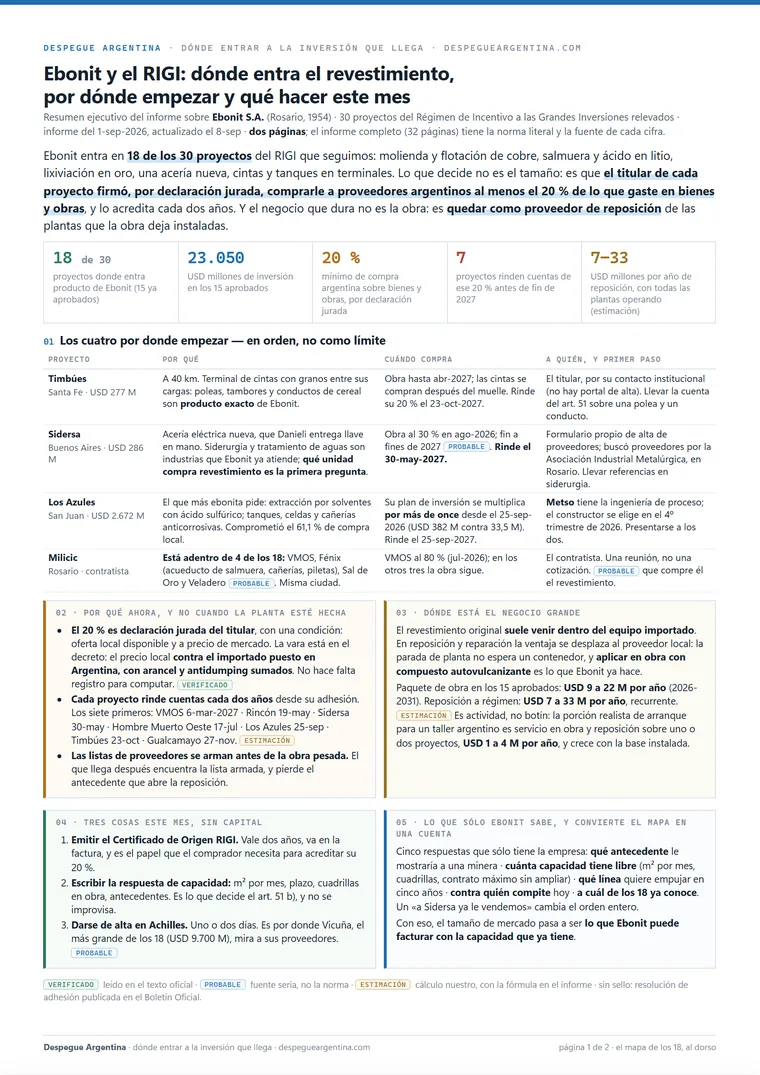 Open the report ↗A real analysis · a real company, open in full →

Analysis and curation: Ignacio Aredez
Head of Despegue
Method and track record →- 20+ years in technology, 15 of them in data and AI, for clients across Europe and the Americas
- Certified in AI governance (ISO/IEC 42001)
- Machine Learning (Google Cloud)
- Registered expert with the European Commission
How to read the seals →
verif primary source · prob primary source pending · unconf a source said it · estim our own calculation · thesis our reading · the date belongs to the datum, at the precision its source allows