In force since Jan 2, 2026
Budget 2026: the first one voted in the Milei era
Ley 27.798
in forceNATIONALApplies the same nationwide
Fiscal and monetary anchor
Ley 27.798 sets spending at $148 trillion and orders 2026 to close with a financial surplus, projected at $2.73 trillion.
The other rules on this subject23
Fiscal Package: asset amnesty, moratorium and tax cutsLey 27.743 (Official Gazette Jul 8, 2024)in force
Fiscal anchor: surplus two years in a rowExecutive execution policy on the extended budget (Decreto 1131/2024)in force
Payment to the creditors who stayed out of the swap: closing the 2001-default lawsuitsLey 27.818 (promulgated by Decreto 564/2026, Official Gazette Jul 1, 2026)in force
What changed and who it applies to
What changed
Congress enacts the first voted General National Administration Budget of the Milei administration: total spending of $148,069,293,526,549 and a projected surplus financial result of $2,734,029,655,055. Art. 1 orders closing fiscal year 2026 with a balanced or surplus financial result. It replaces two consecutive years (2024 and 2025) of governing with the 2023 budget extended by decree. verif Dec 26, 2025 ↗
In force
Fiscal Year 2026 (in force from Jan 1, 2026; published in the Official Gazette on Jan 2, 2026, with no veto or observations indicated in the text). verif Jan 2, 2026 ↗
Who it applies to
The entire National Public Administration: National Public Sector bodies, spending allocations and resources by jurisdiction. Indirectly, every economic agent in the country, because it sets the framework of spending, resources and public investment for 2026 with a balanced/surplus financial ceiling. verif Jan 2, 2026 ↗
The norm
Ley 27.798, passed by the Congreso de la Nación on Dec 26, 2025, published in the Boletín Oficial on Jan 2, 2026 (notice No. 15/26; internal detalleAviso ID 337027). 71 articles in 11 chapters. Official title in the BO: 'PRESUPUESTO'. verif Jan 2, 2026 ↗
Our reading
After two years governing with the 2023 budget extended by decree, the ruling party gets Congress to vote its first budget, and it does so with the fiscal rule fixed in the articles: fiscal year 2026 must close balanced or in surplus (art. 1). It is the fiscal anchor (R1/R6) moving from cash management to a voted law, which gives the course predictability and institutional legitimacy. What to watch without presuming bad faith: the effective execution of spending and that the projected surplus holds against spending pressures over the year. thesis
Analyze this rule for my company
First step
Tell us what your company does
Your website is enough to start. We look at what the company does and reply with the projects and the buyers worth looking at.
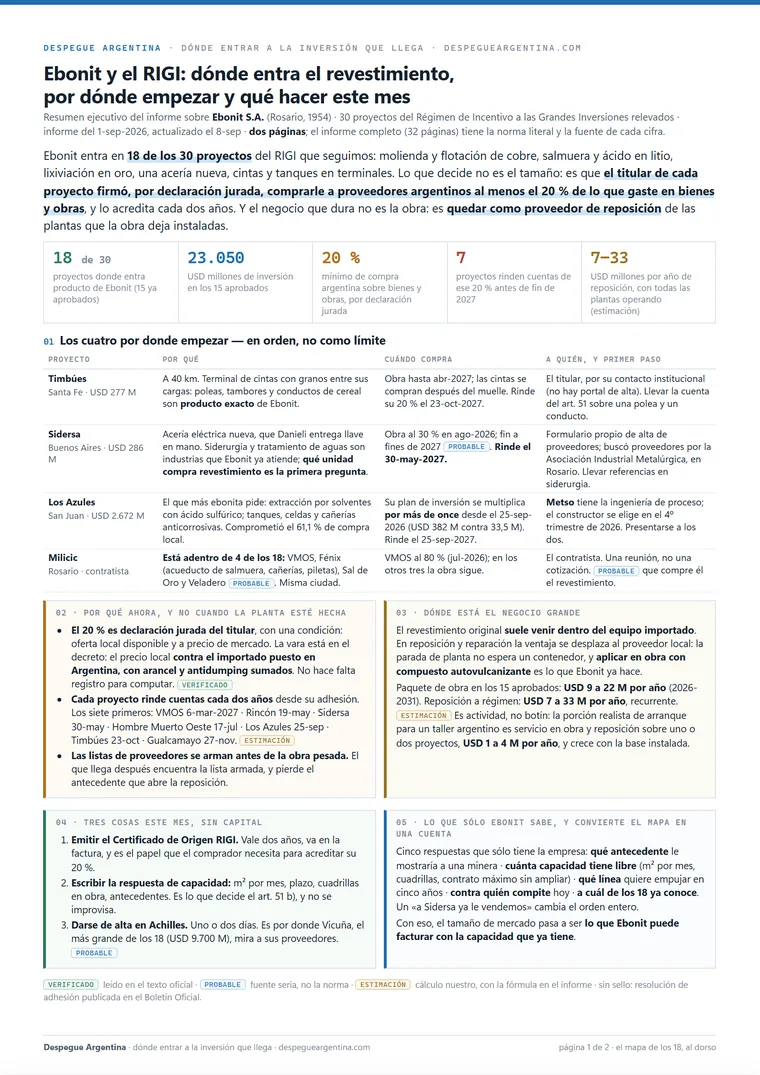 Open the report ↗A real analysis · a real company, open in full →

Analysis and curation: Ignacio Aredez
Head of Despegue
Method and track record →- 20+ years in technology, 15 of them in data and AI, for clients across Europe and the Americas
- Certified in AI governance (ISO/IEC 42001)
- Machine Learning (Google Cloud)
- Registered expert with the European Commission
How to read the seals →
verif primary source · prob primary source pending · unconf a source said it · estim our own calculation · thesis our reading · the date belongs to the datum, at the precision its source allows