In force since Mar 6, 2026
Riders and app drivers: a regime of their own
Ley 27.802, ss. 119 to 128 (Title XII)
in forceNATIONALApplies the same nationwide
Labor
Derives from: The comprehensive labor reform is now law
The platform regime: independent provider, thirteen rights, accident insurance with minimum content, and the Civil Code as the fallback rule.
The other rules on this subject21
The comprehensive labor reform is now lawLey 27.802 (Official Gazette, Mar 6, 2026, promulgated by Decreto 137/2026)in force
Hire formally for 4 years with employer contributions of 2%+3%Decreto 315/2026 (Official Gazette, May 4, 2026), Ley 27.802 Title XXin force
Labor reform regulated: registration with ARCA, digital pay slip and the end of ultra-activityDecreto 407/2026 (Official Gazette, Jun 1, 2026)in force
What changed and who it applies to
What changed
It creates the Regime for Private Passenger Mobility and/or Delivery Services using technological platforms — ten sections that move the debate out of "is this person an employee or not?" and write a statute of its own. The central figure is the "independent provider": a natural person who agrees to provide the service "independently" (s. 120). The section that defines the whole regime is the last one: for matters not provided for, the relationship between the platform and the provider is governed on a fallback basis by the Código Civil y Comercial, not by labour law (s. 128). The provider has thirteen listed rights, and section 126 states before listing them that none of them "implies any indication of an employment relationship, subordination or dependence": refusing orders without justification · receiving an explanation if the platform cuts off access, with a right of reply to a human operator · data portability in a structured format · two free training courses — platform use and road safety — whose costs the platform bears · a personal accident insurance provided by the platform, with minimum cover for accidental death, total or partial permanent disability arising from the service, medical and pharmacy costs and funeral costs · 100% of the tip · connecting with no minimum frequency required · registering without being obliged to connect · disconnecting without prior notice · choosing hours, route and means of transport. On the other side, the provider must be registered with the tax authorities and pay their own contributions, which are what give access to the Universal Basic Benefit, disability retirement, survivor's pension and the National Health Insurance System (s. 125). And on the insurance there is a sentence worth reading in full: "responsibility for providing this insurance and its associated costs shall be freely agreed between the parties involved, without establishing exclusive responsibility for either of them". verif Mar 6, 2026 ↗
In force
In force with the law, from 6 March 2026, across the whole country (s. 122). Section 127 leaves the enforcement authority to the implementing regulation, and Decreto 407/2026 (s. 3) has already designated it: the Secretariat of Transport of the Ministerio de Economía and the Secretariat of Labour, Employment and Social Security of the Ministerio de Capital Humano, each within its own remit. verif Mar 6, 2026 ↗
Who it applies to
To anyone delivering or driving through an app, which in the boom towns is one of the first routes into an income of one's own: the law tells them their work is independent, lists thirteen rights, and imposes one obligation that is not minor — registering and paying their own contributions, because that, and not the platform, is where their pension, disability cover and health insurance come from. And to anyone wanting to set up a platform: the regime gives written rules of the game — information to the provider, a digital complaints mechanism, human operator support, training at the platform's cost, accident insurance — in exchange for removing the risk that every dispute is argued as an employment relationship. And it opens an insurance market that previously had no shape: personal accident cover for riders and drivers, with minimum content defined by law. Who pays is left to agreement between the parties; that it must exist is not. verif Mar 6, 2026 ↗
The norm
Ley 27.802 on labour modernisation, Title XII ("Regime for Private Passenger Mobility and/or Delivery Services using technological platforms"), sections 119 to 128. Enacted on 27 Feb 2026, promulgated by Decreto 137/2026 and published in the Boletín Oficial on 6 Mar 2026. verif Mar 6, 2026 ↗
Our reading
thesis It is worth looking at where the law put each cost, because that is where its logic sits: the platform pays for training, no argument; 100% of the tip goes to the provider, no argument; and pension and health contributions are paid by the provider, no argument. The only item left to negotiate is the accident insurance — the most expensive one, and the only place where the text steps aside and says «freely agreed between the parties». ⇒ That is not an oversight: it is the price the law paid to be able to state, in the same section, that none of this indicates employment. Loading the insurance exclusively onto the platform would have brought back through the window the dependence the whole regime pushes out through the door. And from that comes the concrete opportunity: there is now a personal accident policy with minimum content set by law, compulsory in its existence and free in its funding, for a universe of tens of thousands of people. That product has to be sold, and someone will sell it. What could break this reading: that the insurance stays on paper even though the enforcement authority has already been designated (Decreto 407/2026, s. 3), and that the «independent» classification is litigated anyway, in courts where the fallback rule is the Código Civil but the judge is a labour judge. thesis
Analyze this rule for my company
First step
Tell us what your company does
Your website is enough to start. We look at what the company does and reply with the projects and the buyers worth looking at.
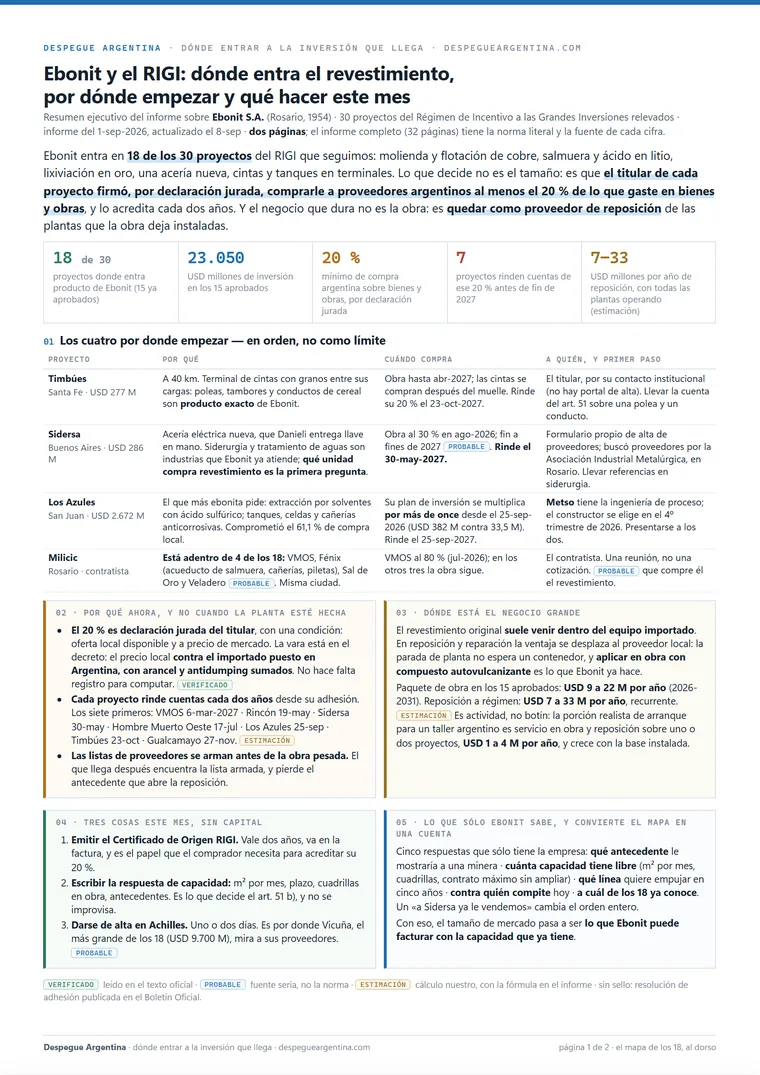 Open the report ↗A real analysis · a real company, open in full →

Analysis and curation: Ignacio Aredez
Head of Despegue
Method and track record →- 20+ years in technology, 15 of them in data and AI, for clients across Europe and the Americas
- Certified in AI governance (ISO/IEC 42001)
- Machine Learning (Google Cloud)
- Registered expert with the European Commission
How to read the seals →
verif primary source · prob primary source pending · unconf a source said it · estim our own calculation · thesis our reading · the date belongs to the datum, at the precision its source allows