In force since Aug 17, 2012
Fracking water and waste: treating flowback is mandatory
Decreto 1483/12 + Decreto 2263/15 + Prov. SSA 585/22
in forcePROVINCIAL
Energy and natural resources
Neuquén's Decreto 1483/12 requires treating all flowback water before reuse or disposal, and bans discharging it into watercourses or soil.
The other rules on this subject43
The State reorders the trunk gas pipelines and forces firm transportation contracts to be redrawnRes. SE 66/2026 (Official Gazette, Mar 13, 2026) + Res. ENARGAS 409/2026in execution
Hydrocarbons: the pre-export local offer fallsSE Res. 166/2026 (Official Gazette, Jul 22, 2026)in force
What changed and who it applies to
What changed
Neuquén regulates the water cycle and the waste of unconventional activity with three chained rules. (1) Decreto 1483/12 (Annex XVI, regulating the environmental Ley 1875) requires a prior Environmental License for every project (art. 3); prohibits using groundwater fit for human consumption or irrigation in drilling and completion (art. 9); requires treating the return water (flowback) in its entirety until it meets the discharge parameters, with three possible destinations: reuse in the oil industry, reuse in irrigation tied to a productive or environmental recomposition project approved by the authority, or final disposal in a sink well (art. 10); prohibits discharging it into surface water bodies under any condition and storing it in open-air containers (art. 11), and requires waterproofed pits for completion water (art. 13). Its recitals add that every flowback-treatment methodology must be approved by the Environmental Authority before being applied verif. (2) Decreto 2263/15 classifies as special waste the flowback (Y9), drilling cuttings (Y13 and Y14), frac sand (Y10) and drilling muds (Y20); requires permanent treatment and final-disposal plants to be located outside the municipal district, 8 km or more from urban areas (art. 39), and requires their projects to be signed by professionals registered in the Provincial Registry of Environmental Service Providers (REPPSA) (art. 40) verif. (3) Disposición 585/22 of the Environmental Undersecretariat closes the circuit: its art. 1 establishes that «every reuse and disposal alternative for the output of treating Special Waste identified as Y8 (water with hydrocarbons) and Y9 (return/flowback water) must be authorized by the Competent Authority», and its art. 2 that this authorization is requested by the generator of the waste and is issued «upon prior accreditation of compliance with the parameters established in the Applicable Rules for the intended use»; its recitals repeat the three destinations of art. 10 of Decreto 1483/12 verif. That is, case-by-case authorization, with the burden of proof on the generator and tied to the intended use, not a generic clearance of the technology thesis. verif 2012-2022 ↗
In force
Decreto 1483/12 in force since 2012 (90 days after its publication); Decreto 2263/15 since November 2015; Provision SSA 585/22 since May 2022. verif Aug 17, 2012 ↗
Who it applies to
Shale and tight operators and concessionaires, who must treat all flowback and request case-by-case authorization to reuse or dispose of it; and, above all, the providers of water treatment, flowback management, cuttings disposal and environmental services: their permanent plants must be outside the municipal district and 8 km or more from urban areas, their projects must be signed by professionals registered in the provincial registry of environmental service providers, and their treatment methods need the environmental authority's approval prob. The rule generates forced and recurring demand, but with concrete authorization barriers thesis. prob 2015-2026 ↗
The norm
Decreto provincial 1483/12 (Annex XVI, 'Normas y Procedimientos para Exploración y Explotación de Reservorios No Convencionales' [rules and procedures for the exploration and production of unconventional reservoirs], Ley reglamentario 1875 on the environment); Decreto provincial 2263/15 (special waste regime, Ley reglamentario 1875); Disposición SSA 585/22 of the Subsecretaría de Ambiente (Environment Undersecretariat). Water: Ley 899 (the Water Code) and Decreto 790/99, whose current enforcement authority is the Subsecretaría de Recursos Hídricos (hidricosneuquen.gob.ar, under the Ministerio de Turismo, Ambiente y Recursos Naturales, confirmed on its official site on Jul 18, 2026) — the name 'Dirección de Recursos Hídricos' belonged to the original text of Ley 899/1975. Detail on Disp. SSA 585/22 (read in the original BO, Jul 16, 2026): it was issued on May 9, 2022 by the Environment Undersecretary (Lic. Juan de Dios Lucchelli) under case file EX-2022-00577931-NEU-SADM#SAMB and published in Boletín Oficial Nº 4038 of May 13, 2022 (pp. 59-60); it is a supplementary rule issued by the Undersecretariat in its capacity as enforcement authority of Ley 1875 (not an Executive Branch decree), and its recitals rest on Ley 1875 and Decretos reglamentarios 2656/99, 1483/12 and 2263/15. verif 2012-2022 ↗
Our reading
For the water- and waste-treatment provider, this regulation is the best client there is: the law requires treating the flowback (everything that comes back from the well), prohibits dumping it into rivers and demands disposing of the cuttings at certified plants. That is demand that does not depend on the price of oil: as long as there is fracking, there is treatment. The flip side is the barrier, which also favors whoever is already inside: the project must be signed by a professional registered in the REPPSA, the plant must be installed 8 km from the towns and the Environmental Undersecretariat must approve your technology. Whoever complies first keeps a captive market. thesis
Analyze this rule for my company
Where it lands, province by province1
Neuquén It creates forced and recurring regulatory demand for environmental services (flowback treatment, cuttings disposal) that sustains our water/waste-treatment satellite opportunity, with entry barriers (REPPSA, location, technology approval) that protect the already-authorized provider. favorable thesis
Which markets depend on this rule2
These niches list this rule among the ones that condition them.
First step
Tell us what your company does
Your website is enough to start. We look at what the company does and reply with the projects and the buyers worth looking at.
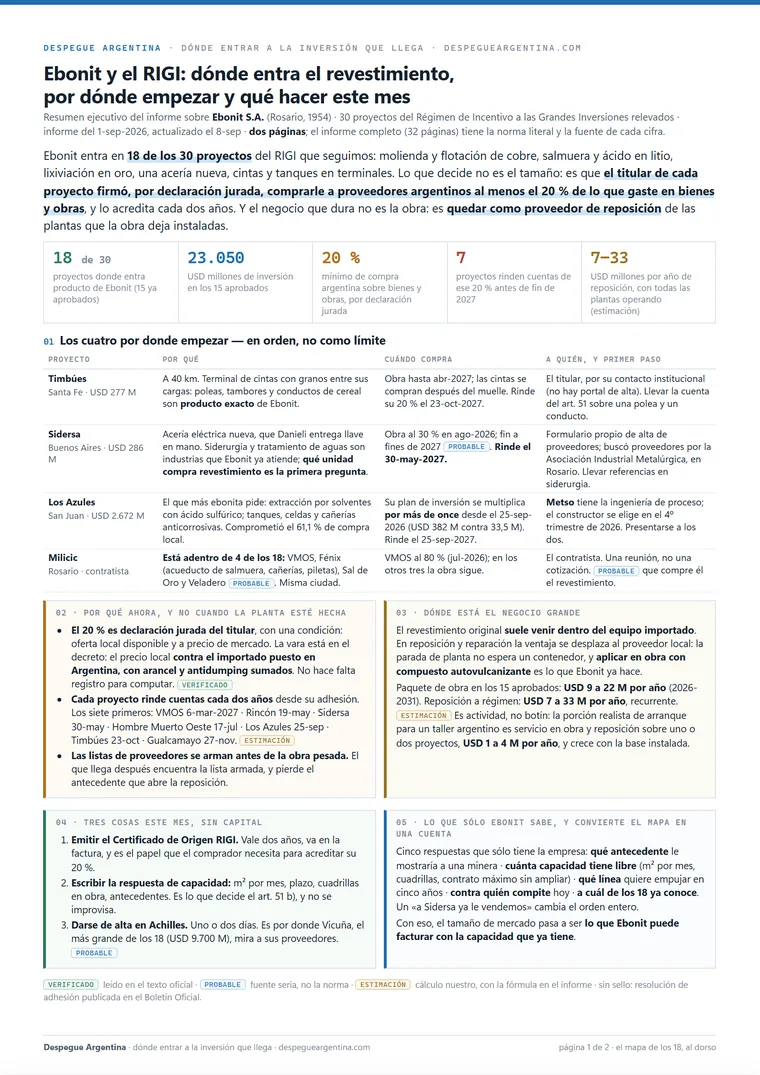 Open the report ↗A real analysis · a real company, open in full →

Analysis and curation: Ignacio Aredez
Head of Despegue
Method and track record →- 20+ years in technology, 15 of them in data and AI, for clients across Europe and the Americas
- Certified in AI governance (ISO/IEC 42001)
- Machine Learning (Google Cloud)
- Registered expert with the European Commission
How to read the seals →
verif primary source · prob primary source pending · unconf a source said it · estim our own calculation · thesis our reading · the date belongs to the datum, at the precision its source allows