In force since Mar 8, 2025
Reiteration: pretrial detention for offenders with open cases
Ley 27.785
in forceNATIONALApplies the same nationwide
State, institutions and security
Ley 27.785 adds art. 222 bis to the Código Procesal: having another open case now counts as procedural risk grounds for pretrial detention.
The other rules on this subject27
Royalties are shared by population, not by where the field isLey provincial 2148 (enacted on 15-Nov-1995)in force
Private property: expropriation costs more and eviction speeds up (half-sanctioned)Bill PE-13/2026 (Mensaje 22/26) — first-round approval in the Senate; now in the Chamber of Deputies (file 0032-S-2026)pending
What changed and who it applies to
What changed
It toughens the criminal regime against repeat offending. It creates the concept of 'criminal reiteration' (new art. 222 bis of the Federal Criminal Procedure Code): being simultaneously charged in another case or cases becomes a procedural-risk criterion that enables pretrial detention. It reforms recidivism (art. 50 CP): someone convicted two or more times to a custodial sentence with the first conviction final is considered a recidivist. And the consolidation of sentences (art. 58 CP) by arithmetic sum of the imposed penalties. It also amends the Federal Criminal Procedure Code (arts. 17, 210, 218) and the Criminal Procedure Code ley 23.984 (arts. 280, 312, 319). verif Mar 7, 2025 ↗
In force
03/08/2025, the day after its publication in the Official Gazette. The legal text itself provides: 'This law will take effect the day after its publication'. verif Mar 8, 2025 ↗
Who it applies to
Defendants with concurrent criminal cases and people with criminal records nationwide: the law amends the National Criminal Code and the federal and national criminal-procedure codes, so it reaches the federal and national criminal jurisdictions. Indirectly, citizens and companies as beneficiaries of the tougher regime against repeat crime. verif Mar 7, 2025 ↗
The norm
Ley 27.785, passed by the national Congress on Feb 20, 2025 and published in the Boletín Oficial on Mar 7, 2025 (notice 322213, BO N° 13187/25). Official title in the BO: 'Código Penal - Modificación' (Criminal Code - Amendment); 'Ley de Reiterancia' is the popular, press-given name. The BO notice transcribes the text passed by Congress; its body states no enacting decree number (the attribution to a 'Decreto 173/2025' does not come from this primary source and remains unconfirmed). verif Mar 7, 2025 ↗
Our reading
The program delivers on the legal security it promised: reiteration and the toughening of recidivism give the courts a concrete tool to keep the offender with several open cases behind bars, a signal of predictability for those who invest and produce (R3, stability and firm rules of the game). What is worth watching, without assuming bad faith, is the judicial front: there are constitutionality challenges to reiteration in specific cases, though to date there has been no general suspension or repeal and the law remains fully in force. thesis
Analyze this rule for my company
First step
Tell us what your company does
Your website is enough to start. We look at what the company does and reply with the projects and the buyers worth looking at.
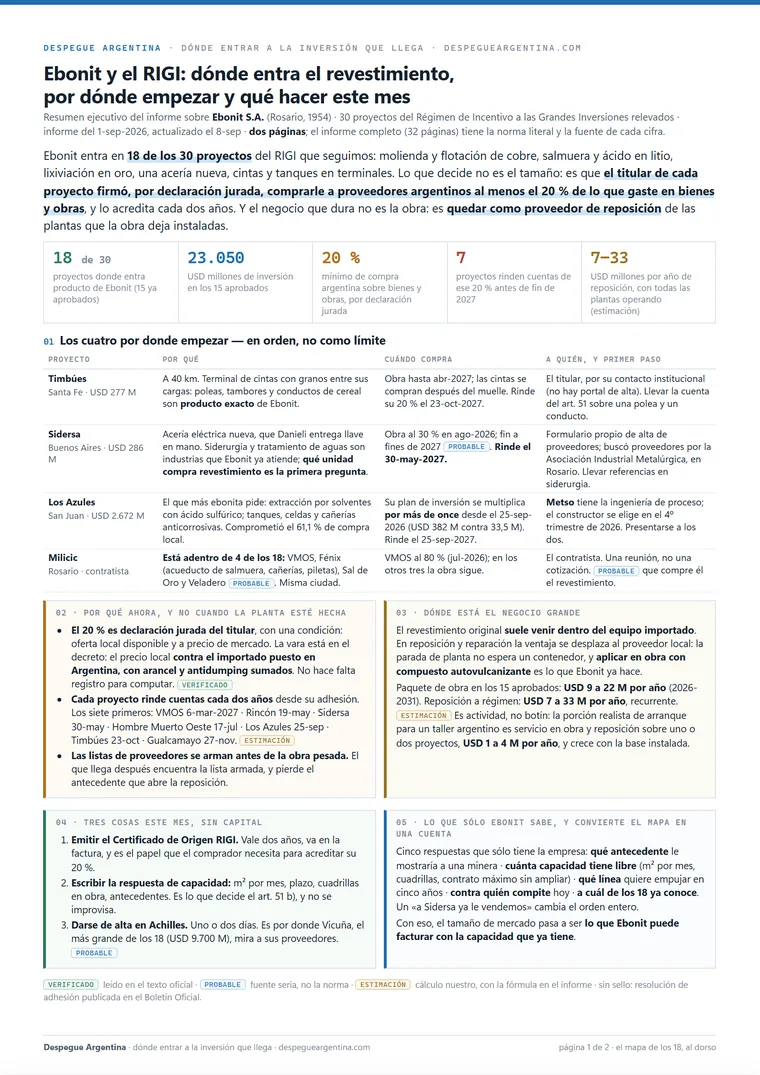 Open the report ↗A real analysis · a real company, open in full →

Analysis and curation: Ignacio Aredez
Head of Despegue
Method and track record →- 20+ years in technology, 15 of them in data and AI, for clients across Europe and the Americas
- Certified in AI governance (ISO/IEC 42001)
- Machine Learning (Google Cloud)
- Registered expert with the European Commission
How to read the seals →
verif primary source · prob primary source pending · unconf a source said it · estim our own calculation · thesis our reading · the date belongs to the datum, at the precision its source allows