In force since Jan 2, 2026
Fiscal Innocence: less prison exposure and less tax-agency pressure for the compliant
Ley 27.799
in forceNATIONALApplies the same nationwide
Fiscal and monetary anchor
Ley 27.799 raises the simple evasion threshold from $1.5 M to $100 M and the aggravated one to $1,000 M, and creates a simplified income tax return.
The other rules on this subject23
Fiscal Package: asset amnesty, moratorium and tax cutsLey 27.743 (Official Gazette Jul 8, 2024)in force
Fiscal anchor: surplus two years in a rowExecutive execution policy on the extended budget (Decreto 1131/2024)in force
Payment to the creditors who stayed out of the swap: closing the 2001-default lawsuitsLey 27.818 (promulgated by Decreto 564/2026, Official Gazette Jul 1, 2026)in force
What changed and who it applies to
What changed
It reforms the Criminal Tax Regime and Ley 11.683. (1) It raises the criminal floors: simple evasion from $1,500,000 to $100,000,000 and aggravated evasion from $15,000,000 to $1,000,000,000, with annual UVA adjustment from 2027. (2) It creates an optional Simplified Income-Tax sworn-statement regime for natural persons (income <= $1,000,000,000 and net worth <= $10,000,000,000) with full releasing effect for the period's tax, a presumption of accuracy and a limit on ARCA audits except for significant discrepancy. (3) It adds extinction of criminal action by payment (debt + interest + 50%, within 30 business days after being charged, once only) and reduces from 5 to 3 years the statute of limitations for compliant taxpayers in national taxes. The OFFICIAL title in the Official Gazette is 'Criminal Tax Regime'; 'Fiscal Innocence' is the popular/professional name. verif Jan 2, 2026 ↗
In force
Jan 2, 2026: the law 'will take effect on the day of its publication' in the Official Gazette. It does not depend on subsequent regulation (a regulatory decree reported for Feb-2026, unconfirmed in the primary source). verif Jan 2, 2026 ↗
Who it applies to
Natural and legal persons with tax obligations, social-security contributors and withholding/collection agents. The Simplified sworn-statement regime specifically targets natural persons and undivided estates with income <= $1,000,000,000 and net worth <= $10,000,000,000. verif Jan 2, 2026 ↗
The norm
Ley 27.799, passed on Dec 26, 2025, enacted and published in the Boletín Oficial on Jan 2, 2026 (notice 337029). Official title: 'Régimen Penal Tributario' (criminal tax regime). verif Jan 2, 2026 ↗
Our reading
The State raises the bar for criminal prosecution and gives the compliant taxpayer a simple path with releasing effect and less auditing: less criminal risk and less friction to declare (R4 deregulation, R5 lower effective burden). In the bullish reading, it lowers the cost of coming clean and operating by the book, which tends to formalize savings today outside the system. What we watch: that the regulation and ARCA follow the law's spirit and do not reintroduce friction through the window. thesis
Analyze this rule for my company
What it leads to1
Inocencia Fiscal II: raises the threshold above which the tax agency can challenge a return (passed, not yet published)Passed by the Senate on Sep 17, 2026 (44-23) · not published in the Boletín Oficial as of Oct 2pending
First step
Tell us what your company does
Your website is enough to start. We look at what the company does and reply with the projects and the buyers worth looking at.
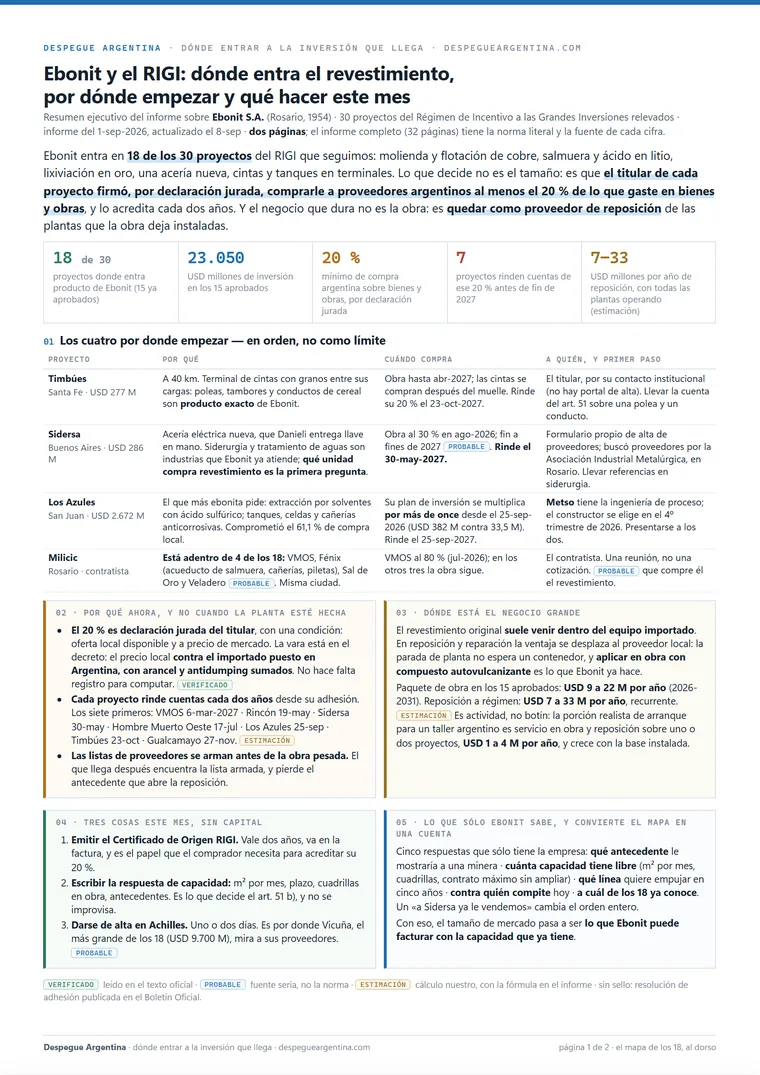 Open the report ↗A real analysis · a real company, open in full →

Analysis and curation: Ignacio Aredez
Head of Despegue
Method and track record →- 20+ years in technology, 15 of them in data and AI, for clients across Europe and the Americas
- Certified in AI governance (ISO/IEC 42001)
- Machine Learning (Google Cloud)
- Registered expert with the European Commission
How to read the seals →
verif primary source · prob primary source pending · unconf a source said it · estim our own calculation · thesis our reading · the date belongs to the datum, at the precision its source allows