In force since May 27, 2026
Setting up the local subsidiary of a foreign company gets faster and cheaper
IGJ Resolución General 4/2026 (Official Gazette May 26, 2026)
in forceNATIONALApplies the same nationwide
Market deregulation
RG IGJ 4/2026 repeals 12 articles of the foreign-company regime and accepts the registration decision in digital form.
The other rules on this subject40
Mega-DNU 70/2023: repeals the Rentals, Shelves and Supply lawsDecreto 70/2023 (DNU-2023-70-APN-PTE)in force
The IGJ digitizes companies' financial statementsIGJ General Res. 9/2026 (RESOG-2026-9-APN-IGJ#MJ), Official Gazette Jul 2, 2026in force
What changed and who it applies to
What changed
The Inspección General de Justicia (IGJ, Argentina's corporate registry) simplifies the registration of companies incorporated abroad (Articles 118/123 of Ley 19.550). It repeals 12 articles and amends another 13 of the previous regime (IGJ Resolución General 15/24). Two central changes: (1) it accepts the resolution of the corporate body approving the registration in digital format reproduced on paper, with a Hague Apostille, instead of requiring notarial or consular certification; (2) it enables 'joint processing': when a foreign company registers in order to take part in a newly formed local company, both filings —the registration of the foreign company and the incorporation of the local one— are submitted and processed in a single case file, rather than two sequential ones. verif May 26, 2026 ↗
In force
May 27, 2026, the date the resolution itself sets (published in the Boletín Oficial on May 26, 2026). verif May 27, 2026 ↗
Who it applies to
Foreign companies seeking to invest in Argentina by forming or taking part in a local company (the typical vehicle of a foreign investor, including the VPUs and dedicated branches that RIGI projects set up), and the professionals who handle their registration before the IGJ. It cuts the cost, the time and the number of sequential filings needed to stand up the local corporate structure of a foreign investment. verif May 26, 2026 ↗
The norm
Resolución General 4/2026 of the Inspección General de Justicia (IGJ, the corporate registry), issued on May 22, 2026 and published in the Boletín Oficial on May 26, 2026 (notice 342361), in force since May 27, 2026. It repeals and amends the regime of RG IGJ 15/24 on companies incorporated abroad. verif May 26, 2026 ↗
Our reading
Corporate deregulation aimed squarely at the administrative bottleneck of investing from abroad: the digital signature plus apostille replaces the notarial/consular round trip, and joint processing removes the need to wait for the foreign parent's registration before incorporating the local company that executes the project. It is the same filing that any VPU or dedicated branch of a RIGI project goes through, at a different scale — part of the State-simplification agenda of the Sturzenegger program, applied this time to the entry point of foreign capital. thesis
Analyze this rule for my company
First step
Tell us what your company does
Your website is enough to start. We look at what the company does and reply with the projects and the buyers worth looking at.
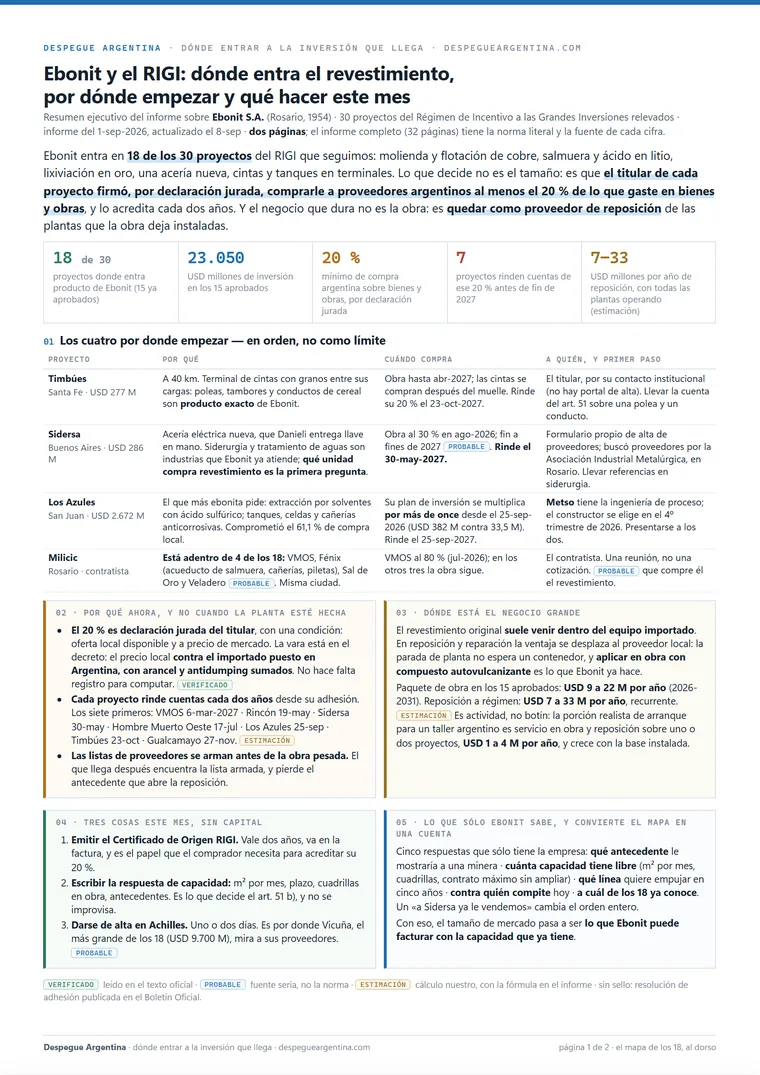 Open the report ↗A real analysis · a real company, open in full →

Analysis and curation: Ignacio Aredez
Head of Despegue
Method and track record →- 20+ years in technology, 15 of them in data and AI, for clients across Europe and the Americas
- Certified in AI governance (ISO/IEC 42001)
- Machine Learning (Google Cloud)
- Registered expert with the European Commission
How to read the seals →
verif primary source · prob primary source pending · unconf a source said it · estim our own calculation · thesis our reading · the date belongs to the datum, at the precision its source allows