In force since Jul 1, 2026
Industrial export taxes to zero: chemicals, metals and autos export duty-free
Decreto 566/2026 (Official Gazette Jul 1, 2026)
in forceNATIONAL
Trade opening
Decreto 566/2026 takes the export duty to 0% for chemicals, plastics, rubber, steel and non-ferrous metals, and phases in the rest of industry.
The other rules on this subject19
Imports: prior approval to bring in goods is eliminatedRes. 1/2023 Trade Secretariat + Joint GR AFIP-Trade 5466/2023 (Official Gazette Dec 26, 2023)in force
Mercosur–EU ratified: 450 million consumers open up to agriculture and industryLey 27.800 (Official Gazette Feb 26, 2026); provisional application from May 1, 2026in force
Argentina and the US sign their first trade and investment agreementBilateral agreement signed Feb 5, 2026 (no number; pending congressional approval)pending
What changed and who it applies to
What changed
The decree reorders industrial export duties (DEX) into THREE schemes: (1) Annex I — IMMEDIATE 0% rate for the listed NCM tariff lines: inorganic and organic chemicals (Chapters 28-29), fertilizers (31), plastics (39), rubber (40), steel (72-73), non-ferrous metals — aluminum, copper, zinc, tin — (74-81) and much of the automotive chain (Chapter 87, hybrids and EVs included); (2) Annex II — a phased reduction for a second group (chemicals, plastics, rubber, automotive), with rates starting in the 4.50%/3.00% range and falling monthly to 0% on Jun 1, 2027; (3) Annex III — petroleum oils and derivatives (headings 2707.30.00, 2707.99.90, 2710.12.10/30/90, 2710.19.19): its own schedule starting at ~7.3333%, which replaces the 8% of Decreto 488/2020, also converging to 0%. Total universe per the official communiqué: ~1,000 NCM tariff lines currently taxed mostly between 3% and 4.5%. verif Jul 1, 2026 ↗
In force
2026-07-02 (Arts. 2 and 3: 2026-07-01) verif Jul 1, 2026 ↗
Who it applies to
Industrial exporters in chemicals and petrochemicals (polyethylene, polypropylene, PVC, methanol), steel and non-ferrous metals, fertilizers, rubber and the entire automotive chain (automakers and parts makers). It improves the netback of SME suppliers and opens up work for foreign-trade and tariff-classification services. verif Jul 1, 2026 ↗
The norm
Decreto 566/2026 of the national Executive Branch, issued on Jun 30, 2026 and published in the Boletín Oficial on Jul 1, 2026. General entry into force from Jul 2, 2026; arts. 2° (Anexo II) and 3° (Anexo III, oils) apply from Jul 1, 2026. verif Jul 1, 2026 ↗
Our reading
Argentina finishes sweeping away export taxes on industrial goods: chemicals, petrochemicals, steel, aluminum, copper, fertilizers and the automotive chain now export free of export duties or converge to 0% before June 2027. A direct improvement in the netback of domestic value added: the export opening is state policy, not an isolated gesture (R3/R4). thesis
Analyze this rule for my company
Where it lands, province by province2
Neuquén Annex III covers naphthas/solvents/oils derived from Vaca Muerta crude and Annex I frees downstream petrochemicals (methanol, polymers) from export duties: it improves the netback of processing Neuquén gas and crude at the source and reinforces the in-basin value-added thesis. favorable better export netback thesis
Río Negro The 0% for chemicals/fertilizers and metals improves the business case for industrialization along the corridor (the Cinco Saltos hub, export-oriented metalworking) and for value-added projects on the gas flowing toward the San Matías Gulf. favorable better export netback thesis
First step
Tell us what your company does
Your website is enough to start. We look at what the company does and reply with the projects and the buyers worth looking at.
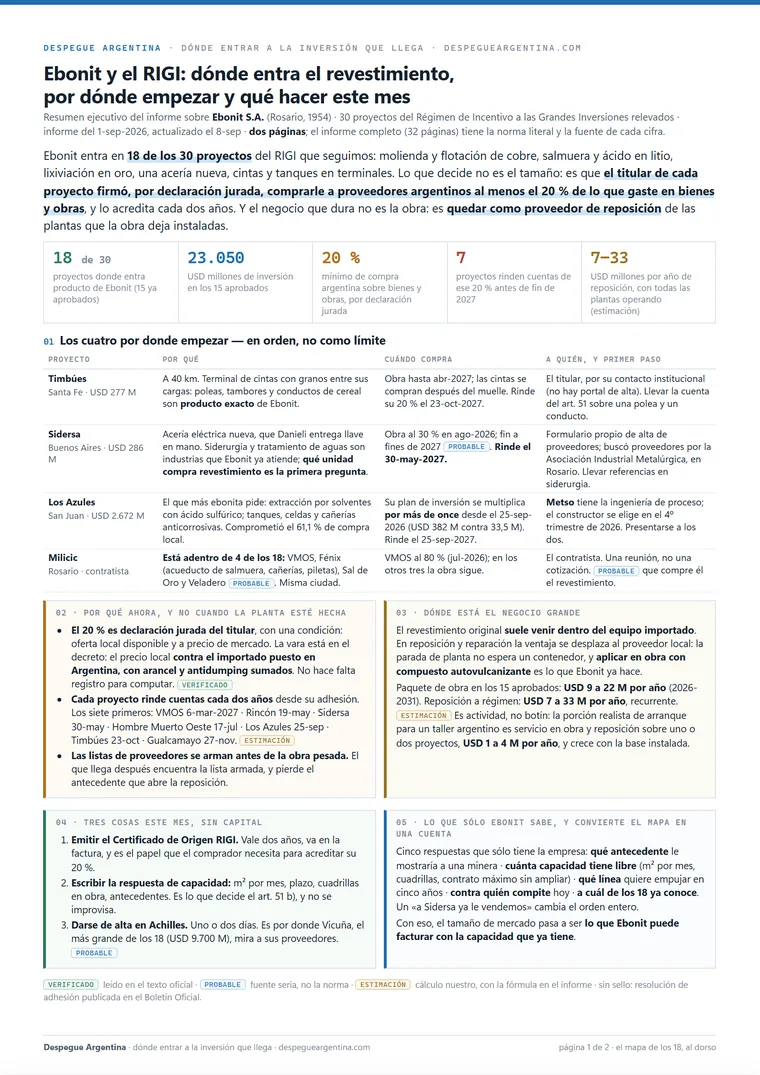 Open the report ↗A real analysis · a real company, open in full →

Analysis and curation: Ignacio Aredez
Head of Despegue
Method and track record →- 20+ years in technology, 15 of them in data and AI, for clients across Europe and the Americas
- Certified in AI governance (ISO/IEC 42001)
- Machine Learning (Google Cloud)
- Registered expert with the European Commission
How to read the seals →
verif primary source · prob primary source pending · unconf a source said it · estim our own calculation · thesis our reading · the date belongs to the datum, at the precision its source allows